
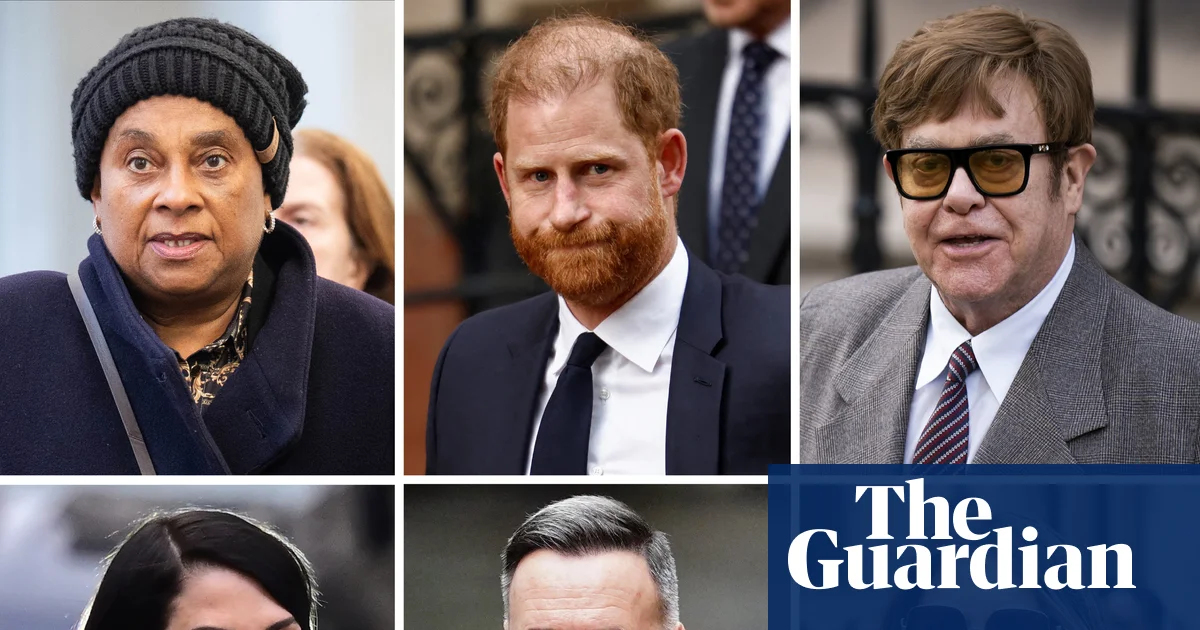
Prince Harry and six other prominent figures are facing a legal bill of up to £50m after losing their case against the publisher of the Daily Mail over claims it used unlawful methods to source stories.
In an emphatic ruling that is likely to signal an end to new litigation relating to the phone-hacking scandal era, the high court dismissed all the group’s claims, stating that the claimants had not proved that any information had been obtained unlawfully.
The 436-page written verdict from Mr Justice Nicklin said the court could not simply infer that a story had been obtained unlawfully if there remained a legitimate and realistic legal way in which it could have been sourced.
Nicklin also dismissed suggestions that senior figures at the Mail, including its former editor Paul Dacre, had lied to the 2011-12 Leveson inquiry into press ethics, where Dacre said no hacking took place at the paper.
The Duke of Sussex was one of a group of seven prominent figures who launched the multimillion-pound case against Associated Newspapers Ltd (ANL), which publishes the Daily Mail, Mail on Sunday and MailOnline.
They accused the publisher of “clear, systematic and sustained use of unlawful information-gathering” over several years. Dozens of journalists and private investigators were named in the group’s claims.
ANL’s legal team described the claims as “lurid” and “preposterous”. In each instance, it said, stories were sourced legitimately from press officers, previous articles or the “leaky” social circles of celebrities.
ANL will try to recover its costs from the mammoth case. It potentially leaves the claimants with a bill of as much as £50m. It said the verdict represented “an overwhelming victory for the Daily Mail and its journalists, and for a free press generally”.
A spokesperson said: “This is a magnificent vindication of the Daily Mail’s journalism. For some of the most outrageous allegations made when the case was launched in a blaze of publicity four years ago – placing bugs in people’s cars and homes, listening to calls as they were made and illicitly accessing bank accounts – no credible evidence was ever presented.
“The reputations of our decent and hard-working journalists were terribly impugned, and today they have been exonerated. As the judgment clearly shows, every single article was legitimately sourced.”
Other claimants in the case were Doreen Lawrence, the mother of the murdered black teenager Stephen Lawrence; the singer Elton John and his husband, David Furnish; the actors Elizabeth Hurley and Sadie Frost; and the former Liberal Democrat minister Simon Hughes.
The group presented the court with 55 articles published between 1997 and 2015, and three incidents that did not lead to articles, that they claimed demonstrated unlawful information-gathering.
A series of extraordinary claims of illegality at the Mail were made by the claimants’ legal team, which alleged “habitual and widespread” wrongdoing. They included claims of phone hacking, landline tapping and bugging via private investigators, as well as making corrupt payments to police.
In a comprehensive victory for the publisher, all the claims were dismissed by the court.
The claimants’ case was seriously damaged after a key witness, Gavin Burrows, a private investigator turned apparent whistleblower, said before his trial that his witness statement was a forgery and that he had not carried out illegal activity for the Mail titles.
In a stark finding for the claimants’ legal team, the judge said he could not reliably conclude that Burrows had said what was in the disowned statement.
after newsletter promotion
In any case, he said, Burrows was “comprehensively undermined” as a witness and there was no independent corroboration for his claims.
During the 11-week trial, dozens of editors and journalists, including Dacre, gave evidence denying illegal activity.
Harry was the first of the claimants to give evidence and said the Mail’s titles had made his wife’s life “an absolute misery”.
The Mail case is the last to be brought against newspaper groups by the prince, who is coincidentally in the UK for a series of charity engagements. He has been at the forefront of legal attempts to hold British newspapers to account for alleged past wrongdoing.
He previously won substantial damages in his hacking case against the Daily Mirror, in which the judge found that 15 out of 33 articles related to Harry put to the court were the product of phone hacking or unlawful information-gathering.
Last year, the prince settled his high court legal action against the publisher of the Sun, News Group Newspapers (NGN), at the last minute. He did so after the group offered a “full and unequivocal apology” to him for the serious intrusion by the Sun between 1996 and 2011 into his private life, “including incidents of unlawful activities carried out by private investigators working for the Sun”.
However, the Mail made no admissions and defended all of the claims brought against it, stating that all the articles brought before the court were the product of legitimate journalism.
The claimants’ lawyers said their case had been hampered by a large number of documents from the era in question having gone missing, with invoices and emails deleted, destroyed or misplaced.
Newspapers have paid out millions in settlements to victims of illegal news-gathering since the Guardian broke the story of the UK’s phone-hacking scandal – a revelation that led to the closure of Rupert Murdoch’s tabloid newspaper the News of the World in 2011 and the Leveson inquiry into the ethics of the British press.
About the Author