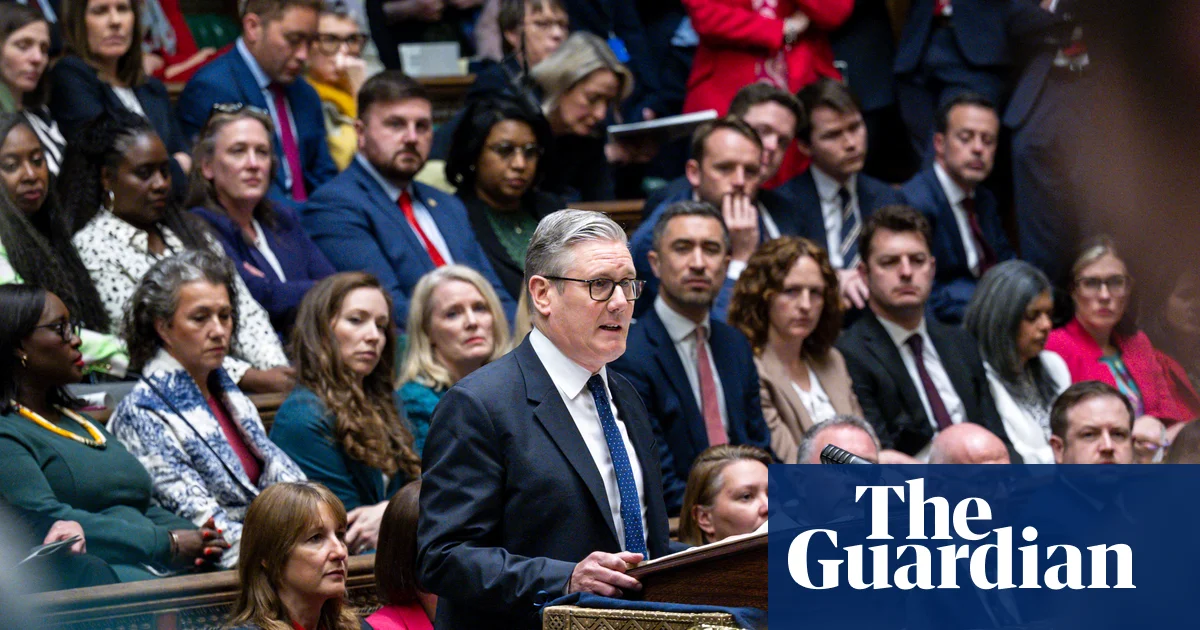
Keir Starmer will face a vote on whether to launch a standards investigation into his decision to appoint Peter Mandelson as ambassador to Washington, prompting senior party figures to call for restraint from Labour MPs.
The speaker, Lindsay Hoyle, has granted a debate on Tuesday after which MPs could vote to refer the prime minister to the privileges committee over claims he misled parliament over his decision.
The vote would be the latest test of Starmer’s authority, which has been damaged by the Guardian’s revelation Mandelson was installed as ambassador despite the advice of vetting officials that he be denied security clearance.
Government whips are considering whether to instruct Labour MPs to oppose any attempt to refer the prime minister to the committee – with senior figures accusing the Conservatives of political point scoring.
The former prime minister Gordon Brown said: “At challenging times both for our country and the world, the Labour party has always sought to put the needs of the country first. With conflicts raging around the world with profound consequences for our country, this is the time to do so.
“Whatever the parliamentary games at Westminster, what the country expects of everyone in Labour is to focus on the priorities of the British people, which is what Keir Starmer is doing and for which he deserves all our support.”
The speaker told the Commons on Monday that “numerous” MPs from different parties – understood to include Labour – had written to him about the issue. “My role is to decide whether an [MP] has made a case which the house itself should be able to consider, not to decide whether someone is likely to have committed a contempt,” he said.
“I’ve decided to allow the house to come to a view on whether the committee of privileges should look at the matter. It is not for me to make any decision or view.”
The Tories have accused the prime minister of misleading MPs when he said “full due process” had been followed during the appointment process. Knowingly misleading parliament is considered a resigning offence for ministers, and a privileges committee investigation in 2023 prompted Boris Johnson’s resignation as an MP. No 10 argues that Starmer was commenting on the facts he had available to him at the time.
Opposition parties have pointed to a memo from Simon Case, the former cabinet secretary, who appeared to advise Starmer to complete security vetting for Mandelson before announcing an appointment. The Guardian understands, however, that Case may have been advising him simply to begin the process.
The Conservatives have also accused Starmer of misleading MPs by suggesting that there was “no pressure whatsoever” applied on the Foreign Office, when Olly Robbins, the top official sacked over the affair, said last week there was.
Downing Street has said the prime minister’s comment about “pressure” referred to the security vetting process, rather than the broader appointment of Mandelson.
In an interview with the Guardian last week, David Lammy, the deputy prime minister, admitted there had been “some time pressures” on the Foreign Office last January to confirm Mandelson in post as Donald Trump was re-entering the White House.
The foreign affairs committee, chaired by the Labour MP Emily Thornberry, has already begun an inquiry into Mandelson’s appointment. Downing Street says the evidence it has heard so far, including from senior civil servants, has shown Starmer told the truth.
The former cabinet ministers Alan Johnson and David Blunkett released a joint statement calling the Tory move a “nakedly political stunt with no substance”, while Thornberry said she could not see the need for a second inquiry while the one she is leading was still taking place.
The government is expected to whip Labour MPs to vote against an investigation – making it unlikely the Conservatives will succeed. However, Tory sources said they wanted to use it to tell voters at the local elections that their Labour MP backed him.
Some Labour MPs may side with the opposition, however, giving a sense of the party’s discontent with the prime minister over the issue.
Although such referrals to the privileges committee are rare, Boris Johnson was forced to wave through his own referral in the wake of the Partygate scandal amid anger on the Tory benches.
About the Author