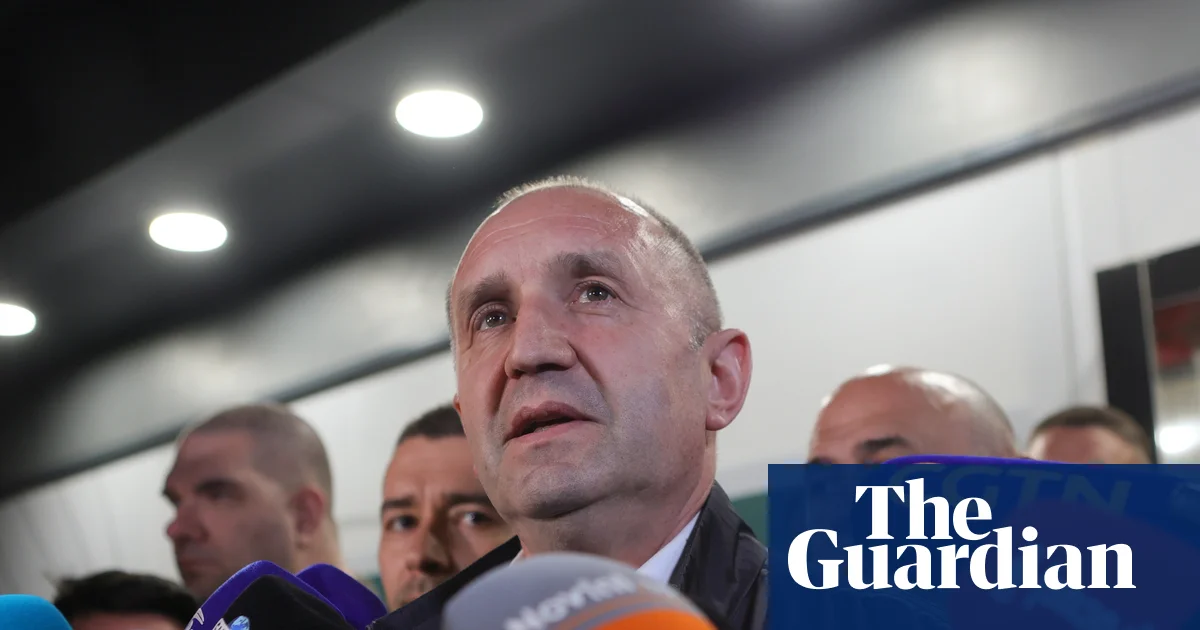
Bulgaria’s Moscow-friendly former president has won an absolute majority in parliamentary elections that could bring the country political stability after years of short-lived coalitions, but leave it walking a tightrope on EU issues.
With all votes counted on Monday, the Progressive Bulgaria party of Rumen Radev, a former fighter pilot and air force chief, had 44.6% of the vote, giving it an estimated 131 of the 240 seats in the national assembly.
The election was Bulgaria’s eighth since 2021, when huge anti-corruption rallies brought down the government of the long-serving pro-European prime minister Boyko Borissov, and Radev’s majority is the first for a single political formation since 1997.
The left-leaning Progressive Bulgaria’s tally put it far ahead of Borissov’s conservative GERB party with 13.4% and the pro-European We Continue the Change-Democratic Bulgaria (PP-DB) coalition, which had 12.6% of the votes in Sunday’s ballot.
Radev, who rode a wave of voter anger at entrenched corruption and the veteran parties that have allowed it, said late on Sunday: “This is a victory of hope over distrust, a victory of freedom over fear, and finally, if you will, a victory of morality,.”
He said Bulgaria would make “every effort to follow its European path”, but added: “A strong Bulgaria and a strong Europe need critical thinking and pragmatism. Europe has fallen victim to its own ambition to be a moral leader in a world with new rules.”
While hailing the benefits to Bulgaria of EU membership, Radev has been critical of several of the bloc’s policies and called unsuccessfully for a referendum on Bulgaria’s decision to join the euro last year.
António Costa, the president of the European Council, said on social media that he looked forward to working with Radev “on our shared agenda for a prosperous, autonomous and secure Europe”.
Radev has also talked repeatedly about improving ties with Moscow and resuming the free flow of Russian oil and gas into Europe, calling for “practical relations with Russia, based on mutual respect and equal treatment”.
The Kremlin on Monday welcomed Radev’s win. “We are of course encouraged by the words of Mr Radev, as well as those of certain other European leaders, regarding their readiness to resolve issues through dialogue,” said its spokesperson, Dmitry Peskov.
Radev, 62, who stepped down from the largely ceremonial role of president in January to campaign on an anti-graft ticket, has criticised a recent defence agreement signed between Bulgaria and Ukraine and opposed Sofia sending arms to Kyiv.
He has, however, pledged not to use Bulgaria’s veto to block future EU decisions, and analysts note he has consistently denied being aligned with the Kremlin, backed EU membership, and appeared deliberately vague on foreign policy.
In a message perhaps designed to calm concerns about a possible pro-Russia drift, one of Radev’s closest associates, Slavi Vassilev, said last week Bulgarians “do not want closer ties to Russia, but rather … continued active participation in Nato and the EU”.
Maintaining a strategic ambiguity towards Russia and the EU, while focusing his campaign on corruption, allowed Radev to take votes from the far-right Revival party, which won just 4% of the vote, and GERB, whose score was its lowest ever.
EU diplomats have said they do not expect Radev to seek to take over from Hungary’s pro-Moscow, anti-Brussels prime minister Viktor Orbán, whose 16 years in power were dramatically ended last weekend, as the bloc’s disrupter-in-chief.
Radev’s majority is not big enough to embark on a full-scale overhaul of the judicial system, which requires a 160-seat supermajority, but he could potentially do so with the support of the PP-DB coalition, which has said judicial reform is its top priority.
Dimitar Keranov, a Bulgarian fellow of the German Marshall Fund’s European resilience programme in Berlin, warned that “the corrupt system remains” and while “the mere prospect of stability is significant … stability is not reform”.
In a hollowed-out system with a captured judiciary, regulators and media, Radev’s majority was “an opportunity for capture to accelerate” under a leader who was “a product of the same environment he claims to dismantle”, Keranov said.
“A Kremlin-friendly leader governing a Nato and EU member state on the Black Sea, days after Hungary voted Orbán out, is bad news for the EU and for Ukraine,” he added.
Turnout exceeded 50%, significantly higher than in recent ballots. Martin Todorov, 41, who returned to Bulgaria three years ago after more than a decade in the UK, said he was upbeat about the result which he hoped would bring much-needed change.
“I am very optimistic,” said Todorov. “The people who have been in the government won’t be there any more. It was full of corruption and I hope now it will be different.”
Others in Sofia, however, were less confident. Yana Kuzoff, 39, an actor enjoying a coffee in the sun before a rehearsal, said she was disappointed. “I’m scared about it,” she said. “Radev is totally pro-Russian. Our parents fought many years ago to live a normal modern life like Europeans.”
About the Author