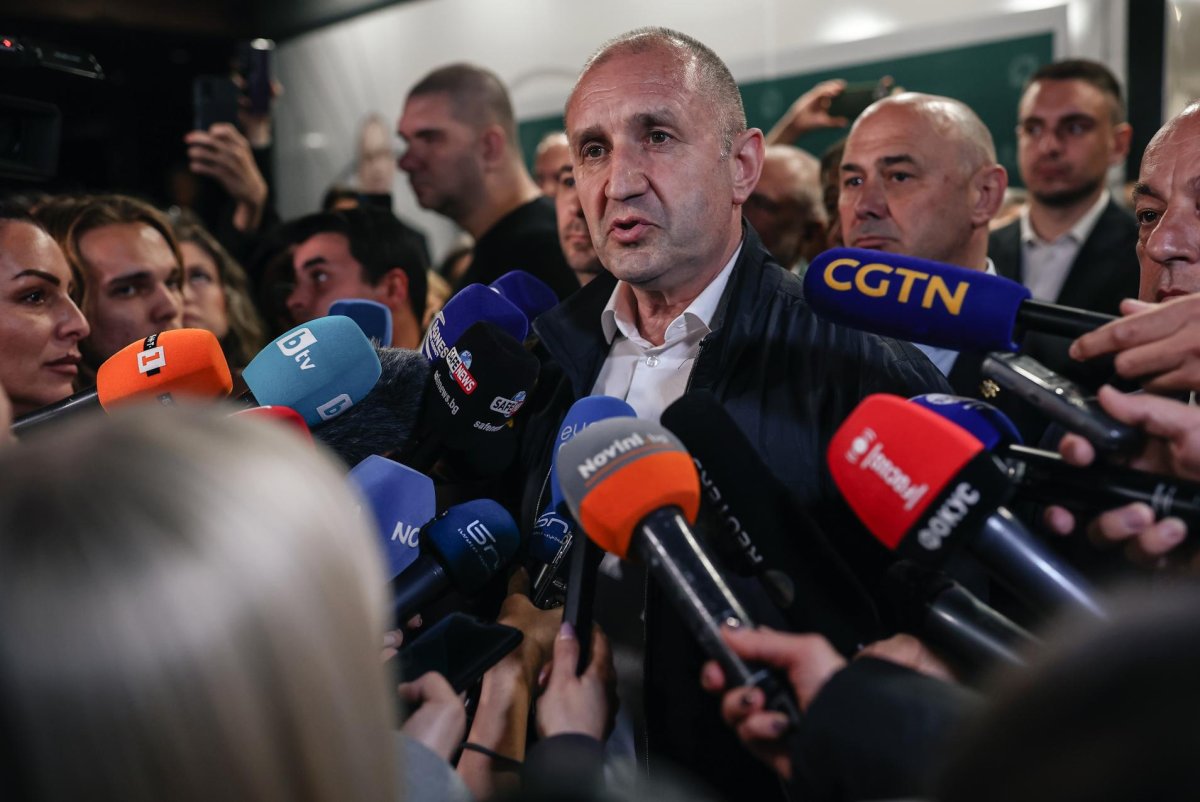
Bulgarian Prime Minister-elect, Rumen Radev (C), leader of the Progressive Bulgaria coalition, addresses the media on Sunday night after the first exit polls indicated he was on track to win. Photo by Borislav Troshev/EPA
April 20 (UPI) — Former president Rumen Radev’s Progressive Bulgaria Party has emerged on top in the country’s eighth general election since 2021, winning a parliamentary majority of at least 135 with most of the seats counted.
The 62-year-old, who has called for friendlier relations with Russia, been critical of European Union sanctions over Ukraine and joined Hungarian Prime Minister Viktor Orban in opposing a $105 billion loan to Kyiv, roundly beat the ruling Democratic Bulgaria-People’s Party coalition and the GERB party in Sunday’s poll.
The election was called after Prime Minister Rosen Zhelyazkov resigned Dec. 11, shortly before a no-confidence vote called by the opposition ahead of the country’s accession to the Eurozone on Jan. 1.
Efforts by the administration to push through a budget in December saw hundreds of thousands come out onto the streets demanding the government stand down.
“People rejected the self-satisfaction and arrogance of old parties and did not fall prey to lies and manipulation. I thank them for their trust,” Radev said, in a victory speech in which he vowed to deliver a “strong Bulgaria in a strong Europe.”
“What Europe needs right now is critical thinking, pragmatic actions and good results, especially to build a new security architecture and … recover its industrial power and competitiveness. That will be the main contribution of Bulgaria to its European mission,” he said.
However, The Washington Post reported that following Orban’s ouster after 16 years in office in the April 12 elections, Bulgaria was now Moscow’s best hope of still being able to reach into the heart of the European Union to try to influence decisions made in Brussels.
In the run-up to the election, TikTok accounts promoting Radev with the hashtag “#rumenradev” grew at the 60 times the rate of similar campaigns for the rival GERB party of three-time former Prime Minister Boiko Borisov with more than 5.5 million views in just over two months, according to AI-powered monitoring firm Sensika Technologies in Sofia.
While it was not possible to differentiate the increase attributable to real people from AI and bot-generated activity, analysts, former diplomats and at least one intelligence official told the Post that they believed the Kremlin was behind it.
“The Russians are very, very keen to at least partially compensate for the loss of Orban in Hungary,” said former Bulgarian ambassador to Russia, Ilian Vassilev.
He added that he believed it was “more than a possibility” that the Russians were banking on Bulgaria stepping in to assume the role played by Hungary until Peter Magyar’s victory in the elections there earlier this month.
The Sofia-headquartered Center for the Study of Democracy, which has been monitoring the potential for online interference aimed at swaying the outcome of elections, expressed similar fears.
“We have strong concerns about Radev’s social media groups acting as an organized Russian influence campaign. But we don’t have clear evidence that this is synchronized or paid in a systematic way,” he added.
Radev has in turn accused Brussels of trying to unduly influence the vote after after it joined forces with the acting government to establish a special unit to counter disinformation and meddling online.
Despite the mandate, Radev indicated he was looking for coalition partners in order to pass legislation outlawing political parties from exerting pressure on the judiciary because he is around 24 seats shy of the two-thirds majority required.
The most likely partner was being seen as the pro-Western center-left Democratic Bulgaria party.
About the Author