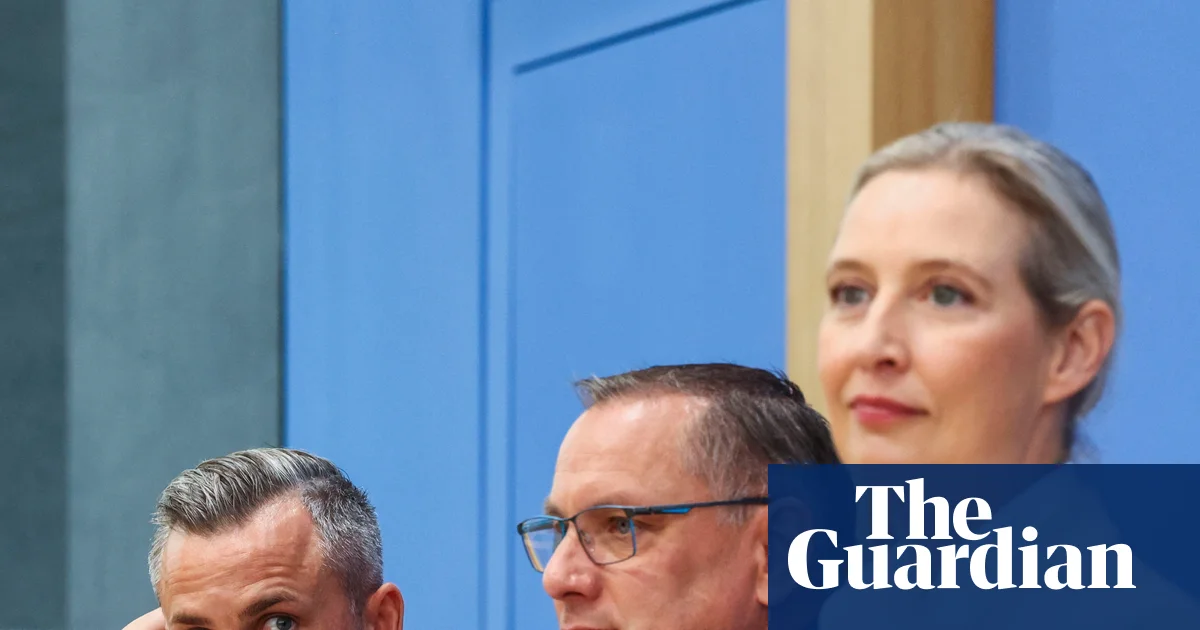
Mainstream politicians around Europe have expressed alarm after the far-right Alternative für Deutschland (AfD) swept to a historic state election victory in Germany, while nationalist figures cheered the result as a mandate for change.
While falling just short of an absolute majority, the AfD surged into first place in the Saxony-Anhalt state election on Sunday, exit polls showed, putting the far right within reach of power at the state level for the first time since the second world war.
“It clearly sends out a very, very worrying signal,” France’s finance minister, Roland Lescure, said on Monday. “This shows that we face a major challenge in the face of a populist wave which is spreading around the world today and which we must resist.”
Lescure’s comments echoed similar remarks on Sunday evening by France’s European affairs minister, Benjamin Haddad, who posted on social media: “To see the far-right prevail in the German regional election marks a very grave moment for Europe.”
Haddad added: “We must listen with humility to the anger, fears and worries and duly respond to these concerns. But nationalism and xenophobia will never be the answer. We cannot forget our history.”
Poland’s foreign minister, Radosław Sikorski, said on Monday the AfD’s win was “a very worrying sign”. Poland’s prime minister, Donald Tusk, said on Sunday night in Poland, “only idiots or traitors can rejoice at the triumph of the AfD in Germany”.
Italy’s foreign minister, Antonio Tajani, described the election result as “terrible news … because it concerns a political force that is antithetical to liberal and western values”.
The reaction was not limited to Europe. Elon Musk congratulated the far-right party on its election victory with a “Well done!” on his social media platform X, prompting Ulrich Siegmund, the AfD’s lead candidate in Saxony-Anhalt, to thank the nativist US tech billionaire for his support.
“If we take on responsibility here, I would very much welcome the opportunity for strong and constructive cooperation,” Siegmund wrote. “Germany would then once again be a place worth investing in. Best regards from Saxony-Anhalt!”
The US president, Donald Trump, whose White House has made no secret of its support for Europe’s nationalist far-right parties, posted a screenshot of the projected election result on his Truth Social platform without any comment.
Kirill Dmitriev, Russia’s presidential envoy, took a screen grab of Trump’s post and praised a “historic win for the pragmatic AfD”. The AfD is pro-Kremlin, has called for an end to aid for Ukraine and and refugee status for Ukrainians.
The former Hungarian prime minister Viktor Orbán, who was heavily defeated in elections earlier this year, celebrated AfD’s win, describing it as “a huge night for Germany and Europe” and adding: “Buckle up. This is just the beginning!”
Far-right leaders in Spain and Portugal also hailed the AfD’s win. Santiago Abascal, of the Spanish Vox party, called it a “spectacular result that represents great hope for Germany and Europe”, while André Ventura, of the Chega party in Portugal, praised a “historic victory”.
Italy’s far-right deputy prime minister, Matteo Salvini, also congratulated the AfD’s co-leader Alice Weidel on X, describing the party’s victory as a “resounding success that highlights the strong demand for change, security, and jobs”.
Salvini, who serves in Giorgia Meloni’s radical right-wing coalition alongside Tajani, taunted “those on the left who stoked fears and catastrophic scenarios”, adding: “Fear? Terror? Danger? No, it’s called DEMOCRACY. Another Europe is possible.”
Not all of Europe’s far-right parties were pleased. France’s National Rally (RN), which two years ago expelled the AfD from its European parliamentary group, has made clear that it finds the German party’s rhetoric and policies too extreme.
The two parties’ rift followed comments by a leading AfD figure, Maximilian Krah, downplaying the crimes of the Nazi SS by suggesting they were “not all criminals” and revelations that the German party backed mass deportations of immigrants.
The RN’s president, Jordan Bardella, confirmed on Saturday that the party, whose figurehead, Marine Le Pen, is comfortably ahead in the polls in the run-up to next year’s French presidential elections, had no plans to resume an alliance with the AfD.
While keeping his distance from the party, however, Bardella noted that “electoral pressure exerted by the AfD in Germany” was contributing to policy shifts within the German government, pointing to Berlin’s re-establishment of border controls.
AfD won 43.8% of the vote, more than double its showing five years ago in the region of 2.1 million people west of Berlin. That was far ahead of Friedrich Merz’s Christian Democratic Union, which polled 17.2% – losing about half its support.
The centre-left Social Democrats scored 9.3%, the Greens 8.9% and the Left party 8.6%, winning eight seats apiece. However, the AfD fell three seats short of an absolute majority, with 39 lawmakers in an 83-member state parliament.
About the Author