
To understand how Samsung ended up building a mid-engined sports car, you have to appreciate just how gloriously unhinged the global auto industry was in the 1990s. This was an era when Lotus, freshly done engineering its front-wheel drive Elan, turned around and sold the whole project to Kia. The South Koreans tweaked the taillights and sent it into production for 1996. If that sentence made sense to you, congratulations, you are ready for what comes next.
Around that same time, Samsung chairman Lee Kun-hee had bigger dreams than televisions and semiconductors. He wanted Samsung in the car business, and he wanted it badly enough to attempt purchasing Kia outright. When that deal fell through, he did what any billionaire chairman with ambition and resources would do: he built two entirely new companies from scratch. Samsung Motors would handle passenger cars, and Samsung Commercial Vehicles would handle everything else. The infrastructure was largely in place by 1995.
Then the Asian financial crisis arrived and destroyed everything. Samsung Motors, barely off the ground, was put up for sale almost immediately. Daewoo Motors could not buy it because General Motors was in the process of absorbing Daewoo. Hyundai passed entirely, choosing instead to invest in a bankrupt Kia in 1997. The whole Korean automotive landscape was a fog of mergers, acquisitions, and quiet desperation.
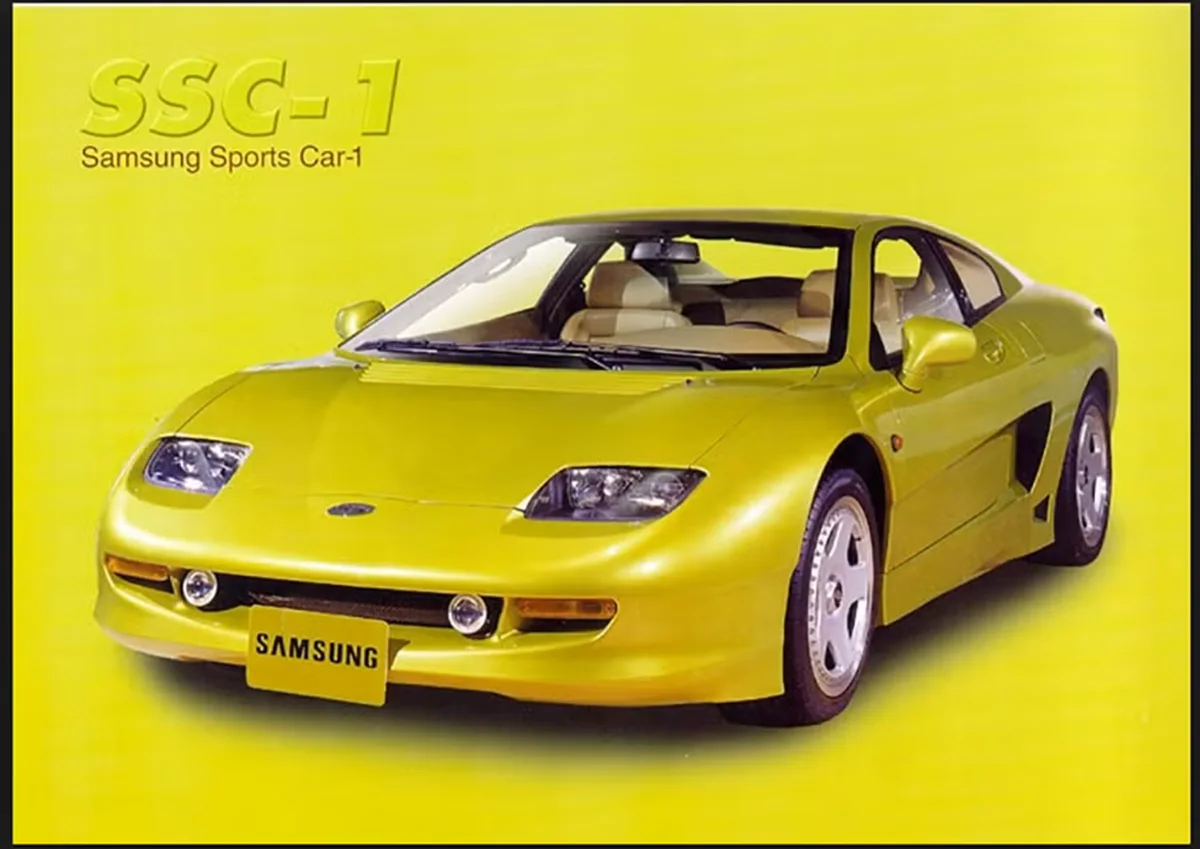
Into that fog, Samsung drove a show car. Literally. At the 1997 Seoul Motor Show, the company unveiled the SSC-1, short for Samsung Sports Car-1, and it was genuinely impressive for a company that had never really built a sports car before. The fact that almost nobody remembers it today is either a tragedy or a fascinating historical footnote, depending on how deep your love for forgotten concept cars runs.
What the SSC-1 Actually Was
Image Credit: Benjamin Hunting.
The SSC-1 is a fully functional, mid-engined two-seater with a fiberglass body and a 190-horsepower 2.5-liter V6 sourced from Nissan. That same engine would go on to power Samsung’s first production sedan, the SM5, so the powertrain was at least proven. Behind it sat a five-speed manual transmission, double wishbone suspension at all four corners, and Brembo brakes peeking through 17-inch wheels.
The headlights came from the Nissan 300ZX, which at least gave the car some legitimate sports car pedigree by association. Inside, Recaro seats and a Momo steering wheel handled occupant comfort and driver engagement, while an Infiniti-sourced infotainment system called the Multi AV handled everything else. It was a cohesive package, clearly put together by people who knew what a sports car was supposed to feel like, even if Samsung had never built one before.
As for its design origins, there is an interesting theory floating around that the SSC-1 shares its proportions and general layout with the Venturi Atlantique, a French mid-engined sports car that was in production between 1991 and 2000. Both cars feature similar silhouettes and mid-mounted V6 engines. Whether that connection is real or coincidental has never been confirmed. What is confirmed is that one year after the SSC-1 debuted, Samsung Motors signed a deal with Renault, which took a 70 percent stake in the failed venture and eventually shed the Samsung name entirely, though it continues building cars in South Korea to this day.
The Mystery of How Many SSC-1s Actually Exist
Here is where the story gets genuinely puzzling. The internet broadly agrees that only one SSC-1 was ever built. But the physical evidence suggests things may be more complicated than that.
A yellow SSC-1 was reportedly photographed at the Samsung Transportation Museum in 2002, according to British stock photo agency Alamy. A silver SSC-1, this time badged as a Renault-Samsung, appeared at the Busan Motor Show in South Korea in 2001. The Busan show runs every two years, so there was no 2002 edition, which means the yellow and silver cars were not simply the same vehicle at back-to-back events.
The differences between the two are subtle but real. The silver car had different wheels and was missing the rear reflectors present on the yellow version. The simplest explanation is that one car was repainted between appearances. But nobody has confirmed that officially, and the Samsung Transportation Museum has not exactly been rushing to clear up the timeline. It remains one of those pleasant automotive mysteries with no clean resolution.
What This Forgotten Supercar Teaches Us About Corporate Ambition
Samsung’s automotive adventure carries a lesson worth remembering, particularly now that rival tech giant Sony is entering the car business through its Afeela EV partnership with Honda. Building cars is extraordinarily hard, extraordinarily expensive, and extraordinarily unforgiving of bad timing. Samsung had the capital, the engineering relationships, and the chairman-level will to make it happen, and still the project collapsed almost instantly under the weight of macroeconomic forces nobody could have predicted.
The SSC-1 itself is a symbol of that ambition at its most concentrated. It was not built to sell. It was built to announce that Samsung belonged on the international automotive stage, that this was a company capable of producing something dramatic and desirable. In that narrow sense, it succeeded. The car was genuinely attractive, technically credible, and generated real excitement at its debut. The fact that Samsung never got to capitalize on any of that excitement is not really a failure of vision. It was just very bad timing.
The automotive journalist who first connected all these threads while researching a piece about Samsung potentially re-entering the car industry later stumbled onto the SSC-1 in person, in a basement in Busan, South Korea, surrounded by SM5 sedans and modern Renault offerings like the Twizzy. The writer described it as one of the most full-circle surprises of their career, a genuine jaw-dropper hiding in plain sight, largely unknown even to people standing right next to it. Sometimes the best automotive discoveries are not found at Concours events or in climate-controlled garages. Sometimes they are just sitting quietly in a basement, waiting for someone to recognize what they are looking at.
They wrote: “I found the SSC-1 nestled with a collection of other Samsung machines, like the SM5, and more modern Renault offerings, like the Twizzy. I was beyond shocked, and had to explain to several of the people traveling with me what they were looking at, because they had no idea that Samsung’s coupe ever existed.”
And now they’ll never forget. I won’t.
If you want more stories like this, follow Guessing Headlights on Yahoo so you don’t miss what’s coming next.
About the Author