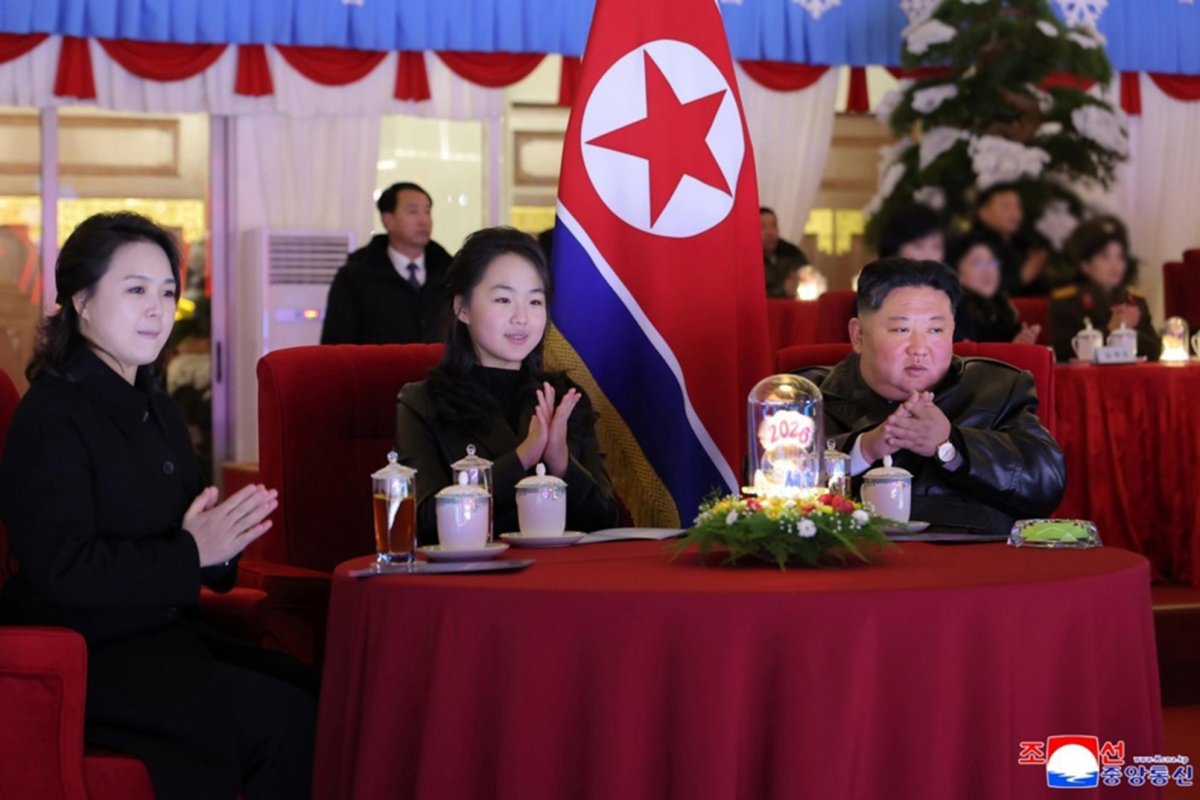
North Korean leader Kim Jong Un (R), his daughter Kim Ju Ae (C) and wife Ri Sol-ju clapping during an art performance celebrating the New Year 2026 at the May Day Stadium in Pyongyang, North Korea, 01 January 2026. File. Photo by KCNA / EPA
April 13 (Asia Today) — This commentary is the Asia Today Editor’s Op-Ed.
The growing public profile of North Korean leader Kim Jong Un’s daughter, Kim Ju Ae, is drawing renewed scrutiny over the country’s succession plans and the role of a child in state propaganda.
Kim Ju Ae has drawn global attention since her first public appearance in November 2022 at a launch event for the Hwasong-17 intercontinental ballistic missile. Her repeated appearances alongside her father have been widely interpreted as signals tied to North Korea’s hereditary power structure.
Born in 2013, she was initially seen as part of an effort to reinforce Kim’s image as a paternal leader and to project continuity of the country’s nuclear ambitions. More recently, however, analysts say she appears to be consolidating her position as a potential successor.
South Korea’s National Intelligence Service told lawmakers earlier this month that it believes Kim Ju Ae has entered a stage in which she is being prepared as a successor, lending weight to speculation about a fourth-generation leadership transition.
Still, experts remain divided over whether Kim is formally grooming his young daughter to lead a male-dominated regime.
Some observers have raised concerns about her well-being. One expert noted that a child of her age would normally be focused on school and play, questioning whether exposure to military activities is appropriate.
Kim Ju Ae’s first public appearance took place at a missile launch site, and she has since accompanied her father to military inspections, including observing weapons tests and handling firearms.
Critics question whether such experiences could affect her emotional development and whether children in such circumstances can fully understand the implications of these activities.
North Korea is a signatory to the U.N. Convention on the Rights of the Child, which outlines protections for children’s development, education, rest and leisure. Observers say the repeated exposure of a minor to military environments and political symbolism could conflict with those principles.
Kim Jong Un himself remained largely out of public view until his formal emergence as an adult in 2010. By contrast, his daughter has appeared publicly at a much younger age, raising additional concerns about privacy and autonomy.
Analysts say it remains unclear whether Kim Ju Ae is being positioned as a future leader or primarily serving a symbolic role tied to regime messaging.
— Reported by Asia Today; translated by UPI
© Asia Today. Unauthorized reproduction or redistribution prohibited.
About the Author