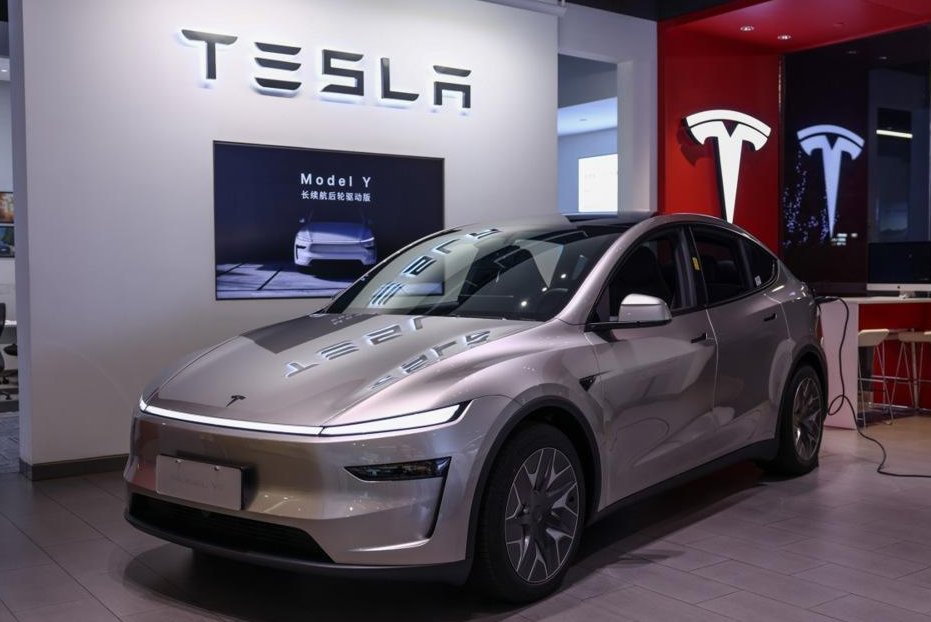
Tesla chose Chile as its first South American market in 2024. The company now leads electric vehicle sales in Chile and has expanded into Colombia, Uruguay and Argentina. File Photo by Wu Hao/EPA
SANTIAGO, Chile, Sept. 9 (UPI) — Chile has become a key entry point for new auto brands seeking to expand into South America, driven by its open trade policies, low import barriers and highly competitive market that now includes 82 brands of light- and medium-duty vehicles.
According to a recent report by Chile’s National Automotive Association, or ANAC, 12 new vehicle brands entered the country between 2024 and 2025, with manufacturers focused on electric mobility accounting for a significant share of the newcomers.
“Chile serves as a gateway to South America. Several Chinese brands debuted here, tested whether their products worked and built their after-sales networks, Matías Díaz, an electromobility specialist and professor in the Department of Electrical Engineering at the University of Santiago, told UPI.
“From there, they moved into Peru and Colombia before entering larger markets where they need to produce locally to compete,”
One of the most prominent examples is Tesla, which chose Chile as its first South American market in 2024. The company now leads electric vehicle sales in Chile and has expanded into Colombia, Uruguay and Argentina.
Diego Mendoza, secretary-general of ANAC, told UPI one of the main reasons for the diversity of brands is Chile’s open trade policy, which the country has pursued since the 1990s.
Chile also has a vehicle certification system similar to Europe’s, facilitating the entry of vehicles from different markets. The development of auto financing and the high level of information available to consumers have also helped support the market.
In addition to Tesla, Mendoza said brands that have arrived since 2024 include Chinese automakers Omoda, Livan, Riddara, Landking, Soueast and Sinotruk; Chinese-Swedish brand Lynk & Co.; Smart, which is linked to Mercedes-Benz and Geely; and Japan’s Isuzu.
The 82 brands available in Chile far exceed the number found in several regional markets with much larger populations.
Mexico, with about 132 million people, has 56 brands, while Brazil, with more than 200 million, has 49. Colombia, with about 53 million people, has 51 brands, while Argentina, with about 46 million, has 41.
Japan’s Toyota leads vehicle sales in Chile with an 11% market share, followed by South Korea’s Hyundai at 8.8% and Kia at 7.3%. Japan’s Suzuki ranks fourth and U.S.-based Chevrolet fifth.
Unlike other countries in the region, Chile does not have a domestic vehicle manufacturing industry that requires protection from imports.
“Most vehicles enter without paying tariffs. Brazil, Mexico and Argentina have plants operated by brands such as Volkswagen, Toyota, Stellantis, GM and Ford, and to protect them they impose high tariffs or require local content. That limits how many new brands can enter,” Díaz said.
Díaz said Brazil, for example, imposes tariffs of up to 35% on vehicle imports, while Argentina maintains similar measures.
“Mexico requires compliance with rules of origin, with about 75% regional content, and since January 2026 it has imposed a 50% tariff on Chinese cars to prevent its market from being used as a back door into the United States,” he said.
Chile’s high level of competition is also reflected in vehicle prices. The automotive association compared the price of the same model with the same origin and equipment level. The list price was $29,100 in Chile, compared with $29,400 in Mexico, $31,000 in Peru and $36,700 in Europe.
The growth of electric mobility is expanding the range of vehicles available even further. The number of brands offering zero- and low-emission vehicles in Chile increased from two in 2009 to 65 in 2025.
Díaz said Chinese brands enter the market at lower prices than traditional automakers, increasing competitive pressure across the industry.
“Chinese brands have vertical integration in LFP batteries and costs that no Japanese, Korean or European brand can currently match. That lowers the entry price for a hybrid vehicle and forces traditional brands to reduce margins, update models more quickly or improve financing,” he said.
Díaz said that although traditional automakers are losing relative market share, that does not necessarily mean they are selling fewer vehicles because the market is also attracting new buyers.
“Chinese brands reached 35% of the new-car market in the first half of 2026, according to the Chilean Automotive Chamber of Commerce,” Díaz said.
The expansion of Chinese automakers is not limited to Chile. Díaz said it is a regional trend, although Chile’s trade environment has allowed the shift to advance more rapidly.
About the Author