The government of Yemen is seeking U.S. military support in its fight against the Houthis, a senior Yemeni official said Wednesday, as the Iranian-backed rebels rapidly expand their control of Yemen’s Red Sea coast and threaten another critical Middle East waterway for global energy supplies.
Yemen’s president, Rashad al-Alimi, conveyed the request for U.S. assistance to President Donald Trump in a call earlier this week, Abdullah Al-Alimi Bawazir, vice president of the Yemeni Leadership Council, told reporters on the sidelines of the U.N. General Assembly.
Asked about a report this week by Reuters, which cited one Yemeni and one Western source as saying that Trump had made no direct pledge of military support to Yemen during the call, Bawazir said he was unaware that the request had been rejected.
He said Trump understands the danger of the Houthis, and that “we hope and expect more support for the Yemeni government in the face of the Houthi militias.”
The White House did not immediately respond to an emailed request for comment overnight.
01:14
Houthis claim attack on Saudi capital
00:0000:00
Bawazir did not say whether U.S. support should extend to direct military strikes.
“We do not ask the American soldiers to actually go into war on our behalf,” he said. “And we don’t really request that they do nothing.”
Yemen does look forward to “mutual coordination on the intel and security fields,” according to Bawazir, who requested that the U.S. enhance the Yemeni government’s own military capacity to take on the threat.
“The aerial campaigns are important,” he said. “But supporting the Yemeni government and forces on the ground is indeed a guarantor to end the danger of those militias.”
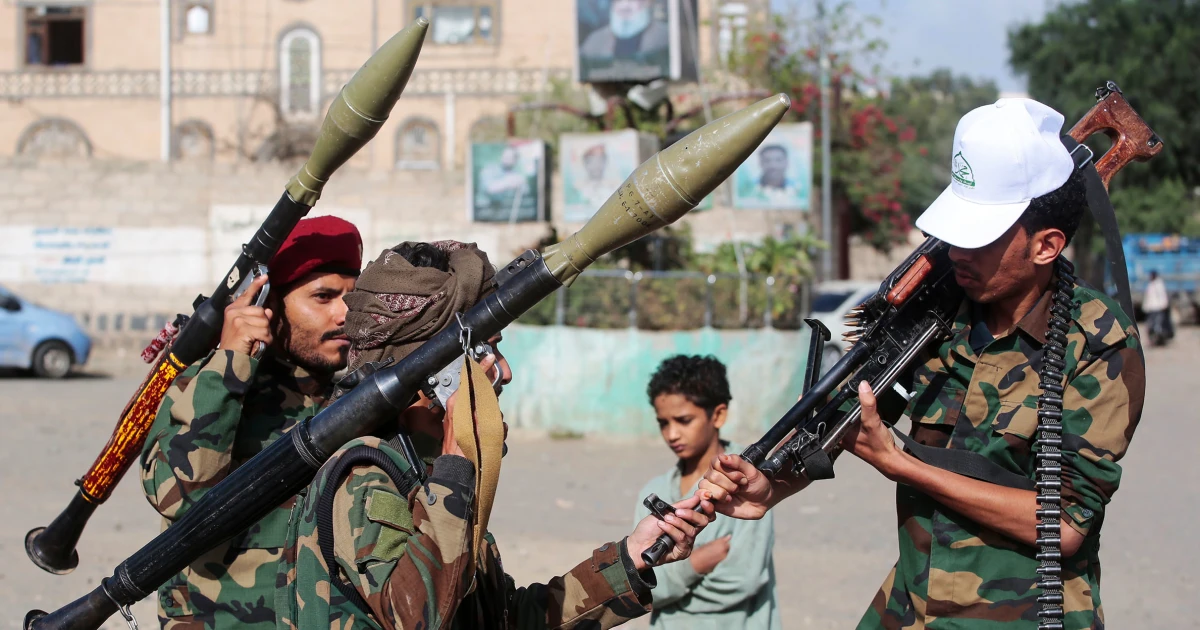
Yemen has been embroiled in various states of conflict since 2014, when the Houthis drove the internationally recognized government out of the capital city of Sanaa and ignited a regional proxy war, with Saudi Arabia supporting the exiled government against the Iranian-backed rebels.
In their latest military campaign, the Houthis have advanced along Yemen’s Red Sea coastline with the aim of cutting off the Bab el-Mandeb Strait, which has become a critical waterway for Saudi Arabia to transport oil after Iran effectively shut down the Strait of Hormuz.
Saudi Arabia, a critical U.S. ally in the Middle East including in the U.S. war with Iran, has urged the U.S. to take military action against the Houthis, who further escalated their actions over the weekend by launching an attack on the Saudi capital of Riyadh. So far U.S. support has been limited to providing intelligence and targeting data.
Trump, who announced a ceasefire with the Houthis last year after weeks of punishing strikes against the militant group, went so far as to order strikes against the Houthis on Sunday, NBC News previously reported, but the order was canceled hours later.
Secretary of State Marco Rubio said Wednesday that the U.S. has made commitments to the Saudis and is living up to them, adding that “obviously, the president has many options available to him.”
Trump said earlier this month that the Houthis, which the U.S. designates as a terrorist organization, don’t want to fight the U.S. and “they don’t want us to go after them.”
“They’ve called and they’ve talked to us, and they don’t want us to,” Trump told reporters while in Ireland. ”They would much prefer not having us involved, and they’re letting most ships go through.”
Mohamed al-Bukhaiti, a member of the Houthis’ political bureau, told the Associated Press on Sunday that it was the U.S. that had reached out to the rebel group after their advancement toward the Bab el-Mandeb Strait.
“We confirmed that we are not targeting the United States, or any other nation, in the strait, with the sole exception of the Saudi enemy,” al-Bukhaiti said. “And that remains the case.”
Bawazir warned it would be a mistake to accept assurances from a group that is “connected to a deviant state in the region,” referring to Iran, as it may be seen as legitimizing the Houthis. But he said that Yemen was comfortable with the U.S. position.
“We do indeed discuss this particular issue very, very deeply,” he said.
About the Author