By noon it is time for a break. The temperature is about 35C, the smell of ash, cinders and burnt wood hang acrid in the air. At tables laid out in the shrinking shade on the desiccated grass and sand outside the sports centre in Le Porge, 200 men and a handful of women have gathered. Firefighters, soldiers, police, gendarmes, officials, first aid teams, foresters and volunteers sit elbow to elbow, plates of sausages, steak and potatoes in front of them.
The village was evacuated just over 14 hours after the “megafire” – as it has become known in France – broke out 6km away last week. The blaze has consumed 42,000 hectares (104,000 acres) of mainly forestland west of Bordeaux. Though finally contained, there are outbreaks every day, pushing to the limit emergency services and the hundreds of amateurs who have come to their aid.
“We’ve turned a corner but we are very, very tired. We have gone beyond what we thought possible,” said a senior firefighter at Le Porge, downing a litre of water in less than a minute. “We stared into an abyss.”
Overhead, three planes carrying huge tanks of water and retardant flew low towards new fires. A drone buzzed nearby, sent up by the fire brigade to detect with thermal cameras the creeping underground blaze – described by local media as a “zombie fire” – that threatens fresh chaos in the coming days, weeks and months.
Around the village, roads run straight through a smouldering, smoking and deserted landscape of charred but upright trees. In places, the forest is intact, the tall pines in their serried green ranks. In others, chosen at apparent random by the racing flames, it has been reduced to ash and cinders as far as the eye can see.
“Now we are all running on adrenaline, but the crisis is going to pass and that’s when it will be really hard. That’s when we will weep,” said Remy Bossion, 46, whose home was damaged in the fire and who is now spending his days helping cut 200-metre-wide firebreaks through the remaining forest to slow any future outbreaks.
This weekend, fires elsewhere in France are bringing similar, if less extensive, devastation. In the Var region, George and Amal Clooney were forced to evacuate their home as a wildfire burned nearby. In the famous forests of Fontainebleau outside Paris, in Corsica and near Dijon, the flames still threaten.
Across Europe, emergency services are struggling. In the UK, 120 firefighters have been tackling a blaze in Suffolk for three days. In Spain, the cumulative number of fires in 2026 has set a new record for this time of year. In Greece, three firefighters died in Crete and thousands of tourists were evacuated from resorts.
The fire weather across the EU has broken records for this time of year, new data shows. Scientists say models of climate change have long predicted such extreme weather, though some disasters appear to be striking earlier and with more strength than expected.
“We still have a month or more of summer to go. We need rain, a lot of rain,” said the senior firefighter in Le Porge, who spoke on condition of anonymity because he did not have authorisation to talk to the media.
Leaders in France have been seeking to reassure worried communities – and avert a political crisis. “We are gradually getting back to normal,” said Sophie Brocas, the prefect of the Nouvelle-Aquitaine region and the Gironde department, which includes Le Porge, on Thursday night. President Emmanuel Macron said last week it was not the time to analyse lessons to be learned while France was still in “full battle”.
No one doubts the scale of the megafire, which at one point reached the suburbs of Bordeaux itself, but the question of its origins and the availability of resources necessary to fight it is bitterly contested.
Among the residents of Le Porge eating at the makeshift canteen was Nicolas Di Domenico, a local public works contractor who learned of the blaze when his electricians working near the village of Saumos called to say a spark from a faulty machine being used by workers cleaning a high-tension cable had just ignited a fierce blaze.
Di Domenico, 46, said: “It was a short circuit or something of that nature and immediately everything went up because it’s all so dry. The guys there tried to use a fire extinguisher but it was too intense. My guys basically ran for their lives and by the time the fire brigade turned up it was huge.”
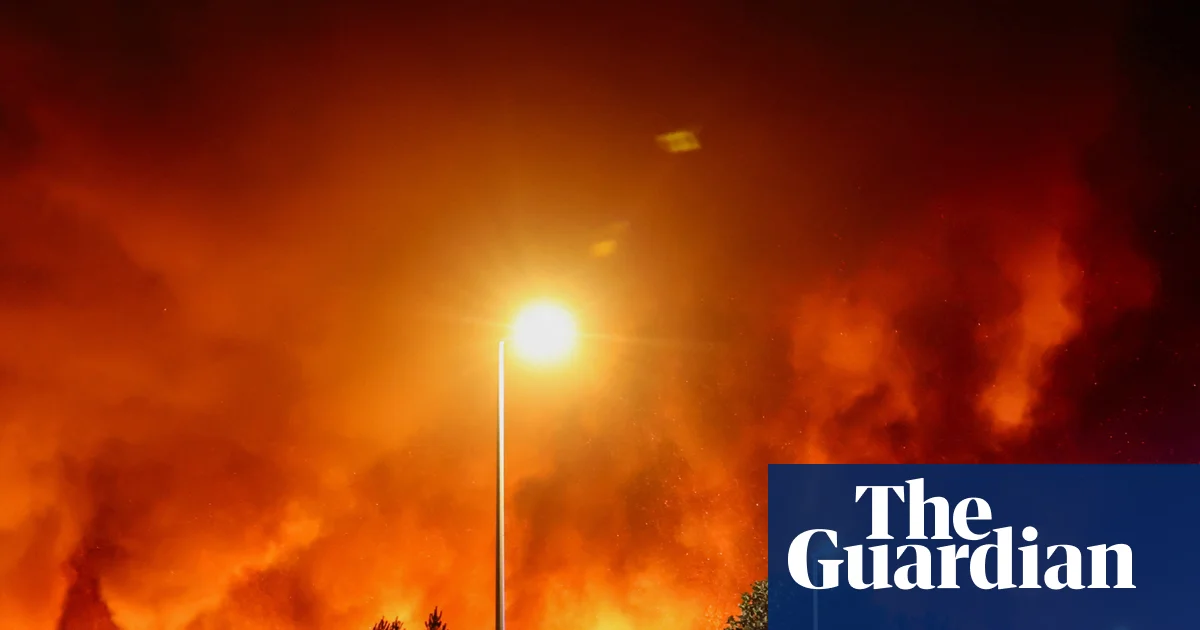
The blaze initially overwhelmed firefighters, who had difficulty accessing the deeper forest where it was spreading. Within six hours, it had travelled 6km (3.7 miles) to reach the outskirts of Le Porge. Very early the next morning, residents were in the streets, burning cinders were falling from a red sky and a decision was made to evacuate.
“The authorities should have stopped all work in the forest. Someone got their priorities wrong,” Di Domenico said.
Many in Le Porge and elsewhere in the region accuse the local administration of being “asleep at the wheel” before the fire, and then failing to commit sufficient resources fast enough. Many have asked why France’s ageing fleet of firefighting planes had not be replaced or sufficiently reinforced.
“We feared this for a long time, and were warning about the planes specifically since 2017,” said Sebastien Delavoux, head of the firefighting section of the CGT union. “This summer has shown we have reached the extreme limit of what is possible for France’s firefighters.”
The mayor of Le Porge, which lost 20% of its homes and only “by a miracle” escaped further devastation, described an event that was impossible to predict, despite multiple warnings over the years.
“The conditions this year are totally exceptional. We’ve never seen anything like this,” Martial Zaninetti said. “You can always say it’s not enough, we’ve not got adequate resources, enough planes, or of whatever, but the scale is completely beyond anything we’ve seen before.”
On Wednesday evening, at a base on the edge of the zone worst hit by the fire, senior firefighters gathered around a map taped to the side of a fire engine for a briefing. Burnt red by the sun and with notebooks in hand, grizzled sector commanders stood to receive missions for the night, when lower temperatures and higher humidity make it easier to fight a blaze. Younger team members, still in their fire retardant overalls and covered in soot, watched as their superiors greeted each other with black humour and bags of Haribo sweets.
“All right, my little chicken? Ready for another night of work? Not too much for you,” joked one officer to his replacement as he finished his 12-hour shift. “Are you planning your holidays already?” came the response.
One said the struggle with the megafire was now shifting from a dynamic and dangerous “war of manoeuvre” to a long, slow and hard “war of attrition”.
“We were on the defensive at the beginning but now it’s not spreading any more. There are still lots of individual outbreaks that have us running around and when everyone is exhausted, that is hard. So the mobilisation remains total,” he added.
Instead of the usual summer tourist traffic on the long straight roads through the pines of the Landes, there are now long convoys of fire trucks, ambulances, police cars and a motley collection of agricultural water tankers, lorries rigged with plastic containers and pickups carrying jerry cans connected to garden hoses. Some ferry water to the fire engines, allowing the crew to remain at an outbreak without leaving to replenish their tanks. Others spray roadsides or the new firebreaks which leave wide, white scars through the forest.
In the small resort town of Lacanau, just to the north of the worst-hit zones, volunteers refilled containers at a makeshift pumping station set up by volunteers at the sailing club.
Armand Fargeas, 51, who runs pleasure trips for tourists on Lacanau’s inland lake, said: “We’ve got 600 people in our WhatsApp group, which for a community like ours is a huge number. What’s really great is that you have every generation getting involved. We might not agree on politics, but the spirit of solidarity is amazing.”
Now the hotels and camping sites are empty – all evacuated – and the bistros shut. Rows of sailing boats and paddleboards were drawn up on the shore.
“We hope the tourists come back. It’s a catastrophe,” said Anne-Marie Nardou, 74, as she brought fruit and drinks to Fargeas and his friends.
Some of the roughly 200,000 people forced to leave their homes by the fire are now being allowed home. On Friday, an exhibition hall in Bordeaux, the regional capital, began to empty of hundreds of evacuees, though many still awaited permission. Tens of thousands of others remained with friends, relatives or in hotels.
Frédéric Farrugia, a 55-year-old financial adviser who lives in the coastal village of Lège, watched on his home’s security cameras as the fire brigade fought to save the building. Eventually, the flames were beaten back, though homes 50 metres away were destroyed. An image of the inferno taken by his wife, Severine, as she escaped with him and their cat after being woken by gendarmes at 2am led to an offer of temporary accommodation from a wellwisher.
“We were on the dual carriageway with these flames like a wall along one side. It was a bit like the apocalypse,” Farrugia said. “I think that now the French will realise that the climate is heating up and that we have to react.”
In Lacanau as elsewhere, many also talk about the obvious effects of the climate crisis. Anthony Legrand, a carpenter in the village, said he had seen massive change over the decades: tides that reduce the width of the stunning beach, green algae and, of course, repeated fires, including one in 2022 that devastated a swathe of forest not far from his small home.
“You’d think that would be a warning but no one paid attention,” he said. “It’ll be the same this time. They’ve got memories like goldfish.”
In Le Porge, the mayor said the “worst had passed for now” but risks of a new megafire remained high, now and in coming years.
“Right now, we need new shelter, clothes, insurance, legal support, doctors and psychologists,” Zaninetti added. “But this is a problem for the long term. Unless we find another way to live with the forest, this will just happen again.”
About the Author