
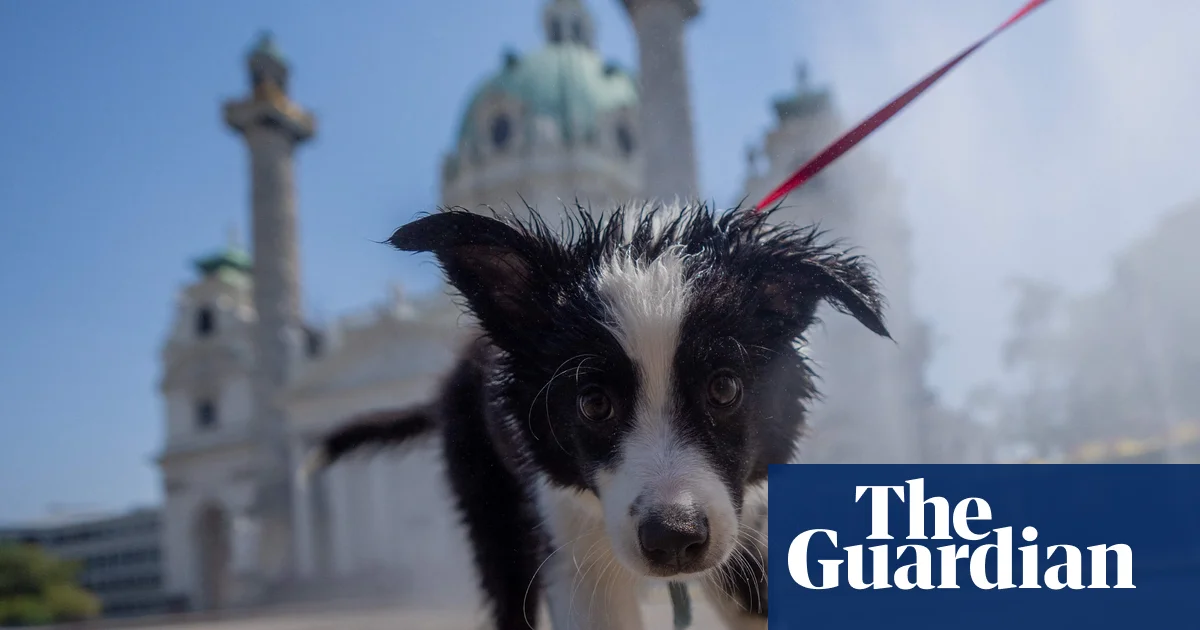
A neighbourhood in Vienna has introduced guidelines for dog walking, including the use of bottled tap water to rinse away urine and protect vulnerable trees.
Neubau, an up-and-coming, densely populated district dotted with cafes and galleries, rolled out the Schönes Gassi (nice dog walk) campaign this week.
The project addresses the impact of the area’s 600 dogs on greenery, including about 250 trees planted over the past decade to help mitigate the effects of the climate crisis.
Using the slogan Das Flascherl zum Sackerl (the bottle to go with the bag), the guidelines say animal urine corrodes tree bark, weakening its protective layer and potentially letting corrosive pathogens and fungi penetrate the trunk.
“While marking territory is a form of communication for dogs, it causes stress for urban trees,” said Grätzllabor, a community group that takes its name from the Viennese slang for quarter or neighbourhood. “This results in rot and, in the worst case, compromised stability.”
The group said the campaign had been launched in concert with “concerned citizens” in the Austrian capital. It also asks owners to carry plastic bags to clean up after their pets.
Owners can pick up a free 270ml water bottle at the town hall to rinse areas used by their dogs. The voluntary scheme could be expanded to other districts.
Fresh canine urine is highly water-soluble and dilution significantly reduces the concentration of ammonia and other harmful substances seeping into the soil, while also softening the smell.
Grätzllabor said the rinsing strategy should not be interpreted as a “licence” for dogs to mark trees or green space but rather as an action owners could take to minimise harm caused by their pets.
Conny Sporrer, who is a dog trainer, said the Schönes Gassi campaign could help head off more drastic calls to mitigate problems linked to animal waste.
after newsletter promotion
“In Vienna, we don’t need a city full of dog bans, or a city where dogs are just allowed to urinate anywhere they please,” she told reporters, saying most pets could be taught where to relieve themselves. “What we need is consideration, education and sufficient suitable facilities for dogs.”
Similar schemes have been introduced in Japan, Italy, Switzerland and Spain, which has the highest share of dog-owning households in the EU at 70%. Austria has relatively low levels of ownership, at just 17% of households.
Berlin, where more than 100,000 dogs are kept as pets after an increase in ownership during the pandemic, has also begun addressing the problem by stopping the planting of black locust trees in some areas because they are particularly sensitive to urine.
In the spring, the western district of Charlottenburg-Wilmersdorf began installing “pee stones” for dogs to use as a target, instead of trees.
About the Author