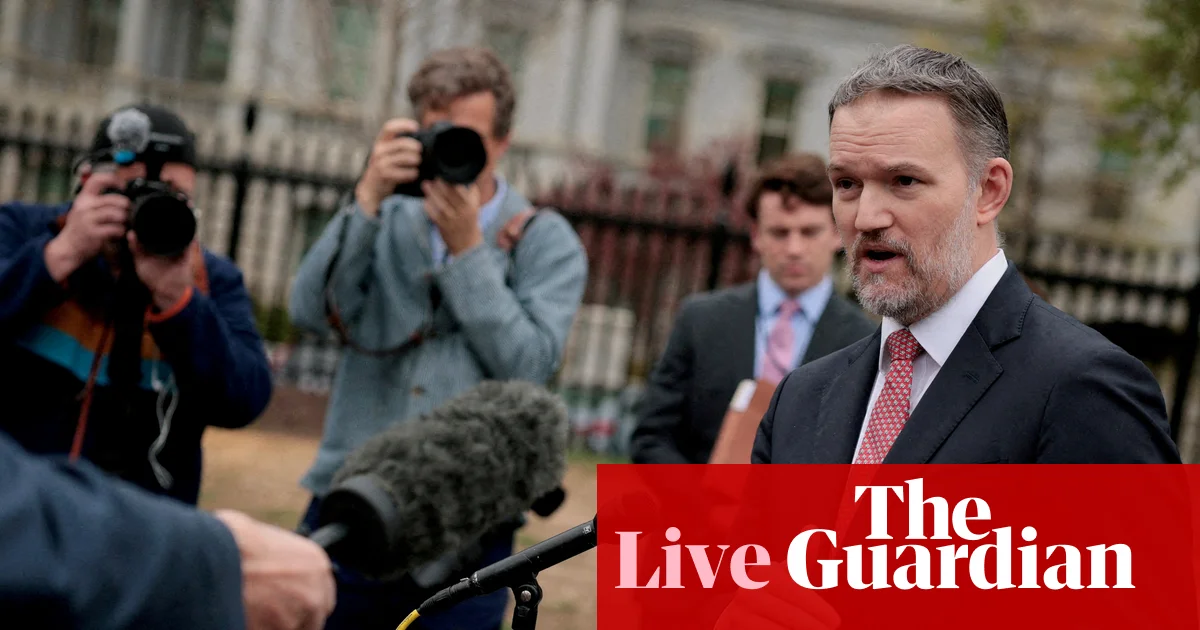
Greer insists that American families have not seen price increases as a result of tariffs
During a heated back and forth with Senator Elizabeth Warren, a Democrat from Massachusetts, Greer insisted that prices for American families have not increased in the wake of Donald Trump’s sweeping tariff policy.
“Core inflation fell to 2.6 % year on year, much better than in January 2025,” the US trade representative said.
While core inflation excludes food and energy, overall inflation is actually around o.5% higher than it was when Trump took office.
Warren pushed back noting that an estimate, produced by Democrats and based on the Congressional Budget Office and the Treasury Department’s own numbers, shows that families are paying an average of $1,700 more in tariff costs since Trump’s return to office.
Key events
Here’s a recap of the day so far
Ahead of Trump’s arrival in Georgia, here’s what’s happened today.
-
On Capitol Hill, Jamieson Greer, the US trade representative, defended the Trump administration’s unremitting “tariff spree” and insisted that prices for American families have not increased in the wake of the president’s duties on several countries. During a heated back and forth with Senator Elizabeth Warren, a Democrat from Massachusetts, Greer noted that “core inflation fell to 2.6 % year on year – much better than in January 2025.” While this metric excludes food and energy, overall inflation is actually around o.5% higher than it was when Trump took office.
-
Trump attended the dignified transfer today of four US service members killed in the Middle East. It was the third ceremony that the president has attended since he launched the war in Iran in February. Speaking to reporters on his way to Dover, Trump called it “one of the hardest things to do as a president.” His message to grieving families, he said, will simply be “we love you, we love your child”.
-
Earlier, the president took to Truth Social and noted that the US will destroy one bridge or power plant, including those near Tehran, “any time” that Iran “shoots a ship” in the strait of Hormuz. This comes after the US conducted its 11th consecutive day of strikes on Iran, with the war showing no sign if easing.
-
Senate Republicans have also released the text for the Clarity act today – the legislation that would ban public officials from issuing or sponsoring cryptocurrency or digital assets. The bill’s guardrails would apply to the president, vice-president, members of Congress, federal judges and their spouses, and wouldn’t expire until January 2029 – the end of Trump’s term. The bill is one of the first major attempts to shape cryptocurrency use for those in office, and comes after the president’s financial disclosures revealed the president took in more than $1bn from his crypto businesses since returning to the White House.
-
Meanwhile, in the House, Republican speaker Mike Johnson is desperate to pass a budget bill that would guarantee funding for the war with Iran. The legislation, which GOP leaders are hoping to pass by reconciliation and avoid the Senate filibuster, faces an array of challenges, including from fiscal hawks who complain that its expected $95bn cost is not offset by any spending cuts, and other Republicans upset that it does not answer the Trump administration’s request for an extra $350bn in defense spending. Johnson can only afford to lose two votes in his quest to pass the package.
Melody Schreiber
A series of health challenges – hantavirus, screwworm, Ebola, cyclospora, measles, whooping cough, bird flu – are exposing the widening gaps in America’s ability to prevent, identify and halt infectious disease outbreaks.
The rapid dismantling of the US public health system at all levels means the US is in worse shape than it was before the Covid pandemic, former top CDC officials say.
The US Centers for Disease Control and Prevention (CDC) lost much of its funding for battling parasites, which are notable global killers, in the last year. Experts were tasked with monitoring potential outbreaks – such as a previously rare parasite called cyclospora – around the US and the world, lending expertise to help stop crises in their tracks.
But their funding was decimated, and many people at the CDC were laid off or resigned without being replaced.
“Are we ready for the next big pandemic? My answer is no,” said Dan Jernigan, the former director of the CDC’s National Center for Emerging and Zoonotic Infectious Diseases.
Debra Houry, the former chief medical officer of the CDC, told the Guardian: “Unfortunately, we’re really moving in the wrong direction.”
Some 80% of senior leadership positions at the CDC still have no permanent officials appointed, and between 25 and 30% of the CDC’s entire staff are gone.
“Those are boots on the ground,” Houry said. “When you have Ebola, hantavirus, measles, and throw cyclospora in there – staffers were already spread thin, and now they’re spread even more thin.”
Read the full report:
As we noted earlier, Trump is now headed to Marietta, Georgia, where he’ll deliver remarks at a local high school at 3pm ET. We’ll bring you the latest as that gets under way.
In the meantime, a White House official says that the family of 1Lt Tyler James Feehan, one of the US soldiers killed during Iranian strikes in Jordan, will be flying with the president and his team. Feehan’s family are from Georgia, the official notes, and the president “offered to give them a ride home”.
Senate Republicans have also released the text for the Clarity act today – the legislation that would ban public officials from issuing or sponsoring cryptocurrency or digital assets.
The bill’s guardrails would apply to the president, vice-president, members of Congress, federal judges and their spouses, and wouldn’t expire until January 2029 – the end of Donald Trump’s term.
It also requires officials to either sell their crypto holdings and investments in crypto companies or place them in a blind trust they are not able to control.
The bill is one of the first major attempts to shape cryptocurrency use for those in office.
A reminder that Trump took in more than $1bn from his crypto businesses since returning to the White House, according to recent financial disclosures. They showed the president earned more than $500m from his World Liberty Financial business selling new crypto products, while another crypto business, CIC Digital LLC, took in more than $600m from sales of souvenir-type “meme” coins stamped with Trump’s face that launched days before his inauguration.
Also today, top Democrat Chuck Schumer plans to seek unanimous consent to pass his Presidential Airlift Security Act, which would stop the Pentagon from spending more to modify, restore, or maintain the Boeing 747-8 gifted by the government of Qatar, which Donald Trump has started to use as the new Air Force One.
Republicans previously blocked the legislation, introduced by the Senate minority leader, last year.
On Sunday, Trump admitted that his jet – valued at close to $400m – cannot match the defensive armor of a true presidential aircraft, telling reporters it will soon be grounded and “maxed out” with the protections it was never built with.
This comes after the New York Times reported that the new plane lacks defensive systems fitted to the purpose-built Air Force One fleet, including infrared countermeasures to divert heat-seeking missiles and sensors to detect incoming launches.
The president flew the jet to Ankara, Turkey for the Nato summit earlier this month but switched to an older, more heavily defended aircraft for his return to the US – at the advice of the Secret Service.
Earlier today, ahead of attending a dignified transfer of US service members who died in the Middle East, Trump claimed that a new poll just claimed that while “Americans don’t want high gasoline prices but they’re not against the war”. However, the president didn’t elaborate on who published the new data.
For context, a recent Washington Post-Ipsos poll actually found that only 29% of Americans approve of Trump’s conduct in overseeing the war with Iran.
Donald Trump salutes the coffins of the US service members killed in the Middle East last week.
The Trump administration is expected to sign an agreement with Saudi Arabia as early as today that could potentially provide the kingdom with uranium enrichment capability for its civilian nuclear program. Secretary of state Marco Rubio says any deal signed by the US would not lead to proliferation.
The deal – confirmed to The Associated Press by two people familiar with the decision who were not authorized to discuss details and spoke on condition of anonymity – could allow for the building of a uranium enrichment facility in Saudi Arabia after a joint US-Saudi study.
Though he wouldn’t confirm the deal, Rubio sought to head off emerging criticism of the decision under questioning by reporters about the risk that helping the Saudis fulfil their long-standing desire to enrich their own uranium could lead to new rounds of nuclear proliferation and competition in a volatile region.
“The US is not going to reach any agreement with any country in the world that leads to the risk of proliferation,” said Rubio, who was traveling in the Philippines today.
The agreement is not expected to include the International Atomic Energy Agency’s Additional Protocol, which would allow for more monitoring, inspections and verification, according to one of the people familiar with the decision.
The deal, expected to last 30 years and involve US firms in developing the program, is expected to be submitted for review to Congress, where it could face opposition.
The expected announcement comes during the war against Iran launched by the US and Israel five months ago, in part, to wipe out Tehran’s ability to develop a nuclear weapon. Iran has insisted its nuclear enrichment program is peaceful.
The White House and Saudi officials in Riyadh did not immediately respond to multiple AP requests for comment on the decision, which was first reported by the Wall Street Journal.
Back at Jamieson Greer’s hearing, he came under questioning from Georgia senator Raphael Warnock, who said that Donald Trump had “made life more expensive for everybody, even before his illegal war of choice set energy prices through the roof”.
Warnock cites a range of findings, including one from the New York Fed that found American businesses and consumers ultimately paid 90% of the economic burden for Trump’s tariff policies in 2025, and studies by the Fed which found the tariffs raised prices and contributed to core inflation.
“Despite this mountain of evidence, you and the president still seem to be in denial that tariffs have raised prices,” he told Greer, “a fact that study after study confirms, and is just basic common sense – everybody sees it, we’re feeling it.”
Warnock asked if the USTR “has ever produced any rigorous peer-evaluated study refuting the fact that the tariffs have contributed to inflation, or is your rebuttal to these conclusion just based on vibes, people’s feelings, politics …?”
Greer replied, “Well no, we don’t do vibes, senator.” He began to talk about inflation and the price of eggs in the last month, before Warnock pulled him up to answer his actual question. When Greer began talking about the price of eggs, butter and smartphones, Warnock interjected: “That’s not my question.”
“The point is that tariffs contributed to inflation,” Warnock said. “Prices are higher than when the president came into office, and tariffs made it worse.”
He then asked Greer: “Within 60 days, will the USTR – since you seem convinced that this is working and that tariffs have not driven up inflation – produce a formal, rigorous study that disproves what all Americans and economists believe to be true about the clear link between these tariffs and price increases?”
Greer said he was happy to talk with him separately.
Warnock then asked how the president was planning to create a manufacturing boom with these tariffs, when at least 75,000 manufacturing jobs have been lost since Trump took office.
After Greer gave a non-answer, Warnock ended his questioning: “These tariffs are raising costs and everybody seems to know that except the Trump administration.”
Tom Ambrose
President Donald Trump is attending the dignified transfer today of four US service members killed in the Middle East.
Trump will be at Dover Air Force Base in Delaware when the remains of the troops killed in action are returned to their families, the White House said.
The ritual is one of the most somber duties of a commander-in-chief. It will be the third that Trump has attended since he launched the war in Iran in February.
Speaking to reporters on his way to Dover, Trump called it “one of the hardest things to do as a president.” His message to grieving families, he said, will simply be “we love you, we love your child.”
“There’s no games, there’s no nothing – that’s their child,” Trump said. “And all you can do is throw out your heart.”
Greer insists that American families have not seen price increases as a result of tariffs
During a heated back and forth with Senator Elizabeth Warren, a Democrat from Massachusetts, Greer insisted that prices for American families have not increased in the wake of Donald Trump’s sweeping tariff policy.
“Core inflation fell to 2.6 % year on year, much better than in January 2025,” the US trade representative said.
While core inflation excludes food and energy, overall inflation is actually around o.5% higher than it was when Trump took office.
Warren pushed back noting that an estimate, produced by Democrats and based on the Congressional Budget Office and the Treasury Department’s own numbers, shows that families are paying an average of $1,700 more in tariff costs since Trump’s return to office.
Greer says he hopes to get negotiation ‘options’ on USMCA to Trump by end of the year
Jamieson Greer noted that he hopes to get “options” for interim arrangements for Trump and the leaders of Mexico and Canada for “interim arrangements” on the United States-Mexico-Canada Agreement (USMCA).
A reminder that Trump refused to renew the North American trade pact he once championed as his signature deal, opting instead to keep it alive on a short leash of annual reviews rather than committing to another 16 years.
“It does take time to to develop these [negotiations],” Greer told Senator Mike Crapo, the finance committee’s Republican chair. “I would love to have, between now and the end of the year, at least some arrangements – one with Canada, one with Mexico.”
During today’s hearing, Wyden also pushed Greer on whether Canada’s new 50% tariffs are higher than any duties imposed on China.
Greer argued that China already faces steep, layered tariffs, and said his office would send Wyden an analysis comparing those rates with Canada’s. “We have stacking tariffs on China that don’t apply to other countries,” he said.
Jamieson Greer, Trump’s US trade representative, noted that the latest consumer price index (CPI) report shows the prices fell 0.4 %, adding that this is “the largest decline since April 2020”.
However, while inflation declined to 3.5%, down from 4.2% in June, it is still higher than when Joe Biden left office in January 2025, where it hovered around 3%.
Throughout his opening remarks Wyden chided the Trump administration for its latest round of 50% tariffs on Canada –under Section 338 of the 1930 Trade Act.
“Americans ought to know that nobody, not even Herbert Hoover, used this provision before. But Donald Trump dug up a zombie law to make things even more expensive for Americans,” the Oregon Democrat said.
In the Senate today, lawmakers plan to question US trade representative Jamieson Greer.
Ron Wyden, the Senate finance committee’s top Democrat, said that Donald Trump’s “tariff spree” has “hammered” farmers and small business owners in his home state of Oregon – particularly in communities which voted for the president in 2024.
“Like so many other promises, Donald Trump has made to working people. The second he set foot in the White House, he did nothing to put American businesses and workers first,” Wyden said.
Darline Graham co-sponsors Save America act, first bill as interim senator
Darline Graham, the interim South Carolina senator filling out the remainder of her brother Lindsey Graham’s term, has co-sponsored the Save American act – her first piece of legislation since being sworn in earlier this month.
The sweeping voter ID bill is one of Donald Trump’s legislative priorities, which would – among other things – require proof of citizenship when registering to vote.
“The American people are demanding immediate action from Congress on election integrity,” Graham said in a statement. “These reforms are common sense and need to be enacted quickly.”
Senate Democrats have routinely poured cold water on the chances of the Save America act advancing in the upper chamber, where it needs to overcome the 60-vote filibuster.
On Monday, Graham announced said she plans to run for a full Senate term after Trump endorsed her last week. South Carolina will now hold a special primary on 11 August to replace her brother as the Republican nominee on the general election ballot.
About the Author