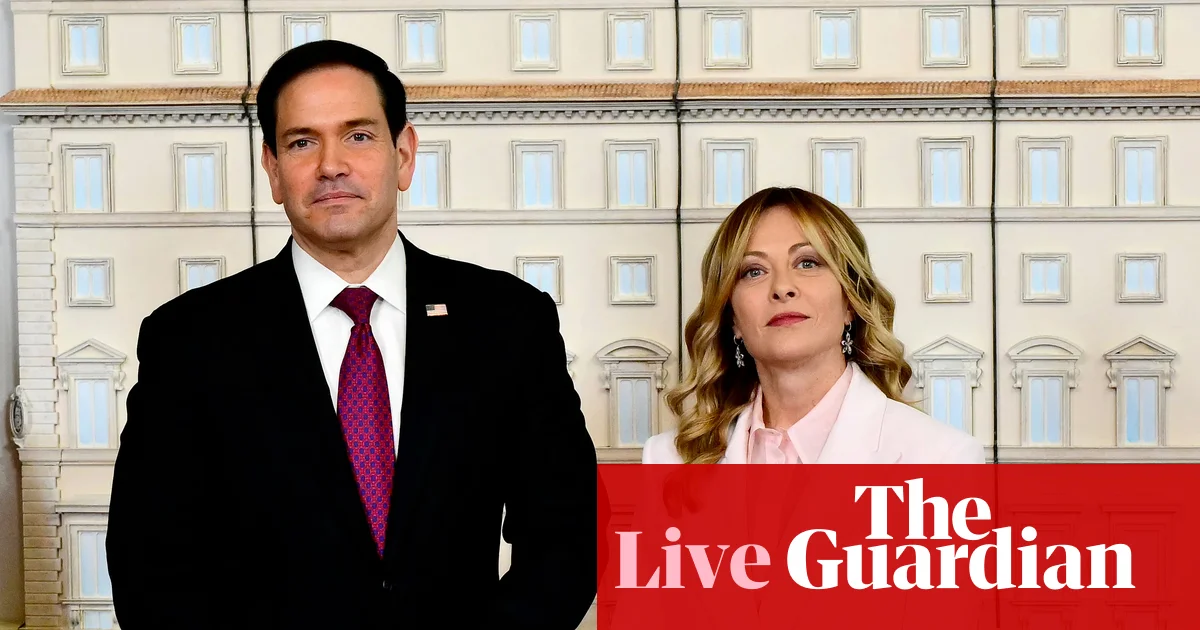
If Nato allies refuse permission to use US bases to project force, ‘that’s a problem and has to be examined,’ Rubio says
Rubio also gets asked about his meeting with Italy’s Meloni amid US president Trump’s threats to pull US troops from Europe.
He says it is a decision to be made by the president.
But he continues:
“I said publicly, and I’ve said repeatedly, I’ve been a strong supporter of Nato throughout my career in the Senate and even now, and one of the advantages of being in Nato is that it allows us to have forces deployed in Europe and bases that allow us a logistical ability to project power in case of contingencies.
We had a contingency and some countries in Europe, some countries in Europe like Spain as an example, denied us the use of those bases for a very important contingency that in some ways, the denial of those bases actually impeded the mission, not severely but had a cost and in fact, even created some unnecessary dangers.”
In a particularly strong line, he says:
“If one of the main reasons why the US is in Nato is the ability to have forces deployed in Europe that we could project to other contingencies, and now that’s no longer the case, at least when it comes to some Nato members, that’s a problem and has to be examined.”
He repeats that ultimately it’s the president’s decision to make, and there is no news so far.
He stresses that the partial withdrawal of US troops from Germany only accounts for “less than 14% of our total troop presence there” and it is part of a “pre-programmed” plan to “shift” some burden within Nato.
Key events
US efforts to end Russian invasion of Ukraine ‘stagnated,’ but US ‘always stand ready’ to get involved, Rubio says
Rubio also gets asked about the current status of talks with Russia and Ukraine.
He says:
“We’ve played … tried to play a mediator role in that so far, it has not led to a fruitful outcome for a variety of reasons. We remain prepared to play that role if it can be productive. We don’t want to waste our time and invest time and energy on an effort that’s not moving forward. But if we see an opportunity to act as a mediator that brings both sides closer to a peace deal, we’d like to see it.”
He says the US sees the continuing war as “a tragedy” with “both sides paying avery heavy prices for it, both economic and obviously at a human level.”
“We’re prepared to play whatever role we can to bring it to a peaceful diplomatic resolution; unfortunately … those efforts have stagnated, but we always stand ready if those circumstances change.”
Don’t let Iran set precedent for control of international waters, and act with more than ‘strongly worded statements’, Rubio tells allies
Rubio also gets asked about the recent escalation with Iran.
He says the US “shot back” at Iran to respond to its attacks.
“What if you fire a drone or a missile at our destroyer, what are we supposed to do? Let it hit it? We have to respond to it. We have to knock down the missile. We have to knock out whatever it is that launched that missile. The alternative is to let it sink one of our ships. That’s crazy.”
He continues, annoyed:
“We’re not going to shoot down your drone? … That’s a stupid position to take. Of course, we fired back at them. They were shooting at us. That’s what I would expect to do. Only stupid countries don’t shoot back when you’re shot at, and we’re not a stupid country. …
If you fire on, if you are a missile launching guy, whatever they call that job, and you’re sitting there, and you fire a missile at the United States, and we saw you fire it, we’re going to hit you.”
Going back to European reactions to Iran and its apparent attempt to control the strait of Hormuz, he says the question is whether the world is planning to accept that claim.
“If the answer is no, we don’t think Iran should be able to control the Straits of Hormuz, then the next question is going to be for everyone. Well, what are you going to do about it? …
The fundamental question every country, not Italy, every country, needs to ask themselves is, are you going to normalise a country claiming to control an international waterway?
Because if you normalise that, you set a precedent that’s going to get repeated in a dozen other places and if the answer is no, we don’t want to normalise it then you better have something more than just strongly worded statements to back it up.”
Asked about Iran and disagreements with the Vatican and Rome on this, Rubio says “I think everybody agrees that Iran having a nuclear weapon is unacceptable, everyone,” so the question then becomes “what do you do about it.”
“The president is actually trying to do something about it,” he says.
He says the US hopes to get a response from Iran today, and “we will see what the response entails.”
“The hope is it’s something that it can put us into a serious process of negotiation,” he says.
Responding to reports that Iran is looking to establish an agency to control the strait of Hormuz, he says that would be “very problematic” and “unacceptable.”
“The world has to start asking itself, what it is willing to do if Iran tries to normalise a control of an international waterway?”
But he says we need to wait to see what comes back from Iran.
“We have not received that yet as the last in the last hour, but perhaps that will come. Their system is still highly fractured and a bit dysfunctional as well. So that may be serving as an impediment. I hope it’s a serious offer. I really do.”
He also gets asked about the situation with Lebanon, he says the US will not negotiate with Hezbollah, but is focused on the Lebanese government.
“Our role is with the Lebanese Government. Lebanon should be governed by the Lebanese government. It should not have a terrorist group operating within its national territory that poses a threat both to its own people, including the Shia population, and to the government and to Israel and to its other neighbours.”
He also gets pushed a bit on whether he told the Pope to tone down his criticism.
He elegantly pivots into saying that was not the aim of his meeting – he wanted to hear his perspective on this as “the most important … religious leader in the world” and it was a “very productive” meeting.
If Nato allies refuse permission to use US bases to project force, ‘that’s a problem and has to be examined,’ Rubio says
Rubio also gets asked about his meeting with Italy’s Meloni amid US president Trump’s threats to pull US troops from Europe.
He says it is a decision to be made by the president.
But he continues:
“I said publicly, and I’ve said repeatedly, I’ve been a strong supporter of Nato throughout my career in the Senate and even now, and one of the advantages of being in Nato is that it allows us to have forces deployed in Europe and bases that allow us a logistical ability to project power in case of contingencies.
We had a contingency and some countries in Europe, some countries in Europe like Spain as an example, denied us the use of those bases for a very important contingency that in some ways, the denial of those bases actually impeded the mission, not severely but had a cost and in fact, even created some unnecessary dangers.”
In a particularly strong line, he says:
“If one of the main reasons why the US is in Nato is the ability to have forces deployed in Europe that we could project to other contingencies, and now that’s no longer the case, at least when it comes to some Nato members, that’s a problem and has to be examined.”
He repeats that ultimately it’s the president’s decision to make, and there is no news so far.
He stresses that the partial withdrawal of US troops from Germany only accounts for “less than 14% of our total troop presence there” and it is part of a “pre-programmed” plan to “shift” some burden within Nato.
US Rubio praises ‘very positive’ talks with Pope Leo
Meanwhile, US secretary of state Marco Rubio is speaking to reporters after his meeting with Pope Leo and Italy’s Giorgia Meloni over the last two days.
Asked about his discussions with the Pope, he says:
“There’s a lot that we work together with the church, and we talked about those areas, that ultimately it’s important. … There’s a lot that we work together with the church, and we talked about those areas that we’re working together on different parts of the world.
I know everyone’s interested in the other aspects of it, but I … updated them on the situation with Iran, expressed our point of view about why this was an important and the danger that Iran poses to the world, which is largely recognised.”
He says that Leo is “a spiritual leader, first and foremost,” and understandably argued the case for peace, but he said the meeting overall was “very cordial” and “very positive,” recognising the church’s role as “an important global institution.”
Airlines cannot charge extra for fuel or relax passenger protection rules as Iran impact hits, EU insists
The European Commission also insisted that airlines must not charge customers extra fuel fees after they have already bought tickets, as the aviation sector feels the pain from high energy prices because of the Middle East war, AFP reported.
“Airlines may adapt their published fares to the situation, but adding a fuel surcharge to a ticket after it has been bought cannot be justified,” EU spokeswoman Anna-Kaisa Itkonen told reporters in Brussels.
The commission stressed that all passenger protection rules are maintained as the impact of the Iran war on the jet fuel market is not severe enough, Reuters added.
It also added that there is no “concrete evidence” of jet fuel shortages at this point.
European Commission ‘sees merit’ in calls for single EU contact for Russia, but says Moscow does not want to engage in serious talks
The European Commission has just been asked about Costa’s comments.
In response, EU’s deputy chief spokesperson Arianna Podestà recalled the commission president’s social media post from last night instead, saying that “airstrikes on Ukraine once again show Russia is not serious when it talks of ceasefire or peace.”
“The only way to stop human suffering and allow space for meaningful peace talks is to stop the killing immediately and agree a long-term ceasefire.”
She added that all sorts of talks on Ukraine and Russia “are taking place in different formats.”
The commission “can see the merit of having one single figure speaking on behalf of the 27, of course, [but] we need to see Russia’s willingness to engage in serious peace talks.”
Foreign affairs spokesperson Anouar El Anouni added that first “we need to get Russia from a position where Russia pretends to negotiate to where they actually negotiate.”
“We have seen that Moscow has not changed its goal nor its actions,” he added.
Diplomats urge caution as EU’s Costa floats idea of future talks with Russia
Jennifer Rankin
in Brussels
And how is European Council President António Costa’s proposal to “organise ourselves” for talks with Russia (12:04) going down in Brussels?
At an event in Florence, Costa, who chairs EU summits, said EU leaders were preparing for potential talks for Russia.
In an on-stage interview with the Financial Times, Costa said the EU needed – one day – to talk with Russia about the future security architecture of Europe.
“We cannot change the geography… and of course we need to talk with them about the future of the security architecture of Europe.
I am talking with the [EU’s 27 national] leaders to see the best way to organise ourselves and to identify what we need effectively to discuss with Russia when it comes the right moment to do this.”
Costa also said he did not see any sign that Russia wanted serious negotiations.
One senior diplomat urged caution. The person stressed the EU needed to ensure its security interests were taken care of in any peace negotiations, while arguing that there was no serious interlocutor in the Kremlin.
“Before we will all get into this question of ‘is this is a good idea?’ ‘is this is a bad idea?’ let’s first wait and see whether we have actually Russia and a Russian president that’s willing to seriously engage. And so far we have seen zero indication of that.
By the time we get to a situation where we have a serious Russian president then we will have to revisit that topic…[It is] perhaps better not to look too far ahead on this, because I think we are nowhere near a situation where this could materialise.”
US peace envoys expected in Kyiv ‘at turn of spring and summer’ as ‘substantive’ talks with US progress
Meanwhile, Ukrainian president Volodymyr Zelenskyy posted an update after yesterday’s talks between Ukraine’s chief negotiator Rustem Umerov’s meetings in the US.
Zelenskyy said the talks were “substantive,” with Ukraine and the US looking at welcoming US envoys to Kyiv “at the turn of spring and summer.”
“We hope this time we will be able to realise what has been planned and reinvigorate diplomacy,” he said.
He added the discussions also involved “humanitarian issues, including the continuation of POW exchanges,” and “refining” of security guarantees.
Back to Moscow’s preparations for the Victory Parade, Reuters is now reporting that, in the latest signal of concern about the event, there is “a limit put on the number of foreign journalists cover it” as a result of “the change format of the parade.”
The Kremlin also responded to a report in the Financial Times newspaper (£) that EU leaders were preparing for potential talks with Moscow, insisting that Putin “is ready to negotiate with anyone” – but will not initiate the process.
US Rubio arrives for talks with Meloni in Rome
US secretary of state Rubio set to meet with Italy’s Meloni in bid to repair relations strained over Iran
We will also be looking at Italy today, where US secretary of state Marco Rubio is set to meet with the country’s prime minister, Giorgia Meloni.
Earlier today, he met with Italy’s foreign minister Antonio Tajani, as he continues his two-day trip to Italy and the Vatican, after meeting with Pope Leo yesterday.
There is no shortage of topics to discuss given growing tensions between Italy and the US in recent months, over Rome’s refusal to join in or support the US war in Iran.
Italy’s Meloni and US Trump had been close allies – with the prime minister even attending his inauguration last year – but as our correspondent Angela Giuffrida noted, that relationship, rooted in shared nationalistic rhetoric, is now unravelling as quickly as it formed.
Trump turned on her telling the Italian newspaper Corriere della Sera recently that she “lacked courage” for failing to join the US-Israeli war on Iran.
The rebuke came after Meloni described Trump’s attack on Pope Leo – who has emerged as a vocal critic of the Iran war – as “unacceptable”.
“She is the one who is unacceptable,” Trump snapped, “because she doesn’t care if Iran has a nuclear weapon and would blow up Italy in two minutes if it had the chance.”
Rumen Radev confirmed as Bulgaria’s new prime minister
Meanwhile, former president Rumen Radev has just been confirmed as Bulgaria’s new prime minister.
During today’s vote in the Bulgarian parliament, all 124 MPs from his party voted in favour, while 70 MPs were against, and 36 abstained.
In last month’s elections – Bulgaria’s eighth since 2021 – Radev’s Progressive Bulgaria won a majority of seats in the parliament, the first such case from 1997.
The former president rode a wave of voter anger at entrenched corruption and the veteran parties that have allowed it.
But there are some questions ofer the new prime minister’s stance on Russia. Radev, 62, who stepped down from the largely ceremonial role of president in January to campaign on an anti-graft ticket, has criticised a recent defence agreement signed between Bulgaria and Ukraine and opposed Sofia sending arms to Kyiv.
AFP noted that Kyiv said Moscow ignored a Ukrainian call to halt fighting earlier this week that Ukrainian president Volodymyr Zelenskyy cast as a test of whether the Kremlin was serious about providing a brief respite in the four-year war.
Russia has threatened a massive strike on the heart of Kyiv if Ukraine disrupts the Victory Day parade on Saturday, repeatedly urging foreign diplomats to evacuate the Ukrainian capital ahead of time.
Morning opening: Ceasefire that wasn’t

Jakub Krupa
Russia and Ukraine are trading accusations of breaking their two very different versions of proposed ceasefire this morning as we get closer to the Victory Day parade in Moscow, with the Kremlin reportedly worrying about a potential Ukrainian strike.
Ukraine suggested an indefinite ceasefire earlier this week, which was repeatedly violated by Russia. After another round of attacks over night, president Volodymyr Zelenskyy said:
“All of this clearly shows that, on the Russian side, there was not even a token attempt to cease fire on the front. As we did over the past 24 hours, Ukraine will respond in kind today as well. We will defend our positions and people’s lives.”
Russia, which wanted a shorter artificial ceasefire to protect the parade to which Kyiv never agreed, said it would be responding to any Ukrainian attacks “symmetrically.”
As my colleague Pjotr Sauer noted earlier this week, Victory Day has been central to Vladimir Putin’s vision of Russian identity throughout his more than 25 years in power. Since the full-scale invasion of Ukraine, the Kremlin has intensified its use of the annual celebration, with Putin deploying the occasion to frame and justify the current war.
Let’s see how the next few hours shape up as we get closer to the celebration. I will also bring you more on the (very short) guest list for the event.
Elsewhere, we will follow US secretary of state Marco Rubio’s meeting with Italy’s prime minister Giorgia Meloni, track the preparations for Péter Magyar’s inauguration in Hungary tomorrow, and see how are things on board of the hantavirus-hit cruise.
It’s Friday, 8 May 2026, it’s Jakub Krupa here, and this is Europe Live.
Good morning.
About the Author