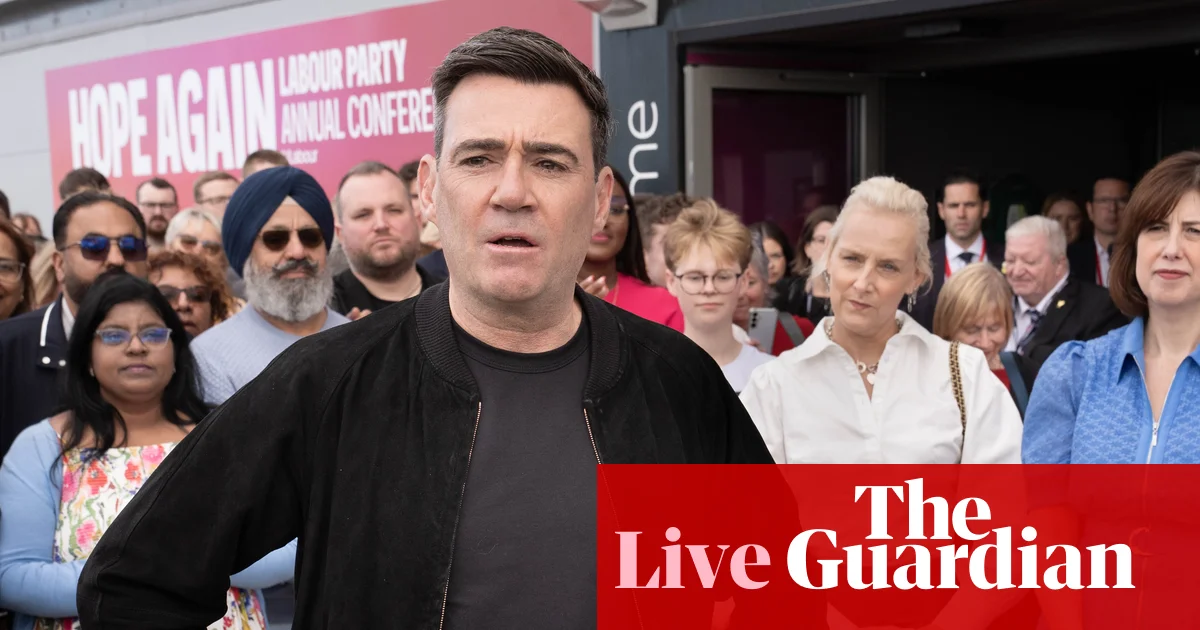
Burnham rejects claim free social care would cost £18bn, and says people already paying ‘huge’ costs now
Kuenssberg puts it to Burnham that, according to the Health Foundation, a system offering adult social care free at the point of deliver (like healthcare delivered by the NHS) would cost £18bn.
Burnham says the cost is “not that high” (ie, not as high as £18bn).
Q: So how much would it cost?
Burnham replies:
Not that high.
But can I directly deal with this issue of the costs?
Because it’s as if there isn’t a cost at the moment. There is a cost. People are paying care charges now. They are spending tens of thousands of pounds from their savings, sometimes losing their homes. That is what’s happening at the moment.
So to suggest there isn’t a cost to people at this moment in time – there’s a huge cost.
Social care in England is as unfair as American health care, where the most vulnerable in society can lose everything. They can be wiped out not just by the condition that they have, but wiped out financially.
So there is a massive cost, and there is also a cost to the National Health Service, as I said, because there are a huge number of people in hospitals across England every day who are medically fit to be discharged home but can’t be discharged home because the social care isn’t there.
Key events
Burnham condemns masked anti-migrant protesters, saying they are ‘creating fear’ and it’s ‘unacceptable’
Asked about the masked men on the streets how have protesting about migrants in towns in the south of England recently, Burnham said this was “unacceptable”.
He said:
Unacceptable. Creating fear and intimidation on British streets – this is not something we’ve seen in this country before and it’s not something we want to see.
Burnham said there were “real worries” about immigration. But he went on:
But let’s look at the facts. Net migration is down 80% on what it was in the Boris Johnson era.
Boat crossings are down 50% this year on what they were in the early 2020s.
So I understand people’s concerns and I will be relentless in addressing their concerns.
But people also have to look at the facts, and they also have to see when people are playing the worst kind of politics with this issue. That is leading to people feeling afraid in their own communities.
Burnham says he would like to see welfare spending fall, but not by using ‘crude cuts’
Q: Do you want welfare spending to go down by the time of the next election?
Burnham said he would like that to happen.
Q: Will you commit to it?
Burnham did not give a firm commitment. He said he was hesitating because he was opposed to “crude cuts”. He explained:
I don’t think you get the welfare bill down on a sustainable basis if it’s crude cuts, because that just plunges people into crisis, and then they will appear in a different part of the system, and you have to spend more public money.
He said he did not want to see young people in their 20s stuck in unemployment.
He said the government is reforming education to create more vocational routes into work. And he said the Alan Milburn review would propose plans to reduce the number of Neets (young people not in education, employment or training).
Burnham dodges question about whether he favours building third runway at Heathrow
Q: Are you in favour of building the third runway at Heathrow?
Burnham said there had been a consultation on this. It was “a contested issue”, he said. He added:
I think principally it’s a matter for London and London MPs.
Q: There will be a vote in parliament. And you are prime minister.
Burnham said he had to listen to the voice of people first. He added:
It’s not right for me to just jump straight in on the back of the consultation.
Kuenssberg said Burnham had expessed doubts about the plan in the past.
Again, Burnham gave a non-committal answer. Kuenssberg tried a final time and got the same reply.
Q: Will you tell us something you are willing to cut to balance the books?
Burnham said, if people wait unti his speech on Tuesday, they will see he is “prepared to take those type of decisions because I won’t do what the previous Conservative government did and take risks with the economy”.
He said the fundamentals of the economy were moving in the right direction before the Iran war started.
And he said John Healey, the chancellor, was clear about the need to be “very prudent” running the economy.
Burnham rejects suggestion he is downplaying importance of economic growth
Turning away from social care, Kuenssberg put it to Burnham that he had already made a series of spending announcements – and that the government’s finances were in a precarious state.
Burnham said the plan he was proposing for social care was “prevantative”. Spending money to keep people in their homes would stop them being sent to hospital unnecessarily, he said.
Tackling rough sleeping would also reduce the number of rough sleepers going to A&E, or being arrested by the police, he claimed.
And he said cheaper bus fares would help people get jobs.
Q: Peter Kyle, the former business seceretary, said you have to focus as much on growth as on tackling rough sleeping.
Burnham replied:
[He’s] absolutely right to say that, and in my former job, I oversaw the fastest growing economy in the country, which is Greater Manchester.
Burnham said that some people would view his social care reform plan as a “hostage to fortune”. But it was a risk worth taking, he said.
The manifesto would include a “precise explanation as to how it’s going to be funded”, he said.
And some in the political world will be saying, watching this, “Oh my goodness, that’s a hostage to fortune.’
But do you know what? I am not going to do politics as usual as prime minister.
Why is the country in the position that it’s in? Because politics has let people down. It has backed away from difficult issues like this. I am not going to do that as prime minister.
Burnham suggests social care reform would come after 2029, saying voters will be asked to back it at election
Q: Will you do social care reform before the next election in 2029?
Burnham said he would stick to the Labour manifesto, and its commitments on tax (which rule out rises in income tax, national insurance or VAT).
Q: But what about a special, new tax to fund social care?
Burnham replied:
Trust is really important to me here. I don’t think you can reform this system without it, without consensus.
So I’m saying to you that I will develop a very clear plan, and I will put that plan to the public at a general election.
He went on:
That will be where the plan gets tested. And people will then be able to decide.
And I am prepared to put myself in that position, recognising that it might be difficult or unpopular with some, but that is the way to do it, to get that endorsement and then introduce the system in the next parliament. Because the the backing of people for this really matters.
Burnham says scaremongering and political ‘cowardice’ should not be allowed to kill off social care reform
Q: Will you go back to the plan you proposed in 2009, for better social care to be funded by a new tax on estates after people die?
Burnham replied:
Nothing is off the table at this moment in time.
Now, that doesn’t mean that I’m going straight back to the proposal that I had in 2010.
I know people will be saying, ‘Well, tell us what what it is.’
The facts of the matter are, I’m going to lay out a broad direction on Tuesday, and then Baroness Casey is going to help me work up the details that we will put to cross-party talks, because we do have to build consensus.
Burnham went on to say, if other parties just resorted to scaremongering, reform would never happen.
If we continue to approach this issue with politics as usual, where people are scoring points and they’re taking a proposal and then trying to frighten the public at home about it, we will never fix it.
And can we honestly justify that? That politics in this country cannot face an issue like this and and deal with it because we’re too scared of it?
I think it’s a real indictment, actually, of our politics, that we’ve had so much cowardice in our political system we’ve not been able to deal with this.
Burnham anticipates attack on his plan saying ‘we have dementia taxes right now’
Asked to give more detail about his social care plans, Burnham said he would say more about this on Tuesday.
He also said in the past announcements on this topic had been easily misrepresented.
The opposition party will leap on one comment and then they will call the policy a dementia tax or a death tax.
Can I just say we have dementia taxes right now and people can lose everything they’ve worked for paying those taxes.
So the idea that there isn’t already a cost is just wrong.
[This policy is] just making that cost fairer and spreading it across across the population.
Burnham says he expects ‘everyone’ to contribute to cost of social care reform – but not necessarily in same way as for NHS
Kuenssberg put it to Burnham that, if social care was going to be like the NHS, everyone would have to pay out of general taxation.
Burnham replied:
It will be a system of that kind. So everyone contributes, everyone’s covered, but not precisely necessarily in the same way that we currently pay for the NHS. This is for Baroness Casey to advise us on.
Burnham says he will give details of plan for fund adult social care reform later this week, and will be ‘honest’ about choices
Q: Where will the money come from for social care reform?
Burnham says he will say more about this “later this week” (in his speech on Tuesday, he implies).
He goes on:
I won’t do anything [if] I can’t, if you like, look the public in the eye and say, ‘I think this is the right thing to do.’
I am going to show leadership on this on this issue. I will not leave office without giving my all to fixing to fixing this, and I will be honest with people. I’m not going to do any sleight of hand here.
We will set out the issues. I will try to build consensus. I’ve already started cross-party talks and we’ll come back to cross-party talks and I won’t … dodge the difficult questions.
I’m going going to rip the plaster off, if I can put it that way, because someone has to do it.
About the Author