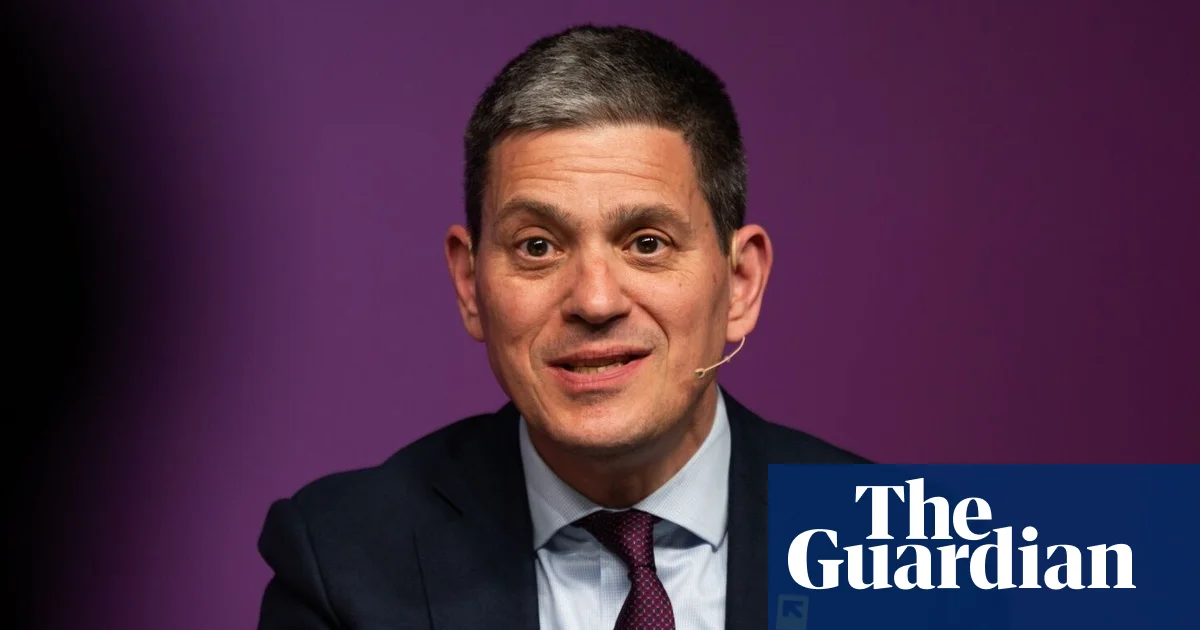
The UK needs a “national consensus” about rejoining the European Union, David Miliband has said, in response to revelations that the UK government pitched the creation of a single market for goods with the EU to the bloc.
The former foreign secretary, who is now president of the International Rescue Committee, said he thought the UK needed a reset of its relations with the EU at “a much higher dosage” than the government was planning.
Asked on BBC Radio 4’s Today programme about the report by the Guardian, he said he was “absolutely convinced” the security and prosperity of the UK depended on an “institutionalised, deep and strong relationship with the rest of Europe”.
“When the government says we want a reset of our relations with Europe, I think that’s a good thing, but then when I look at the reset so far, [which] is only worth £9bn by 2040 and I remember that Britain is a £3tn economy, I’m left saying no, we need a much higher dosage in our reset.”
When pressed on whether he would advocate for rejoining the union, he said: “What we have to do is build a national consensus about our position with the European Union. I’m very happy with it as a long-term goal … I want this strong institutional relationship with the European Union, but then I know the deal we had until 2016 is not available now; we’re not going to be able to get that deal again.”
The European Union is changing profoundly, he said, with Ukraine an increasingly important factor. “The big issue for Brussels today is not Britain joining; it’s Ukraine joining,” Miliband continued. “They’re talking about associate membership for Ukraine; they’re talking about different tiers of membership.”
Regarding the Labour leadership challenge, in which his brother, Ed Miliband, could play an influential role, he said he was more concerned with government action than leadership.
“Britain is in the eye of a global storm. The global order is being ripped up. Our economy is being transformed by new technology. Our welfare system needs to shift from a focus on older people to an investment in younger people – a million people between the age of 16 and 24 [are] not in education or training,” he said. “We have got a massive debate to have in this country about how we spur wealth creation, distribute it fairly [and] reinvent the way in which a government works … If we spend all our time talking about who, not what, we’re going to miss the point. The ‘what’ questions are absolutely key.”
Asked whether he thought the Labour party needed a new leader and the country needed a new prime minister, he said: “When the world changes, we have to change. And in the two years since the general election, the world has changed fundamentally.”
About the Author