Louisiana postpones May primaries after supreme court rules state must redraw congressional maps
Louisiana moved to postpone its May primaries on Thursday in a move that came as other southern states are also scrambling to redraw congressional districts in response to the supreme court’s Wednesday ruling that severely weakened the landmark Voting Rights Act.
Before the supreme court’s decision, eliminating a key protection against racial discrimination in drawing voting maps, some states had already begun initiating processes to redraw districts and gut Black voting power. More states have now followed, with governors calling for special sessions to redraw congressional districts, potentially before the midterm elections in November.
Louisiana governor Jeff Landry and attorney general Liz Murrill, both Republicans, said in a joint statement that the state can no longer use its current districts to carry out the primaries after the supreme court ruling. Early voting had been scheduled to begin Saturday in advance of the 16 May primary.
“The State is currently enjoined from carrying out congressional elections under the current map,” Landry and Murrill said in the statement on social media Thursday. “We are working together with the Legislature and the Secretary of State’s office to develop a path forward.”
Key events
Senator Bill Cassidy, a Louisiana Republican, told CNN he doesn’t think it’s a “very good idea” for the state to postpone its May primaries after the supreme court decision. But, reporter Manu Raju wrote on X, he also said he hasn’t fully thought that through yet.
Supreme court decision more likely to affect local-level government
Sam Levine
There’s rightfully going to be a lot of attention on what the supreme court’s Callais decision means at the congressional level.
But the impact of the law is likely to be far more widespread at the local level.
As this helpful graphic from the Brennan Center points out, since 2015, the vast majority of cases in which a court has found a Section 2 violation have been at the local level.
The election suspension was denounced by some Democrats, the Associated Press reported.
“This is going to cause mass confusion among voters – Democrats, Republicans, white, Black, everybody,” said Louisiana state senator Royce Duplessis, a Democrat who represents the New Orleans area. “What they’re effectively doing is changing the rules of the game in the middle of the game. It’s rigging the system.”
Currently, Louisiana is represented in the US House by four Republicans and two Democrats. But, a redrawn map could give Republicans a chance to pick up at least one more seat in the November midterm elections.
Louisiana wants to redraw maps before the midterms. What about other southern states?

Sam Levine
House speaker Mike Johnson on Thursday urged states to redraw their maps following the Supreme Court’s monumental decision striking down the Voting Rights Act.
Louisiana – where Republicans could reconfigure two district currently represented by Black Democrats – has already indicated it wants to quickly redraw ahead of the midterms.
The landscape elsewhere is a bit more complicated. Alabama is currently under a court-ordered injunction to use its current maps – which has two districts represented by Black Democrats – until 2030. A court put that injunction in place after finding Alabama intentionally discriminated against Black voters. I would expect Alabama to quickly ask the court to release it from that injunction in light of the Callais decision.
Mississippi could also move quickly to get rid of a district represented by Bennie Thompson, a Black Democrat. And Republicans in South Carolina could also quickly move to get rid of the district of Jim Clyburn, one of the most powerful Democrats in the US House.
In Tennessee, Republicans could redraw the map to get rid of a district around Memphis, currently represented by Democrat Steve Cohen. Republicans in Georgia may also try and wipe out several districts held by Democrats.
How Louisiana got here: US supreme court decision severely weakens Voting Rights Act
Sam Levine
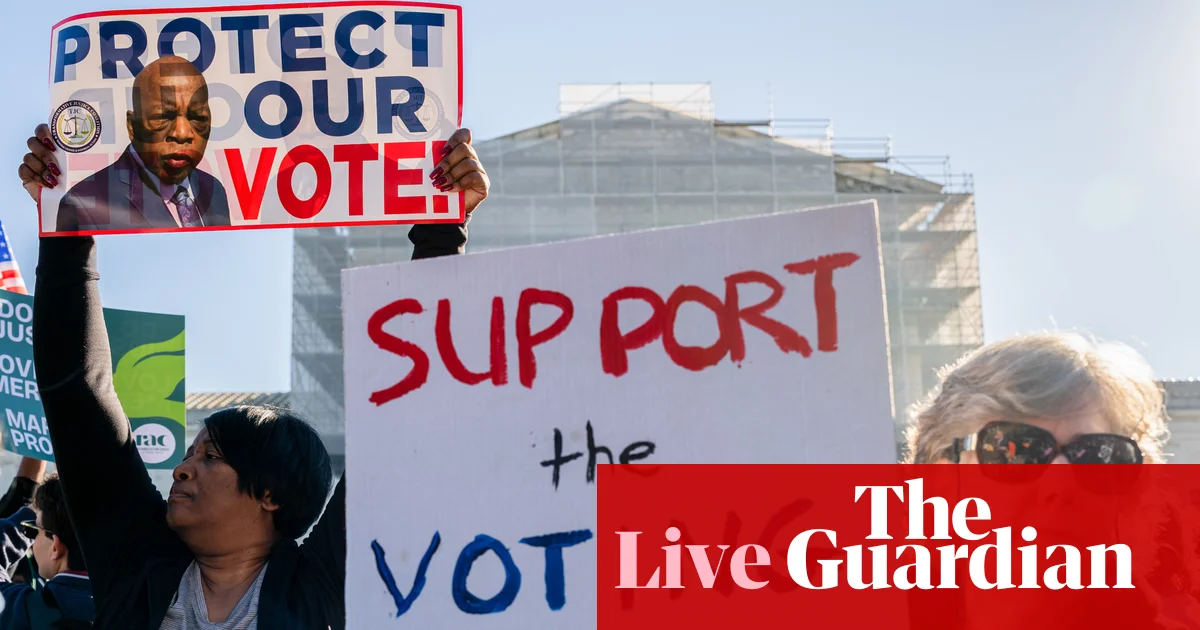
On Wednesday, the US supreme court ruled that Louisiana will have to redraw its congressional map, in a landmark decision that effectively guts a major section of the Voting Rights Act.
In a 6-3 decision along partisan lines, the court rendered ineffective section 2 of the Voting Rights Act, the last remaining powerful provision of the 1965 civil rights law that prevents racial discrimination in voting. Section 2 has long been used to ensure minority voters are treated fairly in redistricting.
“Allowing race to play any part in government decision-making represents a departure from the constitutional rule that applies in almost every other context,” Justice Samuel Alito, a conservative, wrote for the majority opinion. “Compliance with section 2 thus could not justify the state’s use of race-based redistricting here. The state’s attempt to satisfy the middle district’s ruling, although understandable, was an unconstitutional racial gerrymander.”
The court’s decision is a major upheaval in US civil rights law and gives lawmakers permission to draw districting plans that weaken the influence of Black and other minority voters.
Here’s more of that statement from Louisiana attorney general Liz Murrill and Republican governor Jeff Landry:
double quotation mark Yesterday’s historic Supreme Court victory for Louisiana has an immediate consequence for the State. The Supreme Court previously stayed an injunction against the State’s enforcement of the current Congressional map. By the Court’s order, however, that stay automatically terminated with yesterday’s decision. Accordingly, the State is currently enjoined from carrying out congressional elections under the current map. We are working together with the Legislature and the Secretary of State’s office to develop a path forward.
Louisiana postpones May primaries after supreme court rules state must redraw congressional maps
Louisiana moved to postpone its May primaries on Thursday in a move that came as other southern states are also scrambling to redraw congressional districts in response to the supreme court’s Wednesday ruling that severely weakened the landmark Voting Rights Act.
Before the supreme court’s decision, eliminating a key protection against racial discrimination in drawing voting maps, some states had already begun initiating processes to redraw districts and gut Black voting power. More states have now followed, with governors calling for special sessions to redraw congressional districts, potentially before the midterm elections in November.
Louisiana governor Jeff Landry and attorney general Liz Murrill, both Republicans, said in a joint statement that the state can no longer use its current districts to carry out the primaries after the supreme court ruling. Early voting had been scheduled to begin Saturday in advance of the 16 May primary.
“The State is currently enjoined from carrying out congressional elections under the current map,” Landry and Murrill said in the statement on social media Thursday. “We are working together with the Legislature and the Secretary of State’s office to develop a path forward.”
About the Author