Three strategically vital islands at the mouth of the Persian Gulf have once again become a focal point in the escalating US military campaign against Iran.
Abu Musa, along with Greater and Lesser Tunb, were seized by Iran in 1971 from what would later become the United Arab Emirates. These rocky outposts now serve as a critical Iranian garrison, enabling Tehran to exert considerable influence over the Strait of Hormuz, a vital waterway through which a fifth of the world’s oil and natural gas transits during peacetime.
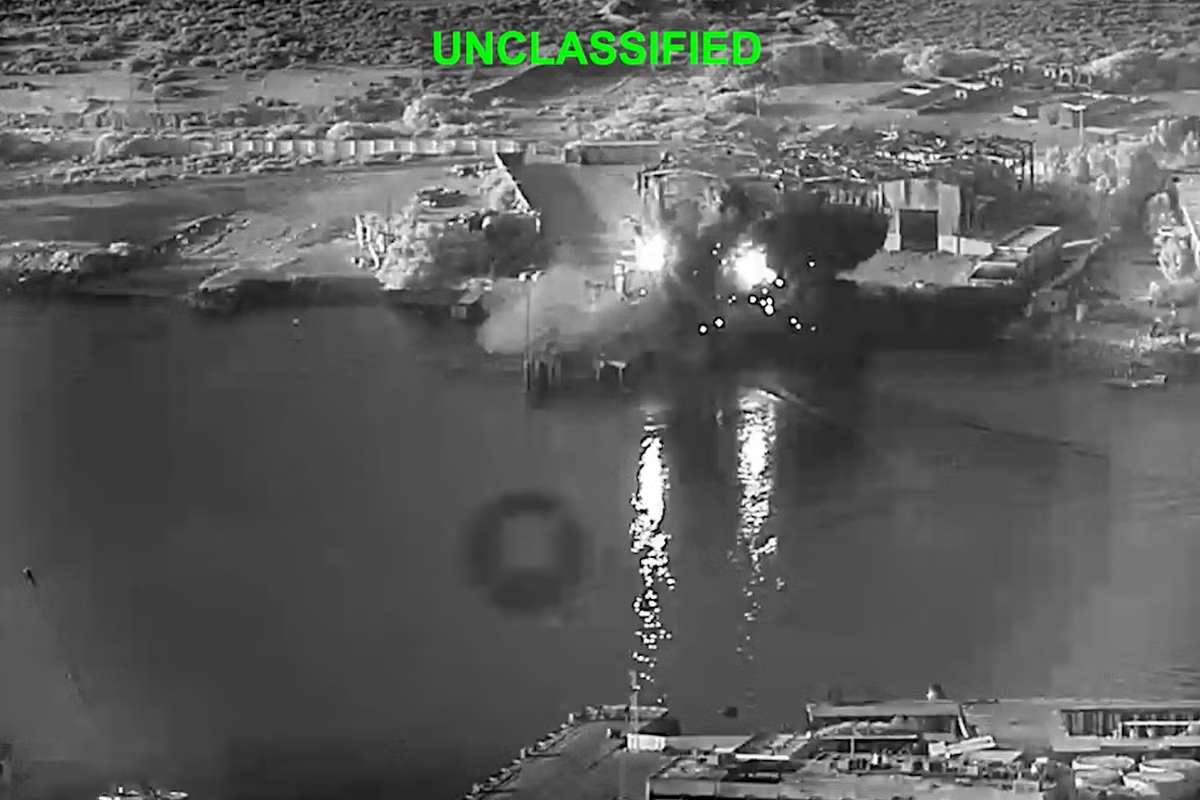
Recent US strikes targeting two of these islands have reignited debate and speculation surrounding their future and their long-disputed ownership.
Three islands sit along the route to the Strait of Hormuz
Despite their modest combined landmass of approximately 25 square kilometres, three islands in the Strait of Hormuz hold immense strategic importance, situated along the crucial deep-water shipping route connecting the strait and the Gulf.
The largest, Abu Musa, hosts a village but primarily functions as a base for Iran’s paramilitary Revolutionary Guard. Here, fast boats and missiles – tools previously employed to harass vessels in the strait – are stationed, alongside air defence systems. Greater Tunb Island features similar military installations, while the significantly smaller Lesser Tunb maintains only a military presence.
The strategic value of these islands has historically made them a flashpoint for regional powers. Iran, then under Shah Mohammad Reza Pahlavi, seized control of the islands by force on 30 November 1971, just two days before the formation of the United Arab Emirates. As a key security ally of the United States at the time, the Shah’s actions met with little international resistance.
Following the 1979 Islamic Revolution, Iran leveraged the islands as a staging ground during the “Tanker War” of the 1980s. During this period, the US Navy escorted oil tankers through the region under Iranian fire, with the islands facilitating monitoring of the strait and the deployment of vessels for mine-laying or direct attacks. US estimates suggest Iran attacked over 160 ships in that confrontation.
In the current conflict, more than 50 attacks targeting vessels and oil rigs have been recorded, according to the Joint Maritime Information Centre, overseen by the US Navy. These incidents include instances where the US has fired upon ships it accuses of attempting to breach its blockade on Iran.
The islands have become US military targets
In recent days as part of the escalation in fighting, the U.S. military launched strikes on both Abu Musa and Greater Tunb islands. Some analysts have speculated that American forces might invade.
“Together they act as a layered denial system to the most critical energy chokepoint in the world,” Isabel Oakeshott, a columnist for The Telegraph who now lives in Dubai, United Arab Emirates, wrote in the newspaper. She equated Abu Musa to “a fixed aircraft carrier” for Iran.
Taking the islands likely would be possible for the U.S., which has both paratroopers and Marines in the region. However, they likely would be exposed to Iranian attack while there.
“Without prepared, hardened fortifications to provide cover — even with air support from nearby naval assets — force protection would be an enormous challenge,” warned Brandon Carr, an analyst with the Washington-based Quincy Institute for Responsible Statecraft, which calls for restraint in American military operations abroad.
“The Marines would come under fire from Iranian ballistic missiles and drones, severely limiting their ability to project power into the strait.”
The dispute over the islands hangs over the conflict
In recent years, the United Arab Emirates successfully lobbied both China and Russia to include language in joint statements about resolving the ownership of the islands through either negotiations or an international court decision.
That infuriated Tehran — but the world largely ignored the dispute.
“What the world called a bilateral territorial dispute was, from the beginning, a strategic claim on a global chokepoint,” wrote Noora Mohamed Al Murry, an Emirati legal scholar, in April.
“Managed ambiguity, in a waterway this consequential, is not a neutral position. It is a choice with a price, and the world is now holding the invoice.”
Oakeshott, the columnist, predicted that the UAE, which hosts U.S. forces and has repeatedly come under Iranian fire in the war, would likely push to get the islands once the conflict ends.
The U.S. campaign may force the issue to a head, some 55 years after the late shah warned the strait could become a “nuisance” for the world.
“It does not take a big boat to carry a bazooka and a few shells,” the shah told The Guardian newspaper in 1971. “But the trouble that it could cause is tremendous.”
About the Author