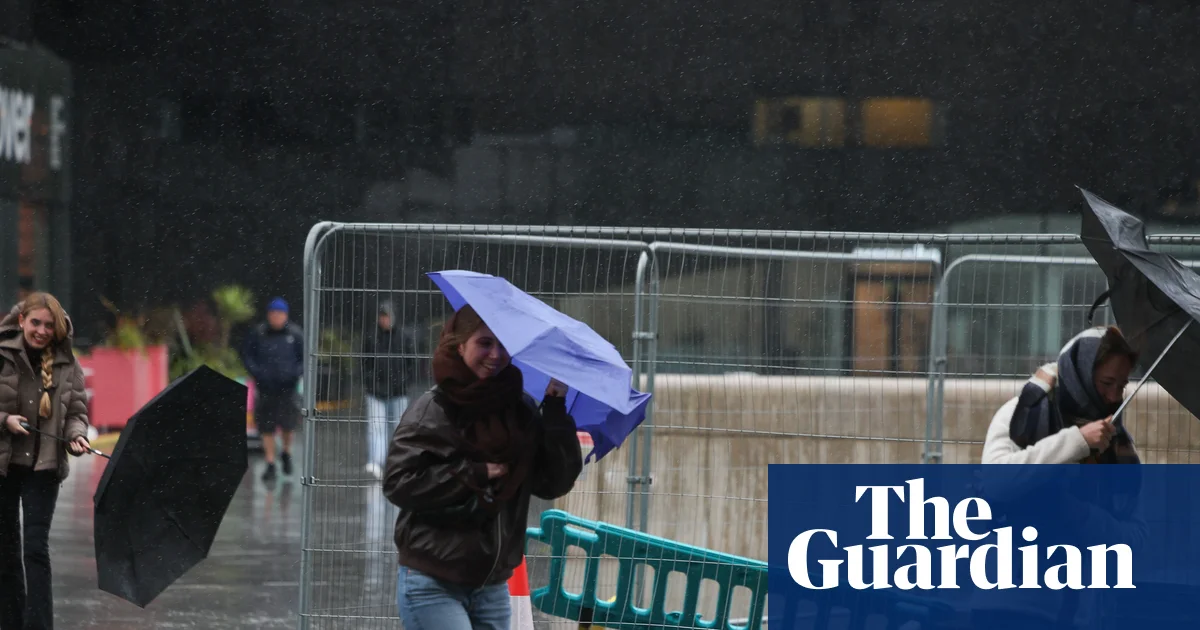
Amber weather warnings have come into force as the worst of Storm Boelo could be set to hit parts of the UK.
Storm Boelo’s winds will peak from Saturday evening, leaving areas in the warning zone, including Scotland, parts of Northern Ireland and the far north of England, braced for gusts of 60-70mph and even 80mph in exposed coastal spots, the Met Office said.
The forecaster’s amber warnings came into force on Saturday at 9pm.
Maximum gust speeds of 75mph have already hit South Uist Range, Western Isles, Highland and Eilean Siar, Scotland, on Saturday, according to the Met Office, which has also issued several yellow warnings for rain.
Storm Boelo follows Storm Austen, the first named storm of the season, which brought strong winds to parts of the UK on Friday.
Gusts of 76mph were recorded at St Mary’s airport in the Isles of Scilly, with 74mph at Aberporth in south-west Wales and 71mph at Culdrose in Cornwall.
Heavy downpours since 8am on Saturday have already seen rainfall totals of 72mm in White Barrow, Wiltshire, along with 43mm in both Cwm Dyli, just south of the Snowdon range in North Wales, and Inveruglas on the west shore of Loch Lomond, Scotland.
Hundreds of homes were still without power in south-west England after Storm Austen hit the region on Friday where the National Grid said power had been restored to 131,225 properties by Saturday at 7pm.
An amber wind warning, the Met Office’s second most severe, is active across Scotland, the north of England down to Carlisle from 9pm on Saturday to the same time on Sunday.
A further amber warning runs from 9pm on Saturday to 10am on Sunday in the north-east of Northern Ireland.
Storm Boelo, the second named storm of the season, will bring a danger to life from flying debris and crashing waves and people should stay indoors as much as possible, the forecaster said.
The amber warning sits within wider yellow wind warnings which extend south into parts of England and North Wales and cover the whole of Northern Ireland.
The Environment Agency had issued 58 alerts for spots across England where flooding is possible by 8pm on Saturday, as well as 12 warnings stating that flooding is expected.
Met Office chief forecaster Jason Kelly said: “Storm Boelo will be felt across the UK this weekend, with the strongest winds and greatest potential for disruption in the north.
“Amber warnings are in place across mainland Scotland, parts of Northern Ireland and the far north of England, where gusts of 60-70mph are expected widely, with the potential for 80mph in exposed coastal locations.
“Strong winds will also affect other parts of the UK, with gusts of 50-60mph possible in places. Heavy rain will provide an additional hazard, particularly in the north, bringing the potential for further impacts.
“People should prepare for the potential for disruption, particularly to travel and power supplies.”
People should secure loose items outside, plan ahead if they are travelling and keep an eye on the latest forecast and warnings, he advised.
Storm Boelo has already caused widespread disruption.
Boelo’s strong winds disrupted flights at Dublin airport, where as of 4pm on Saturday, nine outbound and 10 inbound flights had been cancelled by airlines because of weather issues.
It also reported that six inbound flights performed go-arounds – five of which landed on the second attempt, with the other diverting to another airport before returning a short time later.
Network Rail shared images of a trampoline beneath a train and a shed by the tracks, in a call for those living near rail lines to secure their garden furniture firmly.
Visit Liverpool announced that the region’s River of Light event, featuring illuminated artwork, had been cancelled “in the interests of safety”.
London’s annual Diwali on the Square celebrations this Sunday were also cancelled on independent health and safety experts’ recommendations in light of the storm.
Other attractions closed on Sunday include Edinburgh Castle and the Fountains Abbey estate in North Yorkshire, which was due to host its Fountains by Floodlight event.
About the Author