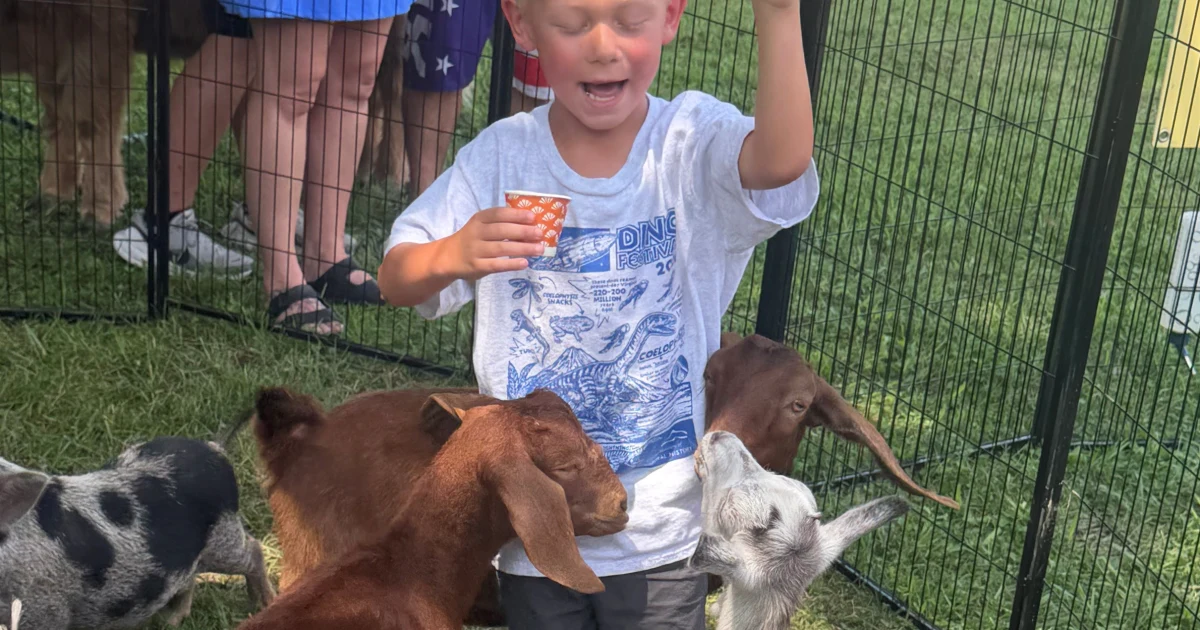
Last Friday, Rebecca Lanning got a shocking phone call: Her 4-year-old son had been exposed to rabies at a recent family outing.
Thirteen days earlier, on Aug. 15, the family had visited a dinosaur exhibit in Mocksville, North Carolina. There were food trucks, carnival games and a petting zoo, where her son fed baby goats by hand.
“I didn’t think anything of it until Friday, when his aunt called me and was like, ‘Hey, we have a situation,’” said Lanning, 30, of Marion. Lanning asked that her son not be named.
Three baby goats at the petting zoo had tested positive for rabies, the North Carolina Department of Health and Human Services announced Friday. The goats, along with a fourth suspected of having the disease, had been euthanized.
Lanning immediately rushed her son to the doctor, where he was given the first two of six shots of the rabies vaccine. The vaccinations are known as post-exposure prophylaxis, meaning they’re given to people after they may have been exposed to rabies to stop the virus in its tracks. Once symptoms of an infection begin, the disease — which attacks the brain and the spinal cord — is almost always fatal.
The vaccine is nearly 100% effective in preventing the disease, but only if it is given before symptoms begin.
People can be infected when they touch the saliva of or are scratched or bitten by a rabid animal.
“My fear is that if he was feeding the goats, and he’s 4, who’s to say that he didn’t touch his mouth or eyes?” Lanning said. “I don’t want to bury my child.”
It takes weeks to months after a person is exposed to rabies to develop symptoms, which can initially feel a lot like the flu: weakness, fatigue, fever and headaches. People may also develop a “prickling or itching sensation” where they were touched or bitten, according to the North Carolina health department.
The health department said Monday that it didn’t have an estimate of the number of people exposed to the infected goats.
They were at a North Carolina-based mobile petting zoo called Farm Adventures and had been featured at events across the state from July 28 through Aug. 23, the state said.
In addition to the dinosaur exhibit in Mocksville, the animals were at private events like birthday parties and a “back-to-school bash,” and they had visited an assisted living center.
A representative for Farm Adventures did not respond to a request for comment. A post on the company’s Facebook page said its goats, which were too young to be vaccinated against rabies, appeared to have been infected by a skunk that got into their pen.
Skunks, along with bats, raccoons and foxes, are typical carriers of rabies.
The state health department said in a statement that it’s “working with local health departments and healthcare systems to make sure rabies post-exposure prophylaxis is available to anyone who needs it.”
Rabies outbreaks appear to be rising across the U.S. According to the Centers for Disease Control and Prevention, 1.4 million Americans are monitored every year for possible exposure to the virus. About 100,000 people get post-exposure prophylaxis shots.
About the Author