Welcome to the Conversation
Luke Harding, author and award-winning foreign correspondent is replying to your questions now. He has covered wars in Afghanistan, Iraq, Libya, Syria and most recently Ukraine.
Key events
Is Putin secure?
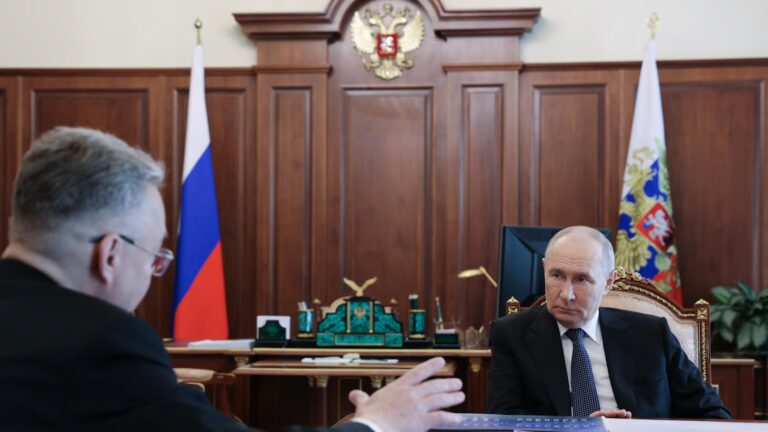
Churchcar72 asks: How safe is Putin’s position? Like Trump if he goes the house of cards falls – yet he seems unassailable – only age and death can bring him down. Is he really that secure?
Luke:
He’s safe. There was much speculation around the time of the full-scale invasion that Putin was sick and possibly dying. This turned out to be wishful thinking. Similarly, there is little prospect of a palace coup or popular revolution in Russia. The reality is Putin will stay in power for life. Most people support him, state propaganda is as potent as ever, and the security services keep a close eye on dissent. Many of those who oppose him left the country in 2022. The majority are passive and fatalistic. The fate of Alexey Navalny – murdered in a Siberian gulag in 2024, likely on Putin’s orders – sent its own grim message.
How can we support women in Afghanistan?
LucyWBMcA asks: What are the options for countries who want to support the women of Afghanistan in their struggle against oppression and restrictions on rights and freedoms?
Luke:
I visited Afghanistan in 2000, when the Taliban were first in power. One image haunts me: when I ate at a restaurant in Kabul I noticed the diners were all men. Outside by the entrance, women in blue burqas begged for scraps. I subsequently covered the US-led invasion of Afghanistan in 2001, when I was based in Delhi for the Guardian, and visited schools for girls.
Five years on from the Taliban’s return, there is no easy answer. Governments need to raise the restrictions on women’s rights and freedoms. And the home office should lift its unjust visa ban on Afghan nationals who want to study in the UK.
What do we know about interference in the Brexit referendum?
IscoBusquet asks: The report into Russian political interference in the UK stated that the security services were not given permission to look into any interference in the Brexit referendum because of political sensitivity. Is it possible for them to revisit this?
Luke:
We never got to see the confidential annex attached to the Russia Report. (If someone has a copy, please send to me ℅ Guardian!) But yes, it revealed that none of the state agencies investigated Russian interference in the run-up to the 2016 referendum. Neither Labour nor the Conservatives are especially keen to examine what happened.
We know the following: that the Kremlin backed Brexit, seeing it as a way of weakening the UK, politically and economically, and estranging it from its European partners. Russian trolls posted thousands of pro-Brexit messages, as well as inflammatory stories about immigrants. I suspect there was espionage too. We need to find out what happened in order to safeguard elections in future.
What impact will North Korea’s support have on the Ukraine war?
Stakeman asks: Do you think the huge influx of North Korean soldiers (circa 50k?) will make a big difference on the frontline boundary battles given that we hear Ukraine drones are picking them off?
Luke:
Yes. Volodymyr Zelenskyy says North Korea is sending another 50,000 troops, in addition to the 12,000 who took part in the 2024-2025 battle for Russia’s western Kursk region. Their arrival will enable the Kremlin to send additional forces to the eastern Donbas, Putin’s main target, where intense battles continue.
Over the past year and a half North Korean soldiers have experienced modern warfare. They have learned about surveillance and kamikaze drones, which saturate the frontline. This hard-won knowledge could be employed in a future peninsula conflict with South Korea.
Will you ever go back to Russia?
BenHSm asks: Do you think you will ever have the possibility to go to Russia again? And if you could, would you?
Luke:
I was stopped at Moscow airport in 2011 and deported from the country. In 2022 Russia’s foreign ministry put me on a list of banned individuals (which also includes several of my colleagues from the Guardian.) There’s no prospect of my returning to Russia while Vladimir Putin’s regime remains in power, and his war in Ukraine continues. Nor would I want to.
But Putin isn’t eternal and at some point Russia may reckon with his decades of delusion and misrule. One fantasy: I return to Moscow as an old man and knock on the door of the Lubyanka, the FSB and KGB’s HQ. I would like to see the FSB’s secret dossier on me and to write a book in the style of Timothy Garton Ash’s marvellous memoir The File.
Has Russia’s relationship with the UK changed?
Philippeblades asks: A couple of days ago the Russian ambassador to the UK was withdrawn after seven years. How much should we read into this?
Luke:
Russia abandoned traditional diplomacy a long time ago. Its emissaries abroad operate as suit-wearing trolls. Their job is to repeat Kremlin lies – for example, that neo-Nazis run Ukraine – to an international audience. Relations between London and Moscow have been awful for well over a decade. Russian state TV calls the UK “Foggy Albion” and periodically threatens nuclear annihilation. I don’t think we should read too much into the ambassador’s departure. But Russia’s dislike of Britain is very real.
Who is your biggest journalistic influence?
leeabroad asks: The days of reporters like Robert Fisk and Marie Colvin going to places and breaking stories that make news around the globe are long gone. Patrick Cockburn is nigh on 80. Who was or is your biggest journalistic influence? Who are the journalists today whose courage and reportage you most respect?
Luke:
What a wonderful question. I admire my Ukrainian colleagues who continue to document the invasion of their country, often at terrible personal cost. Several have been killed and injured. There are many brave international reporters in Kyiv too, who have become dear friends. In terms of influence, I would name two great correspondents, James Cameron and Ryszard Kapuscinski. Both were superlative writers and observers. Cameron’s books – among them An Indian Summer and Point of Departure – are literary gems. And Kapuscinski’s Imperium – about the fall of the Soviet Union – is a masterpiece.
Should the UK have taken the murder of Alexander Litvinenko more seriously?
sberney asks: Do you think the UK government should have taken the murder of Alexander Litvinenko more seriously and not have invited Putin to the 2012 Olympics in London?
Luke:
Yes. I covered Litvinenko’s case from Moscow and London and am good friends with his widow Marina. I also wrote a book, A Very Expensive Poison, which was adapted by Lucy Prebble into a successful stage play. Over the past two decades Russia has carried out various dark deeds. They include sending assassins to kill Litvinenko and Sergei Skripal, shooting down MH17 and in 2014 annexing Crimea. Typically the west’s response has been unimaginative and lacklustre. After Litvinenko’s poisoning Gordon Brown’s government expelled a few diplomats and David Cameron – as you mention – invited Putin to watch judo at the London Olympics. All of this emboldened Russia’s leader. He thought Europe was weak. This led directly to his decision to launch a full-scale invasion of Ukraine.
Welcome to the Conversation
Luke Harding, author and award-winning foreign correspondent is replying to your questions now. He has covered wars in Afghanistan, Iraq, Libya, Syria and most recently Ukraine.
About the Author