This article was produced by National Geographic Traveller (UK).
Home to the Aboriginal Palawa people for 40,000 years, Tasmania was settled by Europeans from 1803. They found a maritime climate, volcanic soils and some of the cleanest air in the world. These bountiful conditions have since helped the apple-shaped island build its reputation for producing superlative wine, whisky and cheese.
On a road trip across Australia’s smallest state, preserved colonial-era towns and farms seem to appear around every corner, while mountains and valleys knitted together by walking trails provide chances to stretch your legs. Meanwhile, after centuries of oppression, the Palawa people invite visitors to connect with their ancestral homelands through the sights, sounds and flavours of the bush.
Advertisement
Advertisement
You could easily drive coast to coast in six hours, but why rush? Tasmanians know that having patience and adopting a slower pace are key to enjoying the finer things in life. Plan up to a week for a road trip from the coast to the high country, starting in the historic southeastern port city of Hobart, Tasmania’s state capital, and finishing in the northerly hub of Launceston. Along the way, make time to savour a drop of local whisky, perhaps sample oysters from a coastal farm fringed by white sand, head into the backcountry for a day’s wilderness walk, or spend time foraging with Aboriginal guides. It’s the simple, wholesome pleasures that make the biggest impression in this island state.
Day 1: Experience a nighttime safari in Hobart
Starting point: Hobart
The harbourside capital of Tasmania, Hobart has built a reputation for fine dining and edgy art thanks to institutions such as MONA (the Museum of Old and New Art) and its neon-lit winter solstice festival, Dark Mofo. But a UV torch reveals mother nature has her own art gallery here, too. Start your journey through Tasmania with an urban nocturnal tour unlike anything else in Australia.
Join Dr Lisa Gershwin, biologist and owner of Glow Show Tours, as she heads out into the city’s parks in search of possums, owls, pademelons (cousins of wallabies) and other critters that glow in the dark thanks to fluorescent pigment in their fur and feathers. Under the right torchlight, you’ll find an otherworldly ecosystem invisible to humans.
Advertisement
Advertisement
(Tasmania’s wildlife turns bioluminescent after dark—and you can see it on this night safari.)
Day 2: Taste the sea with Freycinet’s salt sommelier
Hobart to Swansea
Distance: 83 miles
After a night exploring Tasmania’s state capital, recharge with a coffee from Hobart’s Farm Gate Market then point your tyres east towards the coast and Freycinet National Park. This idyllic peninsula, cutting south into the Tasman Sea, is popular with hikers thanks to its sprawling ocean views and white-sand beaches. Break up the drive with a stop at Tasman Sea Salt, an artisanal salt farm offering factory tours that culminate in a guided tasting led by a salt sommelier.
While pairing the salts with foods such as raw cherry tomatoes and tuna gravlax, your guide will teach you about Tasmanian salt’s unique mineral signature and how to use it to enhance your own cooking. Before leaving the area, make sure there’s time for the steep, mile-long hike from the car park in Freycinet National Park to Wineglass Bay Lookout for spectacular views.
Tasmania is known for its world-class seafood, which is served up creatively at Faro restaurant inside MONA. Alana Dimou
Trent Wrigley is the production manager at Tasman Sea Salt in Mayfield Bay. Alana Dimou
Day 3: Enter Tasmania’s rural whisky lands
Swansea to Oatlands
Distance: 71 miles
Advertisement
Advertisement
Swap the coast for Tasmania’s rural midlands. A winding 90-minute drive past grassy woodlands — occasionally interrupted by sheep farms — will eventually bring you to Callington Mill Distillery in Oatlands. Distilling spirits was illegal in Tasmania for over 150 years but that didn’t stop mill owner John Vincent, who built Oatlands’ historic mill in 1837 as a cover for his clandestine whisky operation.
Despite its long and colourful history, the site lay dormant for decades until the mill and homestead were sold to Callington Mill Distillery and reopened in 2010 after a significant restoration. The heritage buildings have now been upgraded with video displays that bring the site’s history to life.
Today, the historic mill stands opposite a sleek, state-of-the-art distillery where you can settle in for a whisky tasting at the bar or join a distiller to craft your own single malt.
Dove Lake is encircled by multiple walking paths such as Face Track. Alana Dimou
Day 4: Explore the face of Cradle Mountain
Oatlands to Cradle Mountain-Lake St Clair National Park
Distance: 160 miles
Advertisement
Advertisement
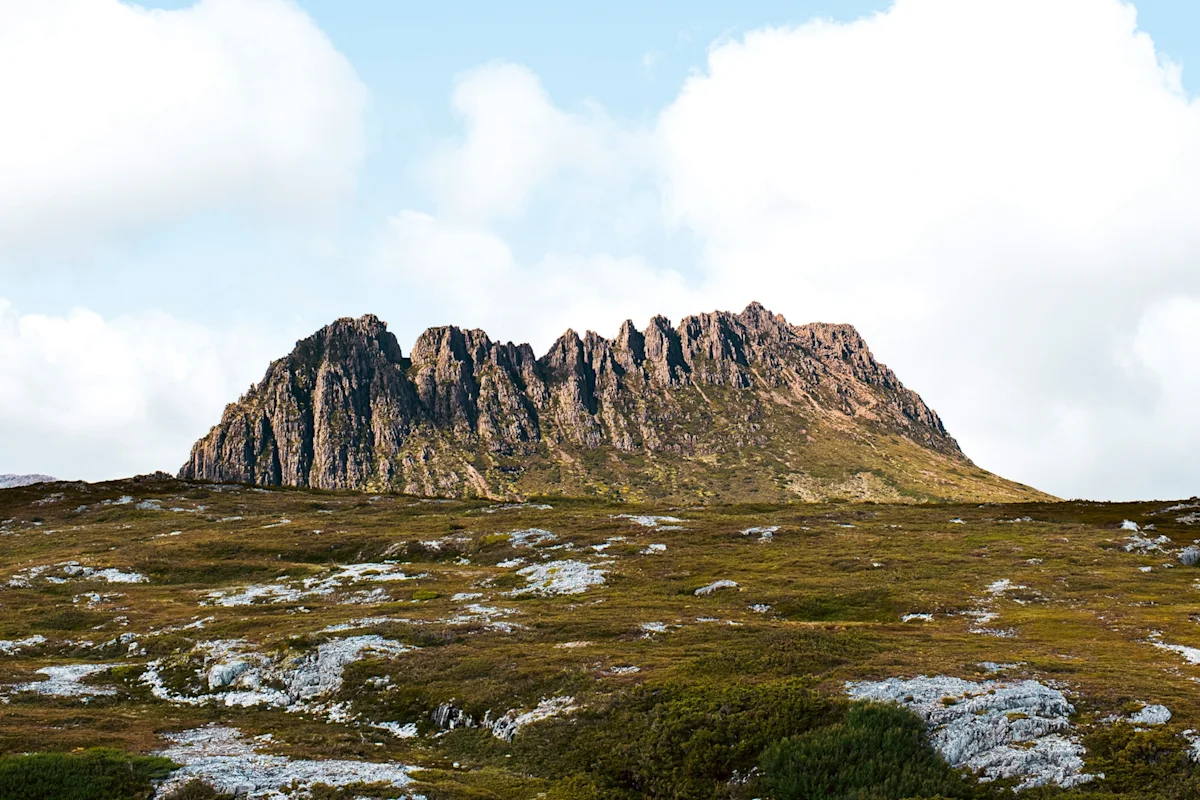
Departing Oatlands, the road climbs then corkscrews upwards towards Cradle Mountain-Lake St Clair National Park, a 623sq-mile reserve two hours from Launceston. The national park is famously known as the starting point for the Overland Track, one of Australia’s premier multi-day hikes, but it’s also laced with various other day hikes, including the lesser-known — and challenging — Face Track. It’s so named because it cuts straight across the face of craggy Cradle Mountain — Tasmania’s most famed peak.
The eight-mile trail leads hikers beneath vertigo-inducing spires and requires you to scramble up and down sheer rock walls. Your efforts are well rewarded with sweeping views of the mountain’s hidden lakes and waterfalls, all but invisible from the viewing shelter most visitors head to at Dove Lake far below. After eight hours of hiking, the trail eventually descends to Dove Lake, where a shuttle bus waits to take you back to your car.
The two-seater chairlift across Cataract Gorge has the longest single span of any in the world, at 308 metres. Alana Dimou
Kooparoona Niara Tours focuses on native plants such as the kangaroo apple, which is traditionally used by Indigenous women as an oral contraceptive. Alana Dimou
Day 5: Enter Cataract Gorge with an Aboriginal guide
Cradle Mountain-Lake St Clair National Park to Launceston
Distance: 88 miles
Allow time for pit stops at small-town bakeries, including Frank and Lotti in Deloraine, during your two-hour drive to Launceston. Your road trip ends on the city’s western edge at Cataract Gorge Reserve, a serene three-square-mile slice of urban wilderness. It’s where the South Esk River flows out from a narrow gorge and pools just long enough to form a lake, then tumbles out to join the Tamar River.
Advertisement
Advertisement
Indigenous-owned Kooparoona Niara runs cultural tours here, exploring how for thousands of years before European settlement, the gorge was a bountiful stopping point for the Aboriginal people of the Stoney Creek Nation during their seasonal transits from the central highlands to the coast. During a wooded walk, your guide will share how Aboriginal people used the gorge like an outdoor supermarket, finding medicine, tools and food among the foliage.
Published in the June 2026 issue by National Geographic Traveller (UK).
To subscribe to National Geographic Traveller (UK) magazine click here (available in select countries only).
About the Author