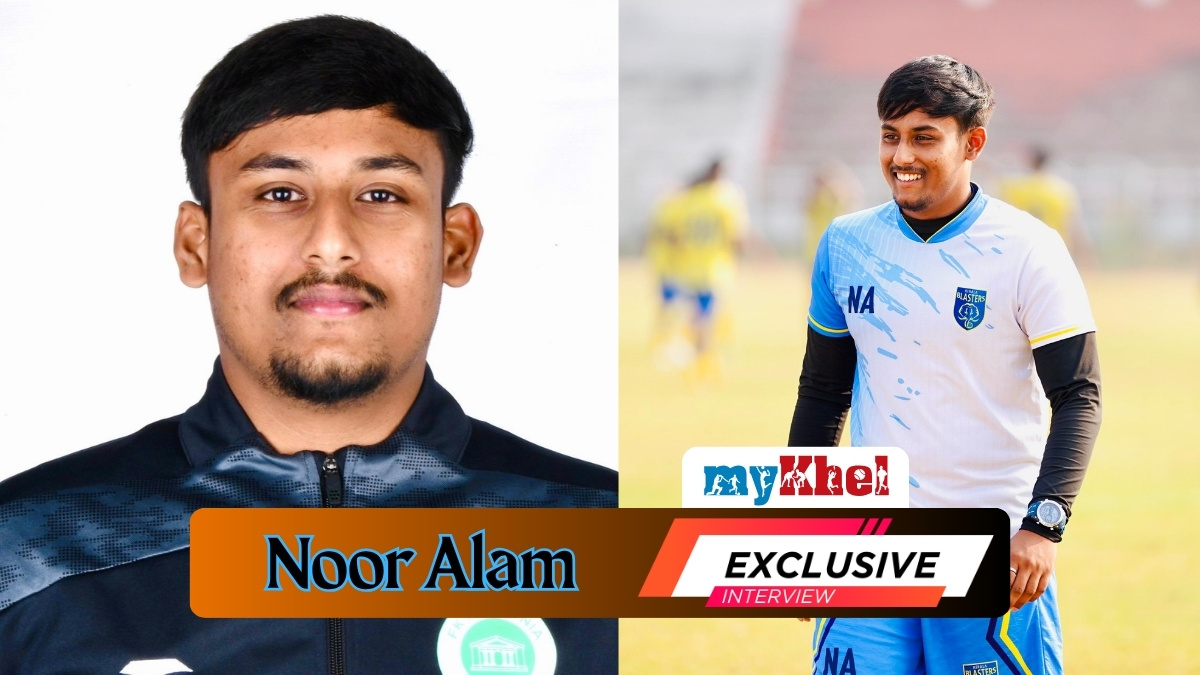
For Noor Alam, the journey from Berhampore in West Bengal to the European football circuit has taken another significant turn.
After establishing himself in Albania as the Sporting and Technical Director of FK Apolonia, the 2026-27 season has now given the Murshidabad-born football professional another opportunity: a chance to lead a senior team from the touchline as a head coach.
His first assignment could hardly have been more challenging or more rewarding, with Alam making his European head-coaching debut in the Apolonia-Tomori derby.
The 13 September fixture marked the beginning of a new chapter in Alam’s increasingly unconventional football career. Apolonia defeated Tomori 2-1 at the Stadiumi “Loni Papuçiu” in Fieri in the opening round of the Kategoria e Dytë Group B campaign, giving Alam a winning start in senior management.
In an exclusive interview with MyKhel, Alam spoke about a plethora of things.
From Bengal to Albania: An Offer That Came Out of Nowhere
Alam’s move to Albania came after his stint with Kerala Blasters youth team, when he was exploring possibilities for the next stage of his career. He had opportunities involving Kryvbas FC in Ukraine and a club in South Africa, but neither of those possibilities eventually became his next destination. Instead, an unexpected message on WhatsApp introduced him to FK Apolonia and ultimately changed the direction of his career.
“The offer from FK Apollonia came from nowhere. I just received a message on WhatsApp with this offer and I was like, ‘Whoa, is this a real message or a fake message?'”
The initial surprise soon turned into serious consideration after Alam researched the club and understood the nature of the position being offered. The Albanian club was prepared to give a relatively young Indian football professional significant responsibility across its sporting and technical operations. For Alam, that level of trust was a major reason behind accepting an opportunity that could provide him with experience unavailable through many conventional career routes.
“For a young guy like me to be the sporting and technical director of the club is something exceptional.”
A European Opportunity Nearly Lost Because of a Visa Rejection
Getting the job did not immediately mean that Alam could begin working in Albania. His initial work-visa application was rejected, creating a significant obstacle at precisely the moment when he was preparing to move into a new professional environment. The setback also gave him an unexpected personal connection to one of the most frequently discussed work-permit issues involving an Indian footballer, Sunil Chhetri’s proposed move to Queens Park Rangers.
“You may have heard that Sunil Chhetri signed a three-year contract with Queens Park Rangers in the Premier League, but it was not possible for him to go and play there because he was denied a work permit. The same was the case for me,” Alam explained.

The situation eventually changed because Apolonia and its legal team continued to pursue the matter instead of allowing the initial rejection to end the process. The club reapplied and appealed the decision, eventually securing the approval required for Alam to travel and begin his responsibilities.
“But I am glad that the club and the club lawyer reapplied, appealed against the refusal, and finally, I got the visa to arrive here and start my work.”
The Sporting Director Who Also Works on the Training Ground
At FK Apolonia, Alam’s responsibilities go considerably beyond a conventional administrative role. His working day is divided between sporting management and technical observation, allowing him to remain involved in both the recruitment process and the development of players on the training pitch. That dual responsibility has given him an unusually broad understanding of the club’s footballing requirements and long-term objectives.
“I divide my day in two halves. In the morning, I generally work with the Sporting Director hat on. I search for players, handle recruitment for different positions, watch player videos, and talk with agents,”
Alam’s mornings are therefore largely focused on recruitment, scouting and planning, with conversations involving agents and the assessment of potential players forming part of his regular routine. The objective is not limited to solving immediate squad problems, because his role also requires him to consider how the club can build sustainably over a longer period. His work covers different levels of the football structure rather than being restricted to the senior men’s squad.
His afternoons and evenings bring a shift in focus from recruitment to coaching and performance. Instead of remaining behind a desk, Alam goes to the training ground to observe sessions, assess the quality of the work being conducted and identify areas where the players and coaching process can improve. His responsibilities extend across the men’s, women’s and academy structures, giving him an opportunity to see the club’s development pathway as one connected system.
“I put the different hat on, go onto the field, and watch trainings. I see how the trainings are happening, what can be improved in terms of player performance,”
Noor Alam’s Head-Coach Debut: A Derby Win in Europe
The next significant step in Alam’s journey came on September 13, 2026, when he took charge of FK Apolonia as a head coach for the first time in senior football. The occasion was the opening round of the Kategoria e Dytë Group B campaign, but the fixture carried additional significance because it was the Apolonia-Tomori derby. Alam therefore walked into his first senior match as a head coach with the pressure of a local derby already attached to the occasion.
Apolonia responded with a strong start and opened the scoring in the 23rd minute through Derrick Owusu. The home side maintained its advantage through half-time before Muhamed Mehmeti extended the lead in the 61st minute. Tomori reduced the deficit through Krios Daullxhiu in the 82nd minute, creating a tense final phase, but Alam’s team managed to withstand the pressure and hold on for a 2-1 victory.

The result gave Alam a perfect beginning to his senior head-coaching career in Europe, but the circumstances made the achievement even more significant. He was not merely taking charge of an ordinary league fixture; he was leading Apolonia in a derby and doing so for the first time in a senior head-coaching capacity.
“It was my first match as head coach, my debut as head coach. I was under a bit pressure, as it was a derby as well. But we have won, very happy with the start,” he said MyKhel after the derby win.
The challenge now is to ensure that the derby victory becomes the beginning of a sustained coaching journey rather than simply a memorable debut.
European Experience Beyond the Men’s Team
Alam’s responsibilities at Apolonia have also included the women’s side, giving him exposure to European women’s club competition. Under his leadership, FK Apolonia’s women’s team participated in the UEFA Women’s Champions League second qualifying round, providing another important international experience for the Indian football professional.
The Albanian side ultimately exited the competition, but the campaign gave Alam exposure to a level of continental football rarely experienced by Indian coaches at such an early stage of their careers.
The 17-Year-Old Who Chose Europe for Coaching Education
Alam’s determination to build a career in coaching began well before his move to Albania. When he discovered that the AIFF coaching pathway required candidates to be at least 18 years old for the D License, he started looking beyond India for an alternative route. UEFA’s coaching education structure offered him an opportunity to begin earlier, and Alam decided not to wait until he reached the required age in India before starting his education.
“Two months before I turned 18, having a full blueprint ready, I sat my parents down and said, ‘Look, this is what I want to do,'” he says.
The teenager did not approach the idea casually. Alam prepared a detailed plan for travelling to the UK, including the costs and logistics involved, before asking his parents for their support.
“It wasn’t a big budget either. I only spent maybe 60,000 rupees; the flight ticket from Calcutta to London was only about 37,000 rupees back then.”
With his parents’ backing, Alam travelled to the UK and began his coaching education in Wales before completing his licences with the Scottish FA. He has since progressed to the UEFA A Licence, an important qualification that underlines the seriousness with which he has approached his coaching career.
Competitive Football: Where Alam Sees India’s Biggest Gap
While Alam is now working in Europe, his observations of Indian football remain sharp, particularly when it comes to youth development. One of his strongest criticisms concerns the number of competitive matches available to young Indian footballers.
In his view, the difference between promising players in India and their counterparts in European systems is not necessarily a lack of ability, but the amount of meaningful competitive football they experience during their formative years.
Alam has highlighted the contrast between the opportunities available to teenagers in Albania and those in India. He pointed out that a 15-year-old footballer in Albania can get around 40 competitive matches in a season, while an Indian teenager may struggle to reach 15 or 20.
“That competitive exposure is where the difference is created. Indian players need to play more matches, which is not happening. A top-flight player plays a maximum of 35 matches a season, which is not enough.”
Alam believes that regular exposure to such environments is one of the fundamental reasons European players can develop at a faster rate, and that India needs to address this structural gap if it wants to produce more players capable of succeeding internationally.
Are Inflated ISL Salaries Holding Players Back?
Noor also offers a direct assessment of one of the more sensitive issues in Indian football: player salaries. The growth of the ISL has allowed Indian footballers to earn significantly better incomes than in previous generations, representing an important development for the profession. However, Alam believes that salaries inflated by domestic competition between clubs can sometimes reduce players’ willingness to move abroad and test themselves in tougher environments.
“A player getting that kind of money in the ISL will never come to play in the Albanian Superliga, or even second or third divisions in Europe, because their quality wouldn’t make the team. No disrespect, but that’s the reality,” he says.
His argument is not simply that Indian players are overpaid. Rather, the Apolonia coach believes there can be a disconnect between domestic salaries and the level of competition a player would be capable of handling in stronger European leagues. A footballer who can command substantial money at home may have little financial incentive to accept the uncertainty, lower wages and increased competitive pressure associated with moving to a European second or third division.
The significance of Alam’s journey extends beyond one individual. At a time when Indian football is debating the structure of its competitions, the number of matches young players receive and the direction of its development pathways, his experience offers a window into another football environment.
His work in Albania allows him to learn from European systems while simultaneously challenging assumptions about what Indian coaches and football professionals can achieve abroad.
His 2-1 derby victory over Tomori may only be the first result of a much longer coaching career, but it provides an important starting point. For a football professional from Murshidabad, the road from Bengal to the European touchline has already produced an unusual collection of experiences, and Noor has set his sights on the future already.
“My next vision is to continue growing and in the next 5 to 10 years, to work in a top club in Europe or Middle East or anywhere in the World. I also aim to work in National Team setup in future. I want to contribute not only on the administrative and sporting side, but also on the pitch, developing players, improving teams and building a great football structure.
Personally, I want to keep challenging myself at the highest level, continue learning, and eventually take on bigger responsibilities in bigger clubs. I want to create an impact for the club, the players and the people around me.”
About the Author