A Maryland state court has struck down a proposed constitutional amendment designed to give Democrats the scope to redraw the state’s congressional map ahead of the 2028 elections.
The decision, delivered Wednesday by a judge in the state capital, deals a fresh blow to national Democratic efforts to offset a Republican redistricting drive backed by President Donald Trump ahead of this year’s elections.
Although the judge determined that the measure cannot be included on the November ballot, he temporarily stayed the ruling to permit an appeal to the state Supreme Court.
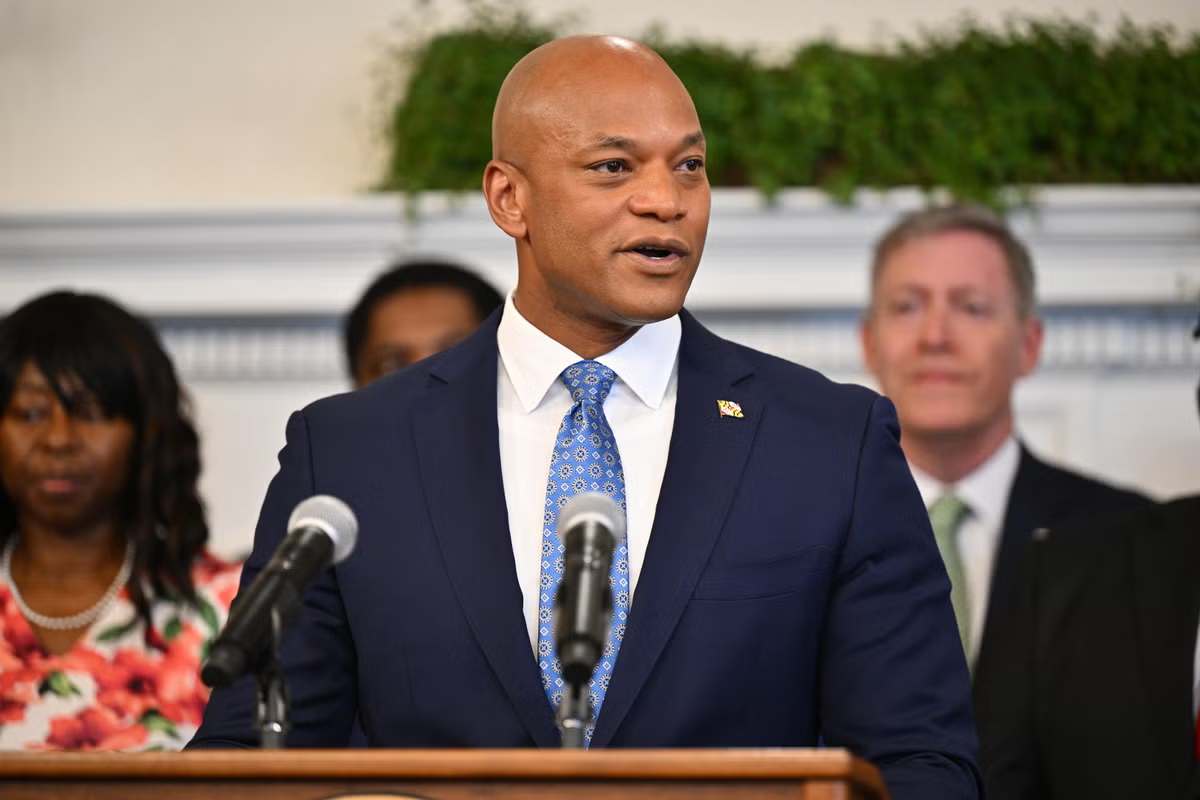
Democrats currently hold seven of Maryland’s eight seats in Congress. In August, Democratic Gov. Wes Moore summoned legislators to a special session to help capture the remaining seat.
The legislative proposal put to the ballot was intended to bypass a 2022 judicial ruling that struck down a previous Democratic redistricting map.
It seeks to establish that constitutional mandates requiring districts to be compact and respect “natural boundaries” apply only to state legislative boundaries, not federal congressional seats.
Such a change would enable Democratic state lawmakers to construct congressional districts spanning the Chesapeake Bay, altering a district to its east currently represented by Republican Rep. Andy Harris, who chairs the conservative House Freedom Caucus.
Anne Arundel County Circuit Court Judge Robert Thompson determined that legislators breached statutory deadlines they had themselves introduced.
Legislation enacted earlier this year and signed by Moore required the secretary of state to submit certified summaries of all statewide ballot measures to the Maryland State Board of Elections by July 1.
Lawyers from the state attorney general’s office contended that the deadline was not applicable to the redistricting measure because lawmakers had drafted their own summary using constitutional powers.
The judge rejected this argument, ruling in favor of the conservative Oversight Project and Republican state legislators who filed the lawsuit.
Thompson further found that lawmakers employed “intentionally misleading” language in the question by suggesting it simply “clarifies” constitutional redistricting rules. He added that the measure violated a constitutional requirement for single-issue ballot items by incorporating a clause granting the state Supreme Court original jurisdiction over congressional redistricting litigation.
.jpg)
“The court has no choice but to enjoin the board of elections from including ballot Question 3 on the general election ballot for November 3, 2026,” Thompson wrote.
The state lodged a notice of appeal with the Maryland Supreme Court shortly after the verdict was delivered.
Democratic Maryland House Speaker Joseline Peña-Melnyk voiced optimism about the eventual outcome.
“We remain confident in the authority of the General Assembly and believe Maryland voters should have the final say,” she said in a statement.
Opponents of the redistricting push acknowledged that the legal dispute remains ongoing.
However, Oversight Project Strategic Counsel Marshall Yates noted in a statement: “today’s decision is a major step in our battle against Maryland’s lawless attempt at redistricting. Complete and total vindication!”
Maryland is the latest state caught up in the wider national clash over congressional lines. Earlier this year, the Virginia Supreme Court struck down a redistricting ballot measure following procedural errors by state legislators. In that instance, voters had already endorsed an amendment in April permitting mid-decade boundary changes when the court decided that lawmakers had taken too long last year to initiate the required preliminary steps for ballot qualification.
Both Maryland and Virginia aimed to emulate California, where electors backed a Democratic-sponsored measure authorizing mid-decade redistricting. Democrats anticipate picking up as many as five congressional seats from California’s remapped districts, along with another seat in Utah.
Conversely, Republicans aim to secure up to 16 additional seats through newly enacted U.S. House maps across Alabama, Florida, Louisiana, Missouri, North Carolina, Ohio, Tennessee and Texas.
Redistricting generally takes place near the start of each decade following the publication of census figures. However, a mid-decade struggle emerged after Trump called on Republican-controlled states to alter congressional boundaries in an effort to help Republicans preserve a narrow House majority in this year’s midterm elections.
About the Author