
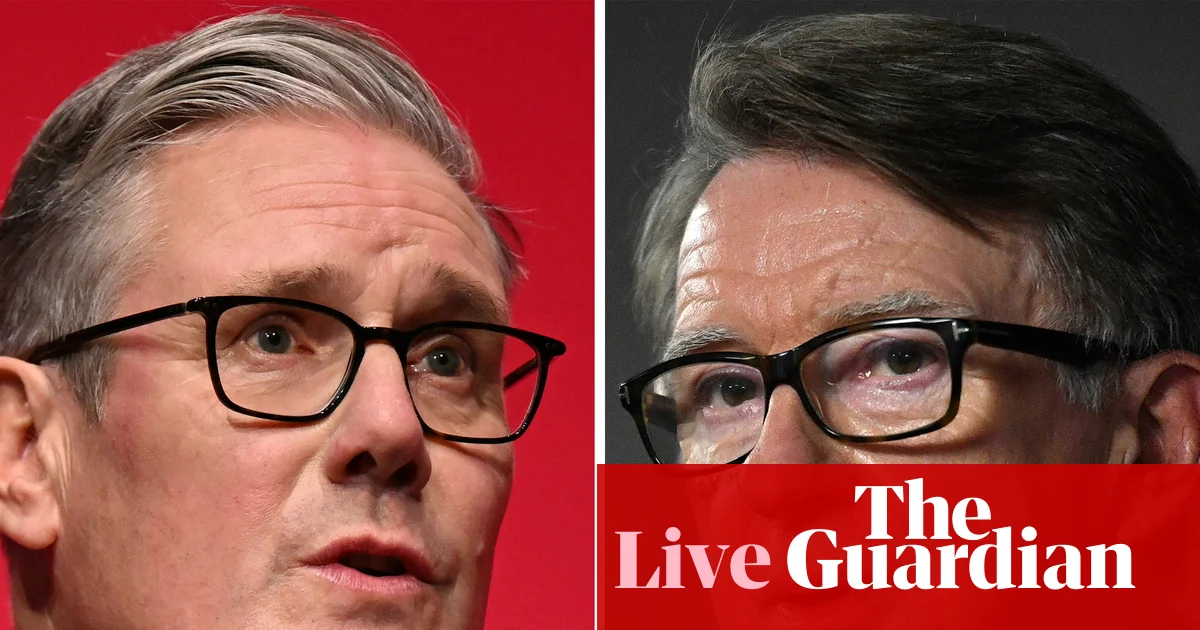
Starmer could have been told about Mandelson’s vetting failure, claims No 10 with release of briefing paper
Good morning. There are occasions when a prime minister wakes up knowing that how they perform in the Commons that day will decide whether or not they keep their job – but they are very, very rare. The best example in modern times is Margaret Thatcher on the day of the Westland debate, when she told staff she would still be in post that evening. Boris Johnson had multiple tricky encounters with MPs, but the most difficult – and the most important for his reputation- was the one before the privileges committee about claims that he lied about Partygate, and that came after he had resigned as PM. For James Callaghan, the confidence debate in 1979 was a terminal moment for his premiership, but that vote was not decided by what he said.
There seems to be little chance that Keir Starmer may be finished off by what happens in the Commons today. Since the revelations in the Guardian last week about Peter Mandelson in effect failing security vetting for his appointment as ambassador to the US, despite Starmer repeatedly everyone that he was cleared, Labour MPs have not been calling for his resignation. It seems unlikely that by 6pm tonight that will have changed. But many or most of them were already of the view that he is not the right person to lead them into the next general election, and the events of the past few days have firmed up that view.
Here is the story by the Guardian’s political editor, Pippa Crerar, setting up what is happening today.
In a separate analysis, Pippa writes: “[Labour MPs] know the public has been losing faith in the political system for years. Every twist and turn of the Mandelson scandal accelerates that. So when another opportunity presents itself to change leadership, they may take it.”
Last week Starmer sacked Olly Robbins, the Foreign Office permanent secretary, for not telling him that Mandelson did in effect fail the security vetting. (But technically he “passed”, because as head of the Foreign Office Robbins had the final say, and he was able to override the recommendation from security chief.) Robbins will give evidence to MPs tomorrow, but we know from what his friends have been saying is that he believes that he was not entitled to give the PM details of what is a very secretive process. The more important point in his defence, which allies have been more reluctant to make publicly, is that given that Starmer had already announced that Mandelson had the job, despite everyone in Westminster knowing Mandelson was a scandal magnet, it was Robbins’ job to implement the wishes of the PM, not block a decision, and an assessment of risk, that had already been taken.
Last night, ahead of the PM’s statement to MPs today, Downing Street took the unusual statement of publishing a briefing paper about the rules regarding the disclosure of vetting information. It says:
double quotation mark The Constitutional Reform and Governance Act 2010 (CRAG) does not prevent civil servants from informing ministers of UK Security Vetting recommendations. What CRAG says is that civil servants make decisions on vetting and clearance. But no law stops civil servants sensibly flagging UK security vetting recommendations, while rightly protecting detailed sensitive vetting information, to allow ministers to make judgments on appointments or on explaining matters to parliament.
We will be focusing mostly on the Mandelson scandal today, but there is still a war on that has not been fully resolved, and the most important set of elections ahead of the next general election are less than three weeks away. Here is the agenda for the day.
11am: Nigel Farage, the Reform UK leader, and Zia Yusuf, his home affairs spokesperson, hold a press conference about the party’s plan to deport thousands of peope already granted asylum in the UK.
11.30am: Downing Street holds a lobby briefing.
After 3.30pm: Keir Starmer makes his statement to MPs about claims that the misled the Commons, and the public, about the vetting process carried out when Peter Mandelson was appointed ambassador to the US.
If you want to contact me, please post a message below the line when comments are open (between 10am and 3pm), or message me on social media. I can’t read all the messages BTL, but if you put “Andrew” in a message aimed at me, I am more likely to see it because I search for posts containing that word.
If you want to flag something up urgently, it is best to use social media. You can reach me on Bluesky at @andrewsparrowgdn.bsky.social. The Guardian has given up posting from its official accounts on X, but individual Guardian journalists are there, I still have my account, and if you message me there at @AndrewSparrow, I will see it and respond if necessary.
I find it very helpful when readers point out mistakes, even minor typos. No error is too small to correct. And I find your questions very interesting too. I can’t promise to reply to them all, but I will try to reply to as many as I can, either BTL or sometimes in the blog.
Key events
Naming Mandelson as ambassador before vetting was mistake, Alexander says
It was a mistake to announce Peter Mandelson as the UK’s ambassador to the US before he was security vetted for the role, Douglas Alexander, the Scottish secretary, said in interviews this morning. Peter Walker has the story.
Former cabinet secretary Gus O’Donnell says Robbins was following rules about vetting disclosure
Downing Street is claiming that under the Constitutional Reform and Governance Act 2010 Olly Robbins, permanent secretary at the Foreign Office, could have told Keir Starmer that Peter Mandelson in effect failed his security vetting. (See 9.21am.) In its briefing document today, it says:
double quotation mark Prerogative powers emanate from the crown but are exercisable by ministers and, when (and only when) delegated or otherwise authorised by ministers or as decided by statute, are exercisable by civil servants. In the context of vetting and clearance, this means civil servants run the process and make the decisions on whether clearance should be granted. There are legal obligations in carrying out vetting processes to ensure the appropriate protection and management of sensitive personal information, in accordance with data protection law.However, no law prevents civil servants – while continuing to protect such sensitive personal information – from sensibly flagging UK Security Vetting recommendations or high level risks and mitigations. This allows Ministers to make informed decisions, including on appointments or when accounting for government business in parliament.
But, in an article published in the Times today, Gus O’Donnell, a former cabinet secretary, has defended Robbins’ decision not to share that information with Starmer on the grounds that he (Robbins) had used his power as the ultimate decision-maker to decide that vetting approval should be granted. O’Donnell says:
double quotation mark For a government often accused of being overly focused on law, legalism and process, they do not seem to have convinced the many sceptics that they have a clear understanding of their own vetting laws and processes. Their explanation of how the express exclusion of ministers, set out clearly in legislation, from the process of national security vetting for officials relates to how ministers are informed has been, to put it charitably, confusing so far.Moreover, the prime minister might feel that this exclusion of ministers didn’t serve him well in this case. But if so, he should change the system. Instead, he appears to have taken a very rapid decision to dismiss someone for applying what seems on the face of it to be an entirely standard, reasonable and perfectly obvious interpretation of the law and rules as they stand.
Douglas Alexander says he thinks Starmer should stay as PM until next election, but ‘there are no certainties’
Douglas Alexander, the Scottish secretary, was on the government voice on the airwaves this morning. Along with Pat McFadden and Darren Jones, he is one of the ultra ‘safe pair of hands’ ministers trusted to do a media round when the government is in a really tricky position.
His argument was that the appointment of Mandelson as ambassador to the US was a mistake, that Keir Starmer has already admitted this and apologised for it, but that he did not lie because he was not told about Mandelson in effect failing the security vetting. Starmer should have been told, Alexander said. He told Sky News:
double quotation mark I think most people watching this programme would think if there was material information, that the UK vetting agencies had come up with concerns and made a recommendation in relation to what’s a highly intrusive vetting process, that rightly and reasonably, that would be flagged to the ministers concerned.
Asked if he expected Starmer to lead Labour into the next election, Alexander said:
double quotation mark I expect so, yes … I think he will.There are no certainties but of course I think he will lead and I think he should because, frankly, on the biggest call in this parliament he’s exercised the right judgment, which is to keep us out of someone else’s war.
Alexander also had an unusual way of saying that Starmer does make mistakes.
double quotation mark As a Scottish Presbyterian I don’t believe in papal infallibility, nor do I believe in prime ministerial infallibility.
Starmer could have been told about Mandelson’s vetting failure, claims No 10 with release of briefing paper
Good morning. There are occasions when a prime minister wakes up knowing that how they perform in the Commons that day will decide whether or not they keep their job – but they are very, very rare. The best example in modern times is Margaret Thatcher on the day of the Westland debate, when she told staff she would still be in post that evening. Boris Johnson had multiple tricky encounters with MPs, but the most difficult – and the most important for his reputation- was the one before the privileges committee about claims that he lied about Partygate, and that came after he had resigned as PM. For James Callaghan, the confidence debate in 1979 was a terminal moment for his premiership, but that vote was not decided by what he said.
There seems to be little chance that Keir Starmer may be finished off by what happens in the Commons today. Since the revelations in the Guardian last week about Peter Mandelson in effect failing security vetting for his appointment as ambassador to the US, despite Starmer repeatedly everyone that he was cleared, Labour MPs have not been calling for his resignation. It seems unlikely that by 6pm tonight that will have changed. But many or most of them were already of the view that he is not the right person to lead them into the next general election, and the events of the past few days have firmed up that view.
Here is the story by the Guardian’s political editor, Pippa Crerar, setting up what is happening today.
In a separate analysis, Pippa writes: “[Labour MPs] know the public has been losing faith in the political system for years. Every twist and turn of the Mandelson scandal accelerates that. So when another opportunity presents itself to change leadership, they may take it.”
Last week Starmer sacked Olly Robbins, the Foreign Office permanent secretary, for not telling him that Mandelson did in effect fail the security vetting. (But technically he “passed”, because as head of the Foreign Office Robbins had the final say, and he was able to override the recommendation from security chief.) Robbins will give evidence to MPs tomorrow, but we know from what his friends have been saying is that he believes that he was not entitled to give the PM details of what is a very secretive process. The more important point in his defence, which allies have been more reluctant to make publicly, is that given that Starmer had already announced that Mandelson had the job, despite everyone in Westminster knowing Mandelson was a scandal magnet, it was Robbins’ job to implement the wishes of the PM, not block a decision, and an assessment of risk, that had already been taken.
Last night, ahead of the PM’s statement to MPs today, Downing Street took the unusual statement of publishing a briefing paper about the rules regarding the disclosure of vetting information. It says:
double quotation mark The Constitutional Reform and Governance Act 2010 (CRAG) does not prevent civil servants from informing ministers of UK Security Vetting recommendations. What CRAG says is that civil servants make decisions on vetting and clearance. But no law stops civil servants sensibly flagging UK security vetting recommendations, while rightly protecting detailed sensitive vetting information, to allow ministers to make judgments on appointments or on explaining matters to parliament.
We will be focusing mostly on the Mandelson scandal today, but there is still a war on that has not been fully resolved, and the most important set of elections ahead of the next general election are less than three weeks away. Here is the agenda for the day.
11am: Nigel Farage, the Reform UK leader, and Zia Yusuf, his home affairs spokesperson, hold a press conference about the party’s plan to deport thousands of peope already granted asylum in the UK.
11.30am: Downing Street holds a lobby briefing.
After 3.30pm: Keir Starmer makes his statement to MPs about claims that the misled the Commons, and the public, about the vetting process carried out when Peter Mandelson was appointed ambassador to the US.
If you want to contact me, please post a message below the line when comments are open (between 10am and 3pm), or message me on social media. I can’t read all the messages BTL, but if you put “Andrew” in a message aimed at me, I am more likely to see it because I search for posts containing that word.
If you want to flag something up urgently, it is best to use social media. You can reach me on Bluesky at @andrewsparrowgdn.bsky.social. The Guardian has given up posting from its official accounts on X, but individual Guardian journalists are there, I still have my account, and if you message me there at @AndrewSparrow, I will see it and respond if necessary.
I find it very helpful when readers point out mistakes, even minor typos. No error is too small to correct. And I find your questions very interesting too. I can’t promise to reply to them all, but I will try to reply to as many as I can, either BTL or sometimes in the blog.
About the Author