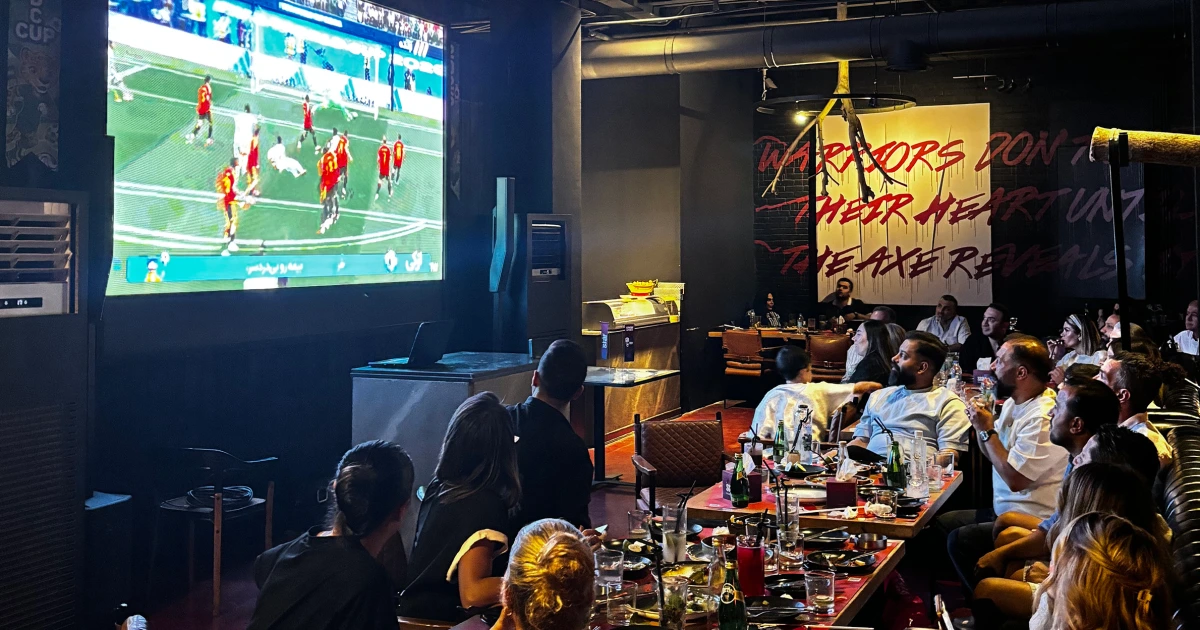
“Even during wartime, people would still spend time together and try to enjoy life. What else could we do? Life had to go on,” Mohsen, 43, told NBC News at one cafe screening the match in Tehran.
NBC News agreed not to use Mohsen’s last name or any of the people interviewed for this article due to fears they might be arrested or harassed by Iranian security forces.
The cafe was one of dozens showing the game across the city, as they did last week for Iran’s first game against New Zealand, which they also tied 2-2.
And despite the 4:30 a.m. kickoff time, the fans were again rewarded with a battling performance from Team Melli, Persian for “national team,” which coach Amir Ghalenoei has described as the “most oppressed” because of travel restrictions imposed by U.S. authorities.
Due to uncertainty over visas and the war, the Iranian players are commuting from their tournament base in co-host Mexico for their three group games in the U.S. and are required to enter within 24 hours of a match and leave the same day.
Despite their travails in Tehran, the atmosphere in the cafe felt lax, with many women not heeding the country’s law requiring women to cover their heads and the shape of their bodies.
Instead of political chants, all the cheers were for the national team and goalkeeper Alireza Beiranvand, who produced several excellent saves during the game and was called “man of the match” by Belgian coach Rudi Garcia.
Ghalenoei, the Iranian coach, said the team had less than 16 hours to train before the match and had to return to Mexico two hours after the match. This reduced the recovery time for the players, he said.

His team nonetheless left a handwritten note in their dressing room calling for “peace, respect and friendship” to “prevail among all nations.”
“From the ancient Persia of thousands of years ago to the civilised Iran of today, the spirit of Iran remains alive and steadfast,” read the message, which was released by the Football Federation of Iran.
“We came to Los Angeles with pride, competed with honour, and leave with dignity,” it added. “Thank you Los Angeles for your hospitality.”
During the game, both Iran’s Foreign Minister Abbas Araghchi and Parliament Speaker Mohammad Bagher Ghalibaf, posted on social media with messages alluding to a U.S. strike on an Iranian school on the first day of the conflict.
Alongside a picture showing young girls with wings helping Beiranvand, Araghchi wrote: “From the football pitch to the negotiating table to the battlefield, every step we take as Iranians is part of a larger struggle: defending the honor and dignity of our dear people.”
Ghalibaf, who has been leading the country’s negotiating team in Switzerland, also praised Beiranvand, alongside the caption: “This is how we protect our land.”

The talks in Switzerland resulted in “a lot of good progress,” according to Vice President JD Vance, after the two sides agreed on a road map toward a final deal to end the war within 60 days.
Technical negotiations continued Monday in the mountaintop resort of Bürgenstock after a first round of marathon talks between senior figures from both countries.
Back in Iran, hundreds of people filled Tajrish Square, where ceremonies for the third Shia Imam, Husayn ibn Ali, were taking place as not far away others celebrated the resilience shown by their soccer team against a Belgian side packed with stars like Kevin de Bruyne and Leandro Trossard.
But some people, like Parham, said he was frustrated with what he said was “politicization” of the sport.
Mohsen, meanwhile, said he wanted Iran to win. “We still try to find reasons to be happy,” he said.
Amin Khodadadi reported from Tehran and Mithil Aggarwal from Hong Kong.
About the Author