The economic fallout from the conflict in the Middle East has become a major new threat to humanitarian aid efforts as Gulf nations that have grown to become major aid donors reprioritise, experts have warned.
Humanitarian groups are already reeling from sweeping cuts to foreign aid programmes from traditional aid donors like the US and UK, with the UN Office for the Coordination of Humanitarian Affairs (OCHA) targeting just $23bn (£17bn) in humanitarian funding this year, which is significantly down on the $37bn raised in 2024.
But while Western countries have been signalling a retrenchment, Gulf states have become ever more significant donors over the past few years, with Saudi Arabia, UAE, Qatar, Oman, and Kuwait collectively providing some $6bn in humanitarian aid last year.
That total is more than the $4bn that the US provided last year, as well as the $1.9bn, $1.4bn, and $1.2bn respectively provided by the UK, Germany, and Japan. Much of the aid from Gulf states has been directed to crises in nearby territories, including Yemen, Gaza and Syria.
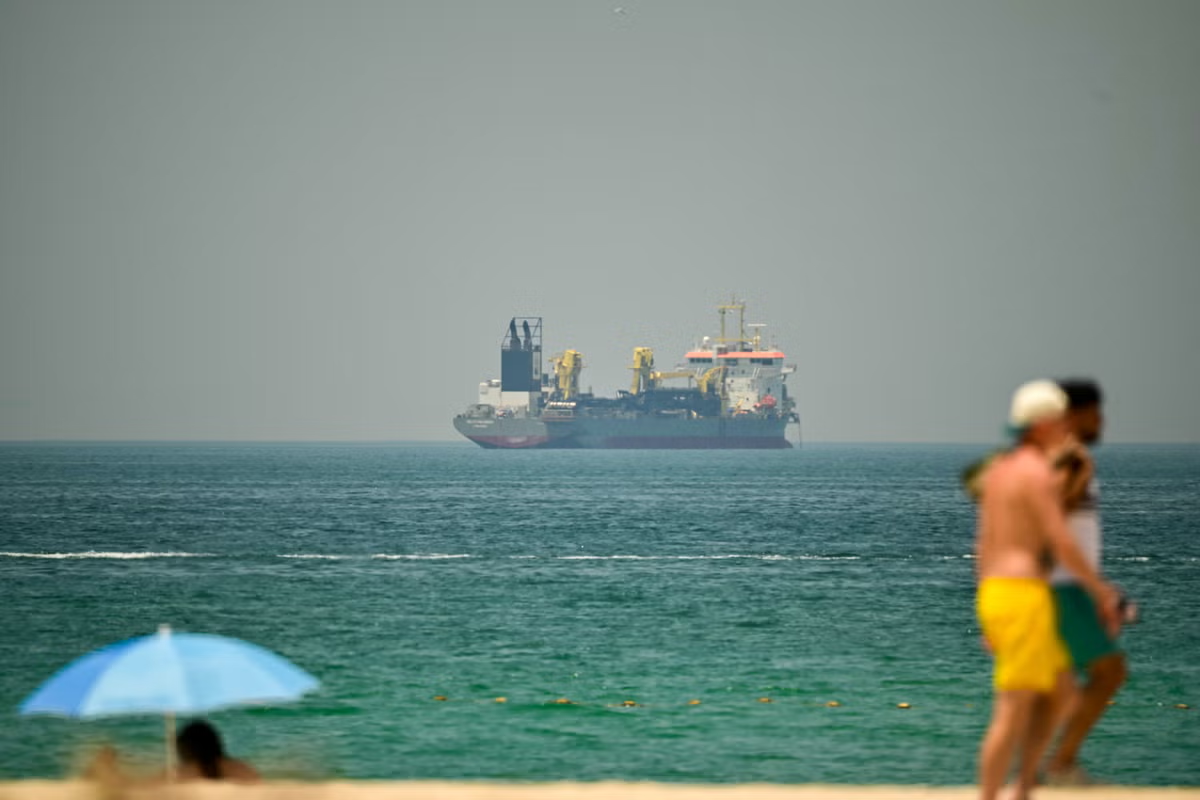
There are now big concerns, however, that the economic fallout from the current conflict in the Middle East – which has seen tourist hotspots attacked by drones and the Strait of Hormuz, a key oil route, close – will include a retrenchment from providing foreign aid.
Speaking at the think tank Chatham House, OCHA chief Tom Fletcher praised the Gulf states for becoming “generous in this space”, but warned that receipts have dried up over the period in which the war has taken place.
“I don’t think we have taken very much at all from Saudi Arabia, Qatar, and the UAE, over the past month,” he said. “Understandably, they’re inward looking, and feeling very defensive.”
Speaking to The Independent, Dr Neil Quilliam, an associate fellow at Chatham House, agreed that the war will have a big impact on where Gulf states choose to spend their money.
He added that the more “opaque” nature of these countries’ governing strategies means that they might not publicly announce a change to aid spending programmes in the same manner that Western governments have done.
“This war is having a significant impact on their budgets, and they’re going to have to reprioritise budgets towards defence and the reconstruction of energy infrastructure that has been hit,” he said.
“They’re also going to have to lower their ambitions for their national visions,” he continued, referring to the hugely ambitious national strategies that Gulf states have pursued in recent years to diversify their economies away from hydrocarbons. “We can surmise from that that they will probably pull back from some of their donor activity also,” he added.
An indication of such a strategic shift came last week when Saudi Arabia’s $925bn sovereign wealth fund published a new , which said it would now prioritise investments in the domestic economy to a greater extent.
The plan also confirmed a strategic shift away from expensive so-called giga-projects such as The Line – a 100-mile steel and glass city in the Arabian Desert – which have more uncertain financial returns than other investments.
There also remain major concerns that ongoing disruptions to shipping in the Strait of Hormuz could have devastating impacts on the operations of humanitarian groups, which depend on the low-cost transit of commodities in order to reach as many people as possible.
“The UAE is specifically positioned as a key humanitarian logistics hub, which means that a lot of humanitarian supply chains have had to be rerouted,” Mike Pearson, research fellow at the think tank ODI Global, told The Independent.
“Impacts to the wider economy will also have affected humanitarian operations, including around supplies of fuel and fertilizer, which are set to affect food supplies, and therefore food prices, later this year,” he continued.
The current shock from the Iran War, Pearson added, is just the latest in a series that started with the fallout from the Covid-19 pandemic, and was followed by Russia’s invasion of Ukraine and then aid cuts from Western governments.
“The bottom line for humanitarian groups is that these shocks increase costs, which ultimately means that they will be able to reach less people,” he said.
Pearson’s comments come as a report published this month by the NGO Mercy Corps warned that humanitarian crises across the Global South are already being seriously impacted.
Impacts cited include the closure of the Strait of Hormuz adding three weeks to the delivery time for humanitarian supplies to Sudan, fuel prices in Somalia rising more than 150 per cent, and irrigation costs for farmers in Myanmar doubling in price.
Growing concerns around humanitarian aid flows come at the same time as aid groups are warning that humanitarian needs are increasing around the world.
There are over 239 million people in urgent need of humanitarian assistance globally in 2026, according to the UN, but OCHA has said that it is only looking to support the 87 million people who have the “most severe humanitarian needs” as a result of shrinking budgets.
The Red Cross, meanwhile, has warned that wars have become a “defining feature of our time”, with the organisation recently telling The Independent that there are numerous humanitarian crises stemming from conflicts that are being forgotten about.
This article has been produced as part of The Independent’s Rethinking Global Aid project
About the Author