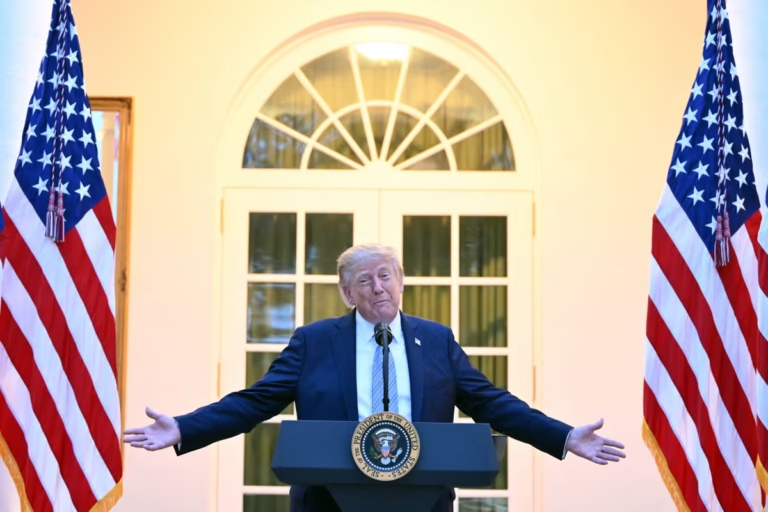
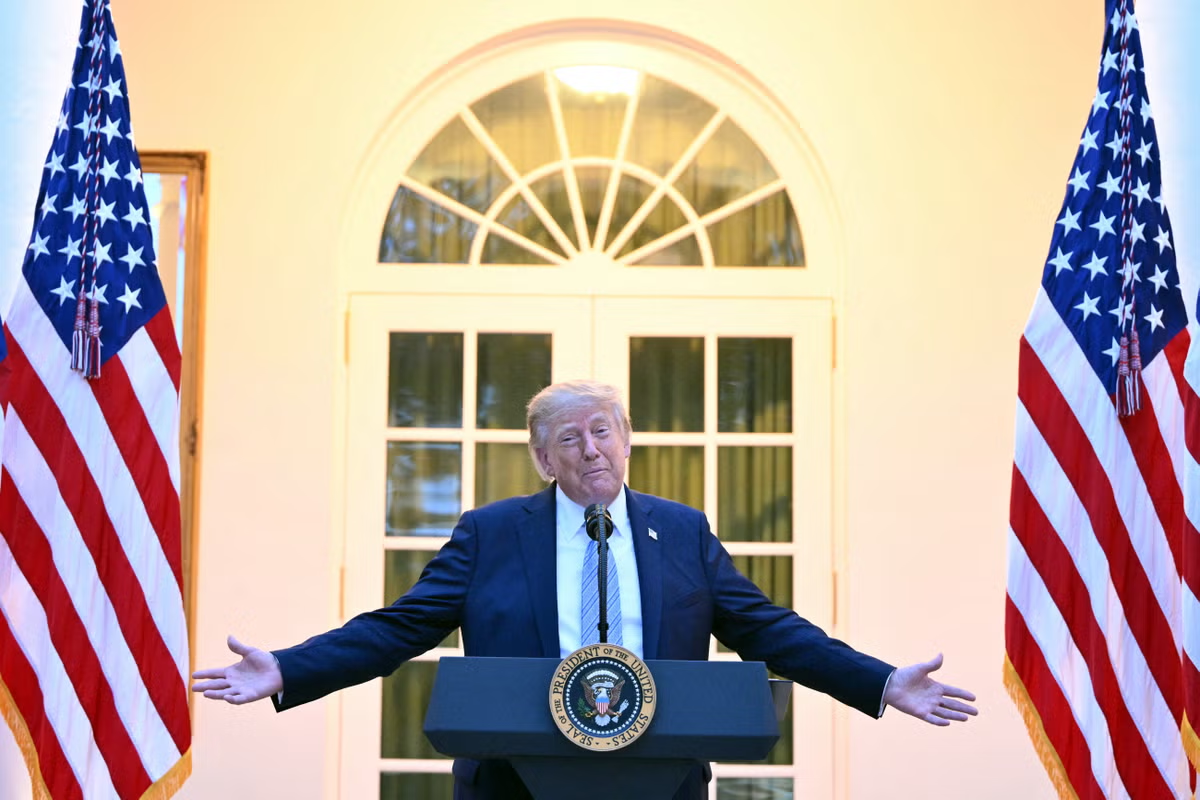
Trump says 250-foot arch will now be a military complex for attack drones, snipers and ammo
Donald Trump made another push on Sunday to redefine one of his Washington, D.C. “beautification” projects that is likely aimed at securing funding for the project from a skeptical Congress.
The president posted on Truth Social that his planned 250-foot triumphal arch will now be loaded up with “large numbers of drones, plus Snipers,” and insisted that the commemorative structure on the grounds of one of America’s most sacred spaces — Arlington National Cemetery — would become a “top grade Military Complex.”
“At the strong request of the United States Military, and for National Security purposes, I have agreed to convert the magnificent Triumphal Arch, planned since the Civil War Era many years ago, at the Receptive Circle adjoining the Arlington Memorial Bridge, into a top grade Military Complex/Triumphal Arch, to house, store, and have the rapid ability to use large numbers of drones, plus Snipers, on both the roof and plaza areas, and additionally have and hold large quantities of sniper ammunition in storage,” wrote the president.
James Reynolds21 September 2026 15:20
Donald Trump said on Monday that Russia has “lost control” of its diesel industry and again called for an end to Moscow’s war with Ukraine.
The rising cost of diesel is hitting US farmers just as the president’s war with Iran weighs on global oil prices. Both risk souring Trump’s domestic approval rating ahead of the November midterms.
“Russia has unfortunately lost control of its Diesel Oil Industry due to its War with Ukraine. A large number of their Diesel refineries have been blown up and are, at least temporarily, out of commission,” Trump said in a social media post a day before he was to meet Ukrainian President Volodymyr Zelensky on the sidelines of the UN General Assembly.
“This ridiculous and never ending War with Ukraine must be ended.”
James Reynolds21 September 2026 15:03
Has Trump achieved his goals in the war with Iran?
Shortly after the US and Israel attacked Iran, Donald Trump laid out several objectives, from destroying Iran’s ballistic missile capabilities to ensuring Tehran can never have a nuclear weapon. Here’s where things stand after seven months:
Before the war, Iran held the largest ballistic stockpile in the Middle East, with between 2,500 and 6,000 missiles of different types. A month into the conflict, US sources told Reuters they believed a third of that arsenal had been destroyed and another third likely damaged, destroyed or buried.
It is unclear how many missiles Iran has left, but the country still has the ability to reach US bases and allies across the region.
The US says it has degraded Iran’s conventional military ability to project power in the region or threaten US operations.
It claims to have destroyed at least 161 Iranian naval ships and 82 per cent of its air defence systems. But Iran’s Revolutionary Guards still exert control over the Strait of Hormuz, disrupting global trade and forcing up oil prices.
Trump has repeatedly said that his main goal is to prevent Iran from developing a nuclear weapon. Tehran says it has no intention of building a bomb and its programme is for peaceful purposes.
But the war has not significantly changed Iran’s nuclear capability. US intelligence estimated two months into the war that Iran would still need less than a year to produce a nuclear weapon – no change from the estimate given last summer.
Trump said on March 2 at the White House that Tehran cannot be allowed to continue to arm and fund the armed proxy groups in Iraq, Lebanon, Gaza and Yemen that Iran has relied on for decades to project power and harass enemies.
US Admiral Brad Cooper said in May that Iran no longer has the ability to reliably supply those groups with advanced weapons. The Yemeni Houthis have regardless tightened their grip on traffic through the Red Sea, cutting Saudi Arabia off as it tries to divert oil from the Gulf. The vital East-West pipeline was cut off in September after it was attacked by drones from Iraq.
Trump encouraged Iranian protesters to overthrow their rulers before the war began and said Supreme Leader Ayatollah Ali Khamenei’s death on February 28 was their “single greatest chance” to seize the government.
The war has failed to dislodge Iran’s government, but supreme leader Ayatollah Ali Khamenei was killed and replaced by his son at the start of the conflict. Trump has since refrained from repeating his calls for the toppling of Iranian leaders.
James Reynolds21 September 2026 14:40
Houthis push on strategic highlands as Trump weighs strikes
Houthi fighters were pushing to seize strategic heights in Yemen on Monday to cut off the Red Sea coast from remaining areas held by Saudi-backed forces, after a report that President Donald Trump had called off US strikes on the group at the last minute.
A lightning advance by the Iran-backed group this month has extended the wider Middle East conflict to a new theatre and further threatened global energy supplies.
Five Yemeni military sources told Reuters the Houthis were now seeking to seize strategic heights, known as the Kahboub Mountains, in two provinces, Taiz and Lahij, which separate the Red Sea coast from the government-held south.

Fighting has centred on the outskirts of the remote mountain Al-Wazi’iyah district in Taiz province, and Ras al-Ara along the Indian Ocean coast between the mouth of the Red Sea that the fighters captured last week and the government’s base in Aden.
The Houthis aim to secure the rear of their forces around the Bab al-Mandab Strait leading into the Red Sea by taking control of the heights, which would allow them to open new fronts, according to the sources. That would help protect exposed positions the Houthis captured during their advance around Dhubab on the Red Sea and on Perim Island in the strait.
The New York Times reported that the Trump administration had prepared on Sunday to launch airstrikes against the Houthis after fresh pleas from the Saudi crown prince. But the newspaper said Trump called off the airstrikes at the last minute, even as troops were loading bombs onto aircraft.
James Reynolds21 September 2026 14:38
Tanker struck by projectile in Strait of Hormuz, two crew injured
A tanker transiting the Strait of Hormuz was struck by a projectile, injuring two crew members, United Kingdom Maritime Trade Operations (UKMTO) said on Monday, citing military authorities.
The two crew sustained minor injuries, while the vessel was continuing to its next port of call, it added.
James Reynolds21 September 2026 14:05
Stressed Trump’s stark warning on Iran: ‘If and when do I blow the entire nation up?’
The president told Fox’s Trey Yingst that for him, the “question” was “if and when” it would be required to “blow the entire nation up” if Iran’s government did not submit to his demands.
“They better behave,” Yingst said the president told him of Iran’s government, adding that the choices included “wiping them out, letting Iran rot economically, or making a deal”.
James Reynolds21 September 2026 14:00
Cost of hiring a supertanker swells as Iran war drags on
Hiring an oil supertanker to load in the Persian Gulf and transit the Strait of Hormuz cost as much as $1m a day earlier this month as the Iran war weighs on global shipping.
That figure, shared by maritime-intelligence firm Windward, is worth around a quarter of the current value of crude oil, and goes some way towards explaining its inflated price.
With Yemen’s Houthi rebels now squeezing the Bab el-Mandeb strait, prices are likely to continue to climb, with fewer alternative routes available to bypass Hormuz.
According to the Wall Street Journal, operators are now also constrained in by a shortage of oil tankers, slowing deliveries and compounding costs for consumers.
Adi Imsirovic, a former energy trader and lecturer at Oxford University, told the Journal: “What matters for refiners is the delivered cost of the crude, and that includes freight. The price at the pump includes all of it and the consumer has to pay the full price.”
James Reynolds21 September 2026 13:55
UK must drill the North Sea to avert looming oil shock, says Tory leader
Kemi Badenoch, the leader of Britain’s Conservative party, urges the Labour government to drill oil and gas in the North Sea, warning the impact of the Iran war is bringing forth another oil shock.
“Saudi Arabia’s East-West oil pipeline has been damaged by drone attacks. The strait of Hormuz is restricted, Houthi bandits threaten shipping routes into the Red Sea. Another oil shock is coming,” the leader of the opposition wrote on social media.
“Yet our Prime Minister and his Cabinet are behaving like a flock of ostriches, heads buried so deep in the sand they could strike oil themselves. The answer is simple: DRILL OUR OWN OIL AND GAS IN THE NORTH SEA.”

James Reynolds21 September 2026 13:37
These are all the countries currently on the Foreign Office ‘do not travel’ list
The FCDO has issued various travel warnings, including advice against “all travel” and “all but essential travel” to entire countries or parts of countries in Europe, Africa, Asia and South America.
Of 226 countries or territories with foreign travel advice pages, 72 are currently flagged as having no-go zones due to security issues, health risks and legal differences with the UK.
James Reynolds21 September 2026 13:20
The latest: Iran and US still trading threats with diplomacy at impasse
Iran and the United States exchanged new threats over the weekend, with Donald Trump warning Iran would fail economically or face its leadership being wiped out if it didn’t make a deal, and the Iranian military saying it would retaliate harshly to any fresh attack.
The conflict has looked stalemated for months, with no sign either side was ready for concessions even as it has deepened a global energy crisis, cratered swathes of Iran’s economy and spilled over into new regional escalations.
In a phone call with a Fox News reporter, Trump said Iran’s leaders should make a deal, rot economically or be wiped out.

However, with Iran’s President Masoud Pezeshkian expected in New York this week for the United Nations General Assembly, Trump said he would be open to meeting him, the Fox reporter added.
Trump has repeatedly made vague threats of major military escalations during the conflict that began with US and Israeli strikes on February 28, without carrying them out.
Earlier, Iran’s military central command said any new attack would trigger sustained retaliation against US bases and interests and that Washington’s regional allies would be considered parties to the conflict.
James Reynolds21 September 2026 12:40
About the Author