Iran does not trust any promises made by the US, says Tehran
We’re just hearing from Iran’s top negotiator and parliamentary speaker, Mohammad Ghalibaf.
He says no agreement with the US will be accepted until Iran’s rights are secured, according to Tehran’s IRNA state news agency.
The Iranian government does not trust promises made by the US side, he said, adding that only objective results matter.
It comes after Donald Trump reportedly asked for changes to the proposed Iran agreement negotiated by US envoys, triggering another round of talks with Tehran.
“At the turn of the week, we hope to have something,” a senior administration official said.
Alex Croft31 May 2026 11:39
What is Beaufort Castle being occupied by Israel?
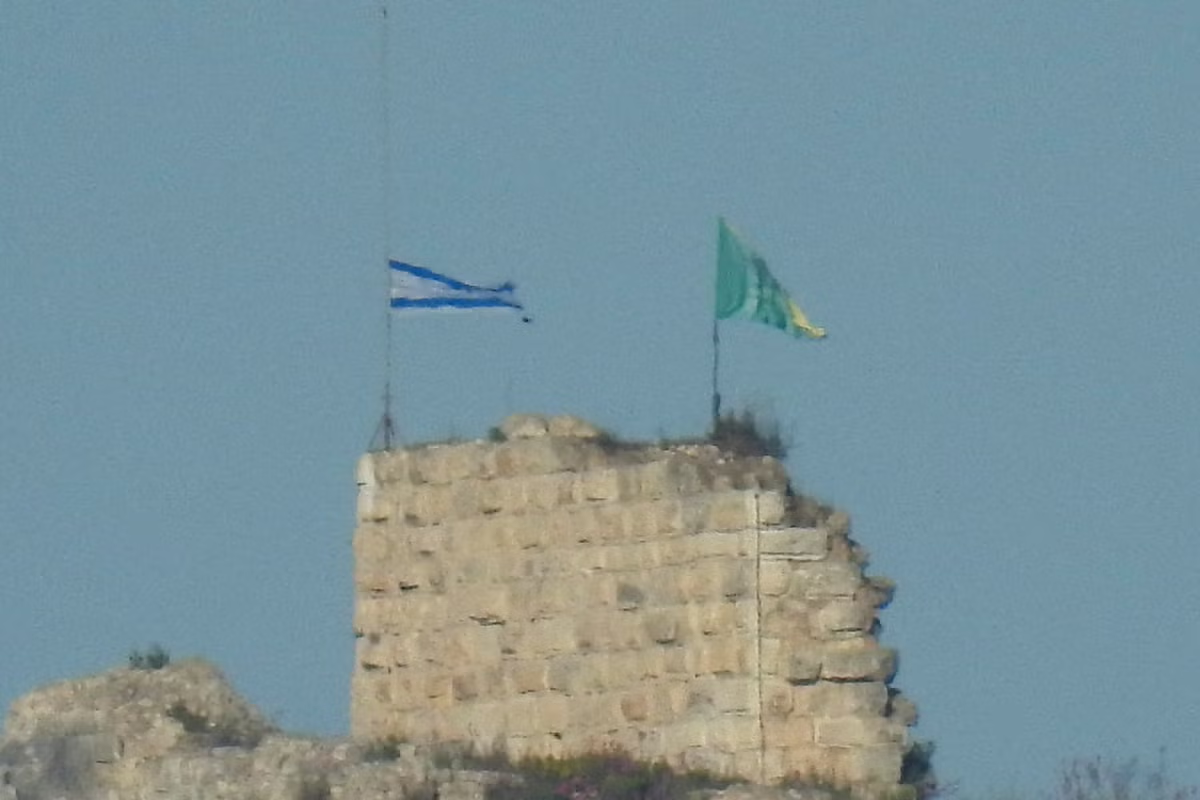
As we reported earlier, Israel has announced its occupation of Lebanon’s Beaufort Castle will remain in place as part of its security zone.
The Israeli military had already been striking in the area around the ancient structure as it deepens its invasion and occupation of southern parts of the country.
The 900-year-old Beaufort Castle was hit by Israeli strikes on Tuesday, as its bombardment of southern Lebanon killed 31 people and wounded another 40 in the deadliest day since a ceasefire was supposed to take hold, state news agency NNA reported.
The fortress has been described by UNESCO as one of the best-preserved examples of medieval castles in the region.
Alex Croft31 May 2026 11:16
In pictures: Israel hoists Israeli flag on ancient Lebanese castle as it deepens invasion


Alex Croft31 May 2026 10:55
Israeli troops will remain in Beaufort castle as part of security zone, says defence minister
Israel’s defence minister Israel Katz has declared that the country’s troops will remain stationed in Beaufort castle as part of the Israeli security zone in Lebanon.
Israeli forces are occupying larger areas of the country as they push their invasion deeper, seizing more territory than they have done in decades and intensifying attacks on the south.
Alex Croft31 May 2026 10:35
In Focus | As Iran war threatens undersea cables in the Strait of Hormuz, is it time to rethink the internet?
When one of the world’s worst ever energy crises began in the Strait of Hormuz in February, few believed that their internet access – rather than their gas bill – would be the worst affected aspect of daily life.
But lurking many thousands of metres beneath the oil ships being attacked by the Iranian navy lie a series of undersea cables that play a vital role in the global economy, helping to power our internet and keep the world connected.
Earlier this month, Tehran floated plans to impose tariffs on Strait of Hormuz submarine cables, warning that they were a vulnerable chokepoint for the region’s digital economy.
Undersea internet cables form the backbone of all worldwide connectivity, enabling bank transfers, messaging, and critical services to function. But as global conflicts threaten crucial chokepoints through which they run, how can the critical cables be protected? Alex Croft reports
Alex Croft31 May 2026 10:14
Dutch defence minister says Iran war shows conflicts are interconnected
Dutch defence minister Dilan Yesilgöz-Zegerius has warned that the Iran war is exposing how closely conflicts in Europe and the Middle East have become intertwined.
Speaking at the Shangri-La Dialogue in Singapore, she cited Iran’s alleged drone support for Russia during the war in Ukraine and growing military cooperation between Tehran, Moscow, North Korea and China.
“A war in Europe involves drones from Iran, soldiers and ammunition from North Korea and various types of support from China,” she said. “The lesson is clear: regional tensions are no longer regional. Our security is interconnected.”
The US, UK, France, and the EU have accused Iran of supplying Shahed drones to Russia for use in Ukraine. Iran has denied sending drones for use in the war, although it acknowledged in 2022 that it had supplied a “small number” of drones to Moscow before Russia’s invasion.
Shahana Yasmin31 May 2026 09:52
ICYMI: Kazakhstan offers to store Iran’s enriched uranium, says IAEA chief
Kazakhstan has offered to take custody of Iran’s stockpile of highly enriched uranium if Washington and Tehran reach a nuclear agreement.
Rafael Grossi, director-general of the International Atomic Energy Agency, told the Financial Times that Kazakhstan has “a place where this could be stored safely,” since it has a “bank” for low-enriched uranium.
Iran’s 440kg stockpile of uranium enriched to 60 per cent purity has become one of the biggest sticking points in negotiations over a proposed deal to extend the ceasefire and restart talks on Tehran’s nuclear programme.
Experts have said the material could be refined further to produce about 10 nuclear weapons.
Donald Trump has demanded the stockpile either be removed from Iran or destroyed under international supervision.
Shahana Yasmin31 May 2026 09:30
Hegseth walks back on ‘any Iran deal will be a good deal’ comment with ‘important clarification’
Shahana Yasmin31 May 2026 09:10
ICYMI: The Situation Room meeting that had the world watching for a deal
President Donald Trump on Friday met with with top aides in the White House Situation Room “to make a final determination” on whether to accept a proposed agreement to end the war he started with Iran three months ago and reopen the Strait of Hormuz to global maritime traffic.
Writing on Truth Social, Trump said the U.S. blockade of Iranian ports would end and Iran would “complete the immediate removal and/or detonation of any mines” in the key waterway so that the strait would be “immediately open, no tolls, for unrestricted shipping traffic” to allow hundreds of ships that have been trapped on the wrong end of the strait to “start the process of ‘heading home!’”
“Say HELLO to your wives, husbands, parents, and families from me, your favorite President,” he said. “I will be meeting now, in the Situation Room, to make a final determination.”
Shahana Yasmin31 May 2026 08:50
Iranian commander warns of ‘more forceful’ retaliation
Iran has warned that any new attack on its territory would trigger a stronger military response, as tensions remain high despite ongoing discussions over a possible ceasefire extension.
Rear Admiral Habibollah Sayyari, Iran’s deputy army commander for coordination, said the country’s armed forces were prepared to respond to further military action.
“The enemy should know that any aggression against the country’s territory will be met with a response even more forceful than before,” he said, per Al Jazeera.
“Today, the army of the Islamic Republic stands firmly and resolutely against any hostile move by the enemy,” Sayyari added.
The warning comes as the US and Iran remain divided over a proposed agreement covering Tehran’s nuclear programme and the reopening of the Strait of Hormuz.
Shahana Yasmin31 May 2026 08:30
About the Author