The president of Iran has rejected Donald Trump’s call for the country’s unconditional surrender as a “dream”, while issuing a rare apology for Iranian attacks that hit neighbouring states, even as missiles and drones continued to strike Gulf countries.
In a prerecorded address broadcast on state television on Saturday, Iran’s president, Masoud Pezeshkian, said the country would never capitulate, responding to remarks by the US president, who said on Friday that only Iran’s total submission could bring the war to an end.
Iran’s enemies, Pezeshkian said, “must take their dream of the Iranian people’s unconditional surrender to their graves”, in remarks that further escalate the eighth day of conflict, which has choked global oil supplies and cut world air travel.
During his speech, Pezeshkian also issued an apology to neighbouring states for Iran’s recent “actions”, in an apparent attempt to ease regional anger after Iranian strikes hit civilian targets in Gulf Arab countries.
Tehran has responded to attacks on its territory by targeting Israel, but also Gulf Arab states that host US military installations, while Israel has also launched intense strikes on Lebanon, where the Iran-backed armed group Hezbollah is based.
Over the past week, the United Arab Emirates, Kuwait, Qatar, Bahrain and Saudi Arabia have all reported drone and missile attacks.
Pezeshkian said Iran’s temporary leadership council had approved suspending attacks on nearby countries unless an assault on Iran originated from those states.
“I personally apologise to neighbouring countries that were affected by Iran’s actions,” he said.
It remains unclear whether Pezeshkian’s remarks signal a broader decision by Tehran to scale back its campaign, or what prompted the apparent shift, with reports suggesting some strikes were still being directed at Gulf states on Saturday morning.
On Saturday, video published on social media and obtained by the BBC shows an apparent drone strike on the property of Dubai international airport.
According to the report, the drone appears to have struck near concourse A, and at least four aircraft could be seen near the site of impact.
The UAE said it intercepted 15 ballistic missiles and 119 drones on Saturday.
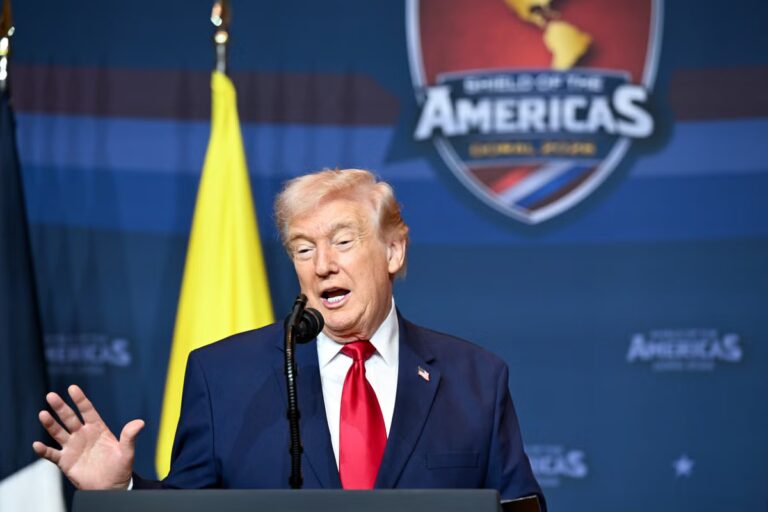
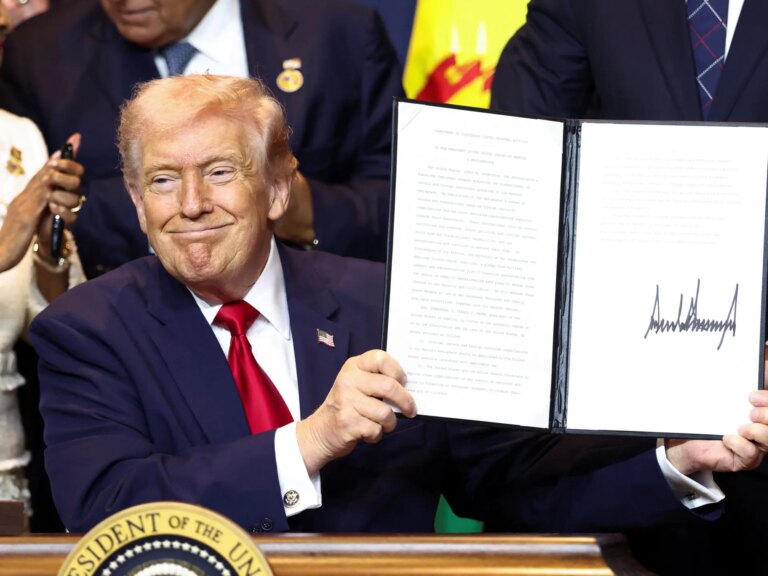
Pezeshkian’s remarks were swiftly followed by a warning from Trump, who said Tehran faced the prospect of “complete destruction” if it did not capitulate, adding that Iran’s apology to neighbouring states was the result of mounting US military pressure.
On his Truth Social platform, Trump replied that if Iran did not surrender, “it will be hit very hard!” adding that the country was “under serious consideration for complete destruction and certain death”.
Trump also said that Iran had apologised and surrendered to its Middle East neighbours, “because of the relentless U.S. and Israeli attack”.
Western officials were seeking to interpret Pezeshkian’s comments regarding the apology and on what authority he was speaking, but said it was best to be cautious in suggesting Iran was looking for an off ramp.
One official said: “We do not know definitely what is driving the Iranian president’s remarks. It is one data point and it is no more than that. We can infer that Iranian capability is degraded. There is no reason to doubt the briefing from Centcom of a reduced number of attacks recently.”
The officials said the Iranian offer to states in the region was implicitly conditional, but the officials added it was not clear if this meant attacks could stop if countries did not allow US bases to be used to attack Iran or whether the very presence of a US base was sufficient reason to attack.
Later in the day, the deputy for communications and public announcements at Pezeshkian’s office, Mehdi Tabatabaei, released a statement about the Iranian president’s remarks, saying his message was “clear”.
“If countries in the region do not cooperate in the US attack on Iran, we will not attack them,” Tabatabaei said. “Iran will never submit to coercion. Our powerful armed forces will give a decisive response to any aggression from US bases in the region.”
Pezeshkian’s speech comes as Israel said it had launched a fresh wave of strikes on Iran, sending 80 fighter jets in a pre-dawn blitz that set one of Tehran’s main airports on fire.
Israeli officials said the targets included a military academy, an underground command centre and a missile storage facility.
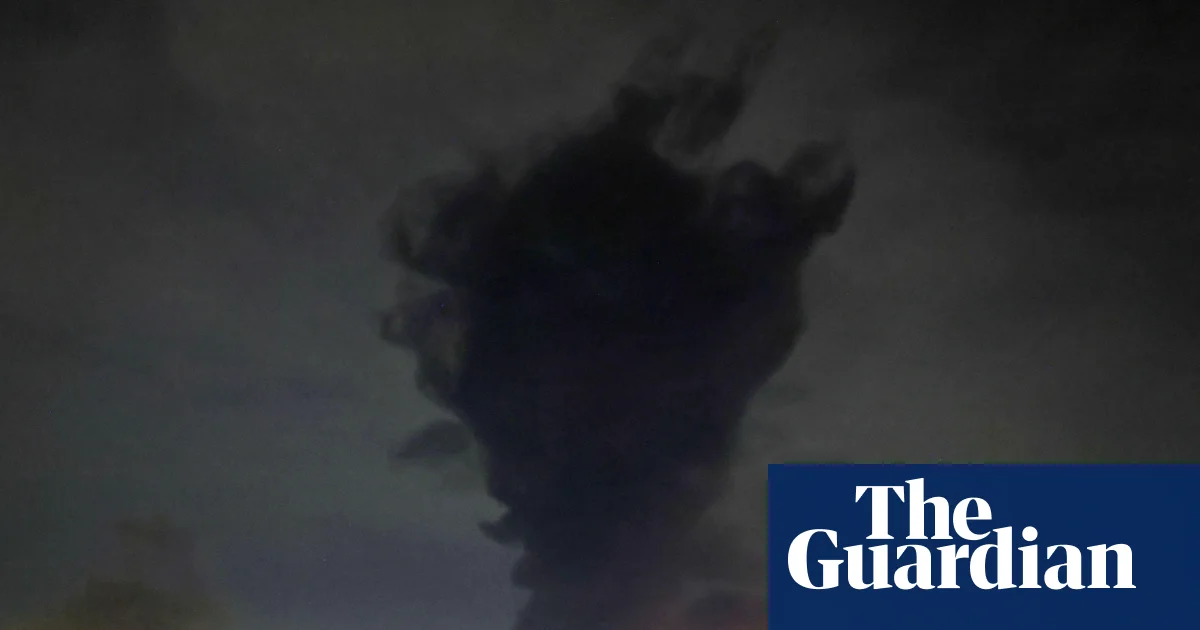
Photos showed flames and thick plumes of smoke rising from Mehrabad International airport, one of the two airports serving the Iranian capital, Tehran.
Iran also retaliated on Saturday. Air raid sirens sounded and explosions were reported above Jerusalem as well as in Gulf cities including Dubai and Manama, and near Riyadh, where Saudi Arabia said it intercepted a ballistic missile aimed at an airbase hosting US military personnel.
Iran’s Islamic Revolutionary Guards Corps said they hit a Marshall Islands-flagged tanker in the strait of Hormuz, Iranian state media reported on Saturday, as it attempted to pass through the strait of Hormuz, a narrow maritime choke point for global shipping that Iran has in effect closed.
Now entering its second week, the war was triggered by joint airstrikes by Israel and the US that killed Iran’s supreme leader, Ali Khamenei.
Since then the conflict has rapidly widened, spilling into Lebanon and reaching as far as the eastern Mediterranean and the Indian Ocean.
Iran’s health ministry said at least 926 civilians had been killed and about 6,000 injured. Israel has also intensified airstrikes in Lebanon, repeatedly targeting the southern suburbs of Beirut.
Lebanon’s health ministry said at least 217 people had been killed, while the prime minister, Nawaf Salam, warned that a humanitarian disaster was looming. The Norwegian Refugee Council said about 300,000 people had fled their homes.
About the Author