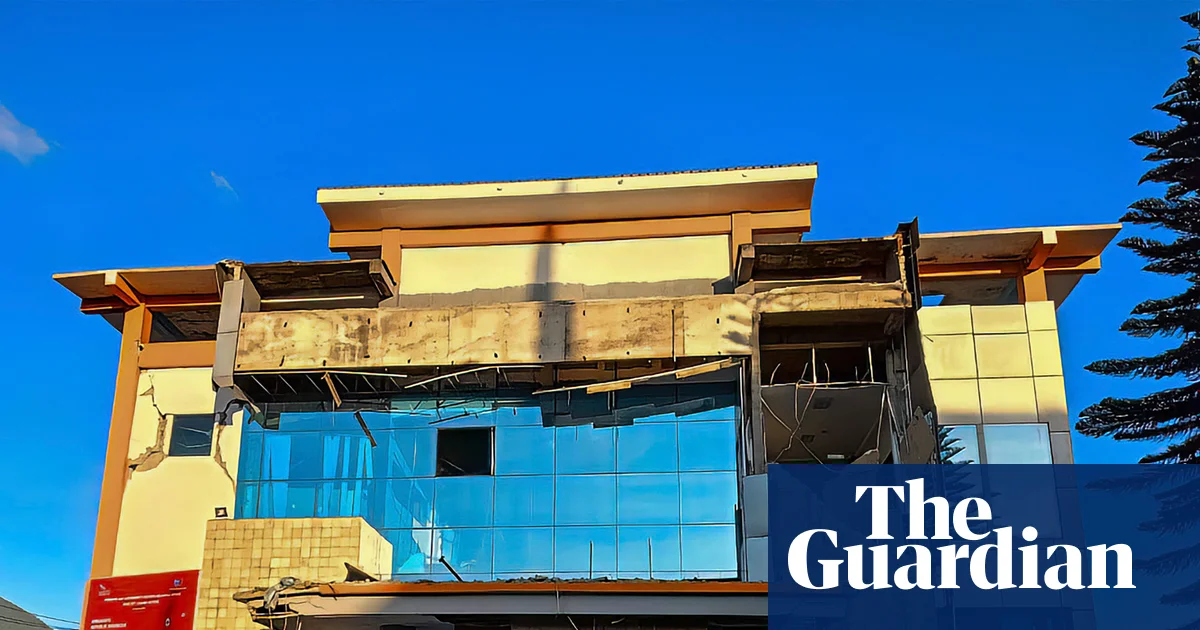
A 7.7-magnitude earthquake that struck eastern Indonesia, has killed at least 40 people, causing widespread panic and collapsing buildings and homes in a region prone to deadly seismic events.
Authorities issued a tsunami warning, which has since been lifted, but there were at least 235 aftershocks, including one of magnitude of 6.1. Indonesian authorities said that monitoring showed no significant sea level changes that could indicate a tsunami.
Tsunami waves of 1.5 metres (3ft) were recorded in several areas.
The Indonesian geophysics agency, BMKG, recorded the first quake at 4.58am on Saturday local time at a depth of 9 miles (15km) in the country’s Flores region.
A second earthquake of magnitude 6.1 struck off northern Sumatra, Indonesia, hours after the initial quake, with no casualties yet reported.
Rescuers around the port town of Maumere found 20 people dead, six severely injured and two trapped under the rubble, said Fathur Rahman, the head of the city’s rescue agency. Eight of those dead had been killed in a landslide. Maumere is the main town in Sikka regency on Flores Island in the east of Indonesia’s vast archipelago.
A video on Facebook, verified by Reuters as being at a port in Maumere, shows parts of a building collapse as people scream and run in the street. Another video showed a coastal village covered in mud and debris after a 1.61-metre tsunami wave hit Ngada village in east Manggarai.
“I have never felt an earthquake this big,” said Yulian Juita Ekalia, a university professor who lives more than 60 miles from the epicentre. “It felt like we were on a trampoline, it was really scary.”
The epicentre off the north coast of Flores, about 42 miles north-west of the coastal town of Ende, US and Indonesian authorities said.
Teams have yet to reach Nagekeo, the region closest to the epicentre, and communications signals there had been affected, Fathur said. Road access was blocked by landslides, and a team was attempting to reach the area by ferry, he said.
The police chief of East Nusa Tenggara province, Rudi Darmoko, said the earthquake caused power cuts that made communication difficult between cities and villages, complicating rescue efforts.
“We are continuing to collect reports of damage and casualties, but there are communication disruptions,” he said. He said landslides in Ende regency had cut off the Trans-Flores highway, a 435-mile mountain road.
Residents in Nagekeo regency raced for higher ground immediately after the earthquake.
“Suddenly it started to shake and I panicked,” Lukas Lotar, a hospital customer service official, said. “Patients also fled the hospital, the jolt was big. I saw some walls were cracked.”
Nagekeo resident Yohanes Babo said he was at a market when the quake hit.
“The shaking was strong. Thankfully, we were already outside the house,” he said. “People were panicking, running here and there. We’re evacuating for the time being … and trying to get to the hills. My family is safe. No one was harmed.”
About 2,000 people in Nagekeo evacuated, and damage to a number of houses, warehouses and government facilities was reported, the national disaster mitigation agency, the BNPB, said. Authorities also reported traffic congestion and power cuts affecting parts of the regency, it said.
Local television showed patients at several hospitals being evacuated from buildings as a precaution after the quake. Healthcare workers set up temporary treatment facilities outdoors, moving beds, IV stands and oxygen on to the streets.
The BNPB, which put the quake’s toll at one dead and four injured, said it was still gathering data.
Images broadcast on Indonesian television showed hundreds of people in nearby Nagekeo regency evacuating the area, surrounded by the rubble of damaged buildings.
Yohanna Embu, a resident of Sikka, a regency in East Nusa Tenggara province, said a number of buildings were damaged by the strong shaking and panicked people ran to higher ground.
“Many buildings here were damaged … I saw that the waiting room at the port terminal in Maumere had collapsed,” she said.
Indonesia, consisting of more than 17,000 islands, is prone to earthquakes and volcanic activity because of its location on the “ring of fire”, an arc of geophysical activity in the Pacific basin.
In 2004, a 9.1-magnitude earthquake struck off the coast of western Indonesia, causing a tsunami that killed 220,000 people in the Asia Pacific area.
With Agence France-Presse and Reuters
About the Author