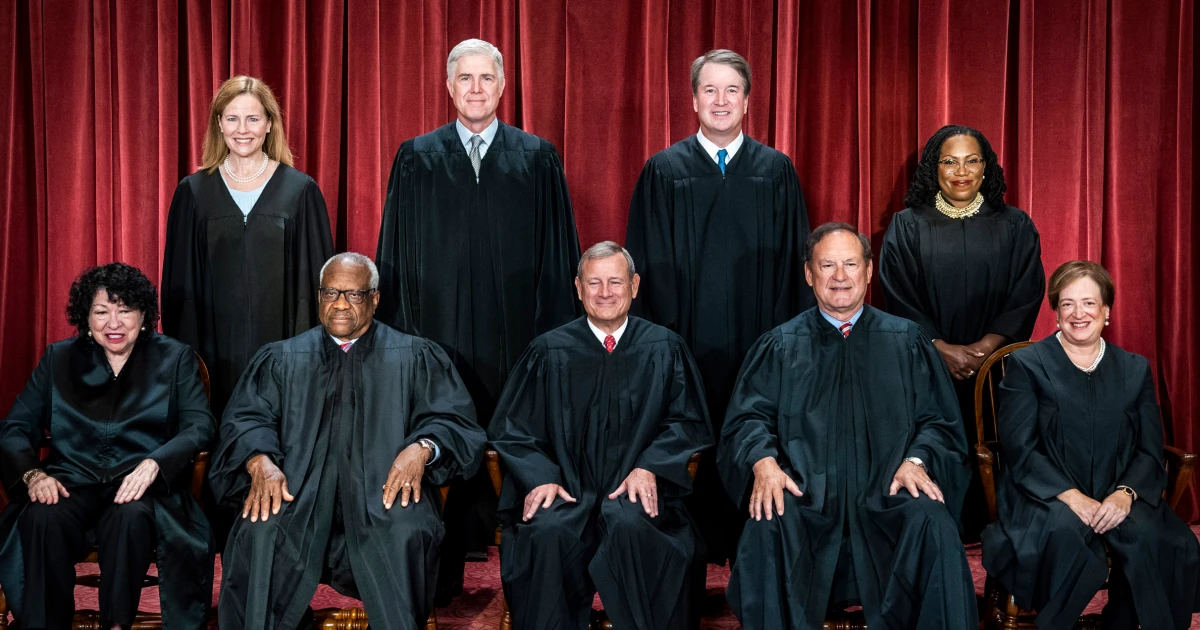
WASHINGTON — The House on Wednesday voted down a proposed constitutional amendment to keep the Supreme Court at nine seats, with the measure falling short of the two-thirds majority needed to pass.
The vote tally was 212-206. All but one Democrat voted against it, as openness within the party grows for expanding the high court by four seats.
The joint resolution, offered by Rep. Andy Biggs, R-Ariz., calls for amending the Constitution to say: “The Supreme Court of the United States shall be composed of nine justices consisting of one chief justice and eight associate justices.”
The office of House Minority Whip Katherine Clark, D-Mass., encouraged lawmakers to vote “no,” saying it takes away a power intended for Congress and does nothing to address the “affordability crisis” under President Donald Trump.
“This proposed constitutional amendment would permanently fix the number of Supreme Court justices at nine, stripping Congress of yet another constitutional authority that is meant to be controlled by the American people’s representatives,” Clark’s office wrote to lawmakers Wednesday ahead of the vote.
The Constitution does not specify the size of the Supreme Court; it defers to Congress on that matter. The Judiciary Act of 1789 established six justices for the court. The size of the court changed a half-dozen times over the next century, both shrinking and expanding to a high of 10 seats, before getting set at nine seats in 1869, where it has remained since.
The vote on the GOP measure isn’t a perfect breakdown of support for expanding the Supreme Court, as many Democrats haven’t endorsed the idea. But the cause has migrated from the far left to the Democratic mainstream in recent years, fueled by decisions from the 6-3 conservative majority that overturned Roe v. Wade, weakened the Voting Rights Act and granted Trump immunity for moves deemed official acts.
“What was once a fairly dramatic and fringe idea has now become mainstream because of how fed up the country has become with the [Chief Justice John] Roberts majority,” said Josh Orton, president of the progressive judicial group Demand Justice, which has been pushing for court expansion since 2020.
“People understand this is now an emergency,” he added. “They see the Roberts majority as more corrupt, more friendly to corporate power and to the Trump administration, and more anti-democratic.”
Along with a measure denouncing socialism, the Supreme Court resolution was part of a series of messaging votes set up by House Republican leaders to make the case against Democrats in the 2026 midterm elections.
“Give House Democrats an ounce of power, and they’ll use every bit of it to fundamentally transform America into an unrecognizable socialist hellscape,” said Mike Marinella, a spokesman for the House Republicans’ campaign arm.
Rep. Don Davis, D-N.C., was the only Democrat who voted Wednesday with all Republicans in support of the proposed constitutional amendment. Rep. Kevin Kiley, an independent from California who caucuses with Republicans, voted against the resolution.
Proposed constitutional amendments need two-thirds support in both the House and Senate to start the ratification process.
Speaker Mike Johnson, R-La., said Republicans will keep nine seats on the court if they stay in charge.
“Now you’ve heard the Democrat Socialists of America, the communist socialists and Democrat Party, who are taking the party over,” he told reporters on Tuesday.
Appearing Sunday on NBC News’ “Meet The Press,” Rep. Jim Clyburn, D-S.C., a former House majority whip and influential figure inside the party, endorsed the idea of expanding the court to 13 seats.
“I think that we are in a position now that calls for some significant actions taken by the Congress, and we ought to expand,” Clyburn said. “Thirteen is a pretty good number. A baker’s dozen would be a good number to have on the court. And I would hope we would get people on the court who will follow the constitutional underpinnings of this great nation of ours.”
Former Vice President Kamala Harris, the 2024 Democratic presidential nominee, voiced some support for the idea of adding Supreme Court seats, saying earlier this summer: “We need to revisit the point of expanding the court to 13 justices.”
Orton said it’ll be an issue going into the 2028 presidential race.
“We intend to continue building the case for major Supreme Court reform through the 2028 election cycle,” Orton said, dismissing “passive” Democrats who oppose the idea for fear that Republicans would respond in kind and add more seats.
“You can be damn sure that if there had been a longstanding progressive majority on the court, Republicans would have already voted to expand it,” he said. “This has to happen in the first two years of the next Democratic administration.”
About the Author