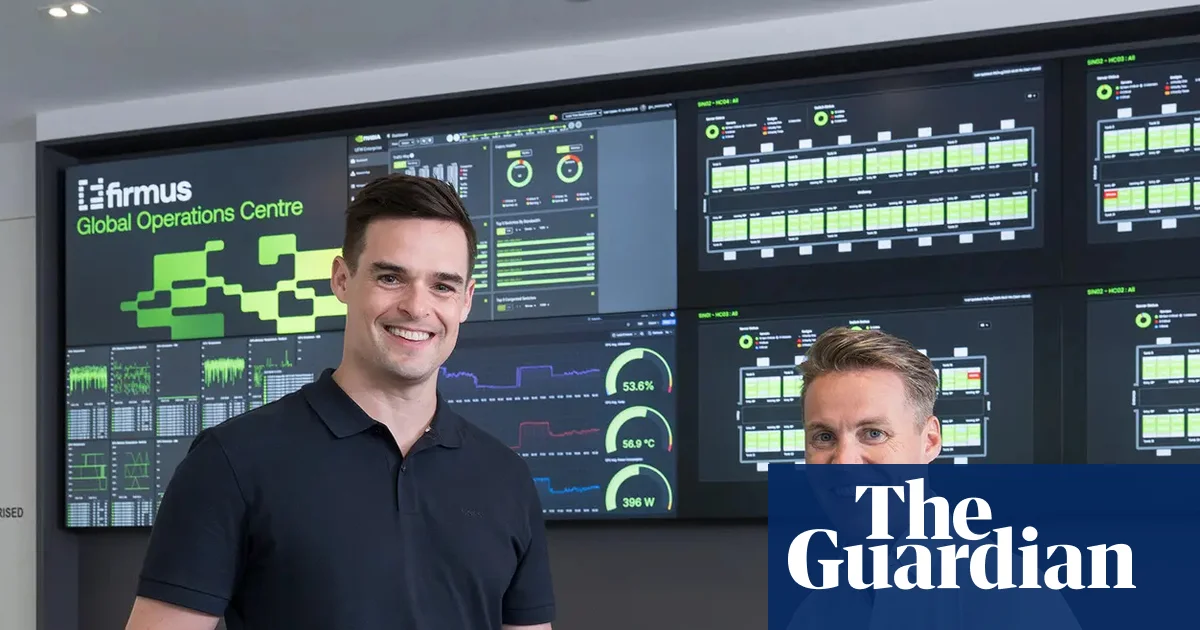
Firmus Technologies has scrapped what was set to be Australia’s biggest company listing in decades after investor demand for its much-hyped AI datacentre business failed to materialise.
A Firmus spokesperson said the board decided that proceeding with the offer was no longer in the best interests of the company and its shareholders.
“Firmus will now pursue capital from the private markets and consider alternative public and private market options,” the spokesperson said on Friday morning.
“We will provide additional information to shareholders as those options progress.”
Firmus, with an anticipated $44bn valuation, was expected to be the biggest ASX listing since Telstra in 1997.
But it faced mounting scepticism over its huge valuation, and forecast earnings, for a company in its startup phase with just two, small operational sites.
Backed by chip maker Nvidia and Wall Street firms Blackstone, Jane Street and Coatue, Firmus’s backers believed they could raise billions of dollars by selling shares in a public float with the help of five brokers.
The lack of demand means Firmus will need to raise money from private investors to fund its plans to build liquid-cooled “AI factories” in Australia and across Asia.
Frantic discussions
The polished Firmus pitch started to unravel midweek after it became clear the company’s bankers had vastly overestimated demand in their bid to raise $7bn from investors ahead of listing on the ASX on 23 October.
This prompted discussions about a heavy reduction in the company’s proposed $11-a-share initial public offering, according to one investment manager briefed on the matter.
The company ultimately decided to withdraw its application to list on the ASX altogether.
Guardian Australia previously reported growing concern that early Firmus investors were going to use retail investors buying into the float as their “exit strategy”, leaving small investors exposed if the excitement dissipated.
The datacentre company’s troubles have already rattled other parts of the market, with shares in Firmus investor Maas Group plunging more than 20% on Thursday.
after newsletter promotion
The anticipated financial worth of the founders – Oliver Curtis, his cousin Tim Rosenfield, and Curtis’s former brother-in-law Jonathan Levee – will also be greatly reduced.
‘Diverging’ mission blamed for CDC split
Veteran datacentre firm CDC this week ended what was touted as a $73bn deal with Firmus named Project Southgate, which was aimed at building sovereign, renewable-powered AI infrastructure and which claimed Nvidia as its first customer.
On Friday, appearing at the federal parliament’s joint standing committee on AI, CDC’s chief strategy officer, Dr Jack Dan, said the arrangements began when Firmus’s focus was “a lot more on Australia and creating sovereign AI capability in Australia.”
“Their business model has then since evolved and probably the most blunt way of putting it is we have a very clear business model and a very clear mission for our company,” he said. “And when things start diverging significantly from that, we continue to follow our core mission.”
The deal was first announced in October last year.
Dan said Firmus had a “very different approach to developing datacentres” and CDC is “very much about critical infrastructure, very significant resilience … essentially 100% availability.”
“That comes with a certain degree of assurance, a certain degree of rigor and a certain degree of process, which probably was or could have been construed as being a little bit too heavy for a more commercial type development.”
Earlier in the hearing, Dan observed that CDC had been around for nearly 20 years, and until last year, “no one really cared who CDC datacentres was” but now datacentres were front and centre of the national conversation.
About the Author