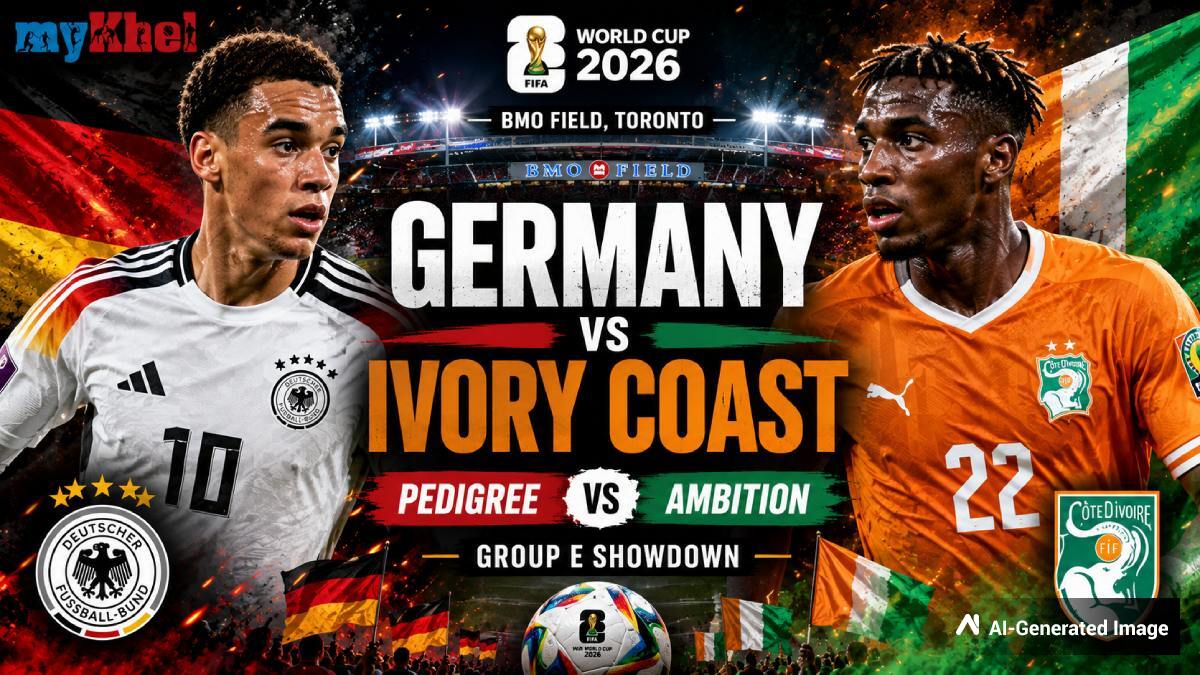
Germany arrive for their second game in the Group E encounter at the FIFA World Cup 2026 against Ivory Coast on Sunday, June 21.
Four times World Champions, Germany won their first title in 1954, 1974, 1990, and 2014, while also having the credit of having to settle for the runner-up spot on four occasions: 1966 (lost to England), 1982 (lost to Italy), 1986 (lost to Argentina), and 2002 (lost to Brazil).
The women’s team of Germany is also no stranger to World Cup glory, having won the crown of the world in 2003 and 2007, the second most successful women’s team in the tournament’s history, trailing only the United States, who have won four titles. So, it won’t be a surprise that the German side will be carrying the weight of one of football’s richest legacies on their shoulders.
Ivory Coast steps onto the grand stage determined to prove that Africa’s reigning champions belong among the elite. It is a fascinating contest between pedigree and ambition, between a four-time world champion seeking to reclaim its former dominance and a fearless African side eager to create another memorable chapter in its growing football story.
Ivory Coast, meanwhile, continue to write their own compelling story. After producing golden generations led by Didier Drogba, Kolo Touré and Yaya Touré, the Elephants have returned to the global stage after missing the last two editions. Three-time Africa Cup of Nations champions, including their dramatic triumph on home soil in 2024, they now seek to translate continental dominance into World Cup success.
History offers little by way of precedent between Germany and Ivory Coast, with the two nations having met only once before. Their lone encounter came in an international friendly at the Veltins-Arena in Gelsenkirchen on November 18, 2009, producing an entertaining 2-2 draw.
Lukas Podolski gave Germany an early lead from the penalty spot before Emmanuel Eboué and Seydou Doumbia turned the contest in Ivory Coast’s favour. Just when the Elephants appeared destined for victory, Podolski struck deep into stoppage time to rescue a dramatic draw for the hosts.
Germany’s Football history is woven with excellence. Yet the painful group-stage exits in 2018 and 2022 forced a period of introspection before Julian Nagelsmann rebuilt the side around youth, intensity and tactical flexibility. Germany’s road to North America was a dominating performance as they comfortably topped their European qualifying group with commanding victories against Slovakia, Northern Ireland, and Luxembourg. Nagelsmann’s aggressive pressing and fluid attacking system transformed Germany into one of Europe’s most entertaining sides before they arrived at the finals.
Ivory Coast qualified by finishing atop their CAF qualifying group, overcoming the challenges posed by Gabon, Kenya, Burundi, Gambia and Seychelles. Their disciplined defence, quick transitions and attacking flair ensured a deserved return to football’s biggest stage.
Germany could hardly have asked for a better start to their World Cup campaign. A resounding 7-1 demolition of Curaçao restored memories of the ruthless efficiency that once defined the Germans. Jamal Musiala dazzled with his creativity, Nathaniel Brown emerged as one of the tournament’s early revelations, while substitute Deniz Undav continued his remarkable scoring form after coming off the bench with a goal and two assists. Yet Nagelsmann was quick to remind his players that sterner examinations lay ahead, with Ivory Coast expected to pose a far greater tactical and physical challenge than their tie against Curaçao.
Ivory Coast’s opening victory over Ecuador was less spectacular but perhaps even more satisfying. It was a performance built on discipline, resilience and patience before the decisive late breakthrough secured a priceless 1-0 victory. The Elephants defended with remarkable organisation while repeatedly threatening on the counterattack through their explosive pace. That victory has placed them firmly in contention for a place in the knockout rounds and significantly boosted belief within the squad.
Germany’s strength lies in the extraordinary quality spread throughout their squad. Jamal Musiala of Bayern Munich remains the creative heartbeat, the attacking midfielder already a Bundesliga champion whose dribbling and vision can dismantle any defence. Captain Joshua Kimmich of Bayern Munich controls midfield with unmatched intelligence and has won multiple Bundesliga titles and the UEFA Champions League.
Antonio Rüdiger of Real Madrid brings authority at the back, having lifted both the UEFA Champions League and La Liga. Kai Havertz of Arsenal continues to provide movement and versatility in attack after famously scoring Chelsea’s winning goal in the 2021 UEFA Champions League final, while Leroy Sané offers blistering pace from the wings.
Ivory Coast possess an equally exciting blend of experience and youthful exuberance. Amad Diallo of Manchester United has matured into one of Africa’s brightest attacking talents with his pace and creativity from wide positions. Nicolas Pépé continues to provide unpredictability in the final third, while Sébastien Haller of Borussia Dortmund remains a proven centre forward whose inspirational comeback from illness culminated in leading Ivory Coast to their unforgettable Africa Cup of Nations triumph. At the heart of defence stands Evan Ndicka of AS Roma, combining composure with physical dominance, while teenage sensation Yan Diomande of RB Leipzig has emerged as one of the breakout stars of the tournament after an outstanding club season.
The tactical battles promise to be captivating. Musiala’s ability to drift between the lines against Ivory Coast’s compact midfield could determine Germany’s attacking rhythm. Kimmich’s duel with Franck Kessié will shape control of possession, while Rüdiger faces the demanding task of containing Haller’s aerial strength.
Equally intriguing will be Germany’s full-backs attempting to cope with the electric pace of Diomande and Diallo on the counterattack, an area Nagelsmann has specifically identified as Ivory Coast’s greatest weapon. Ivory Coast’s rising star Yan Diomande, who plays for RB Leipzig, was named the 2025/26 Bundesliga Rookie of the Season, adding a highly specific German-league angle to the matchup. The 19-year-old Ivorian winger and RB Leipzig forward has been one of the standout revelations of the tournament, capturing global attention and winning Player of the Match honors for Côte d’Ivoire against Ecuador.
There are fascinating storylines surrounding this encounter. Germany are attempting to reach the knockout rounds for the first time since lifting the World Cup in Brazil twelve years ago. Ivory Coast are chasing only their fourth World Cup victory in history, yet their recent continental success has convinced many observers they are capable of finally progressing beyond the group stage. This meeting also represents one of Europe’s traditional heavyweights against Africa’s reigning champions, adding another layer of intrigue to an already compelling fixture.
The setting is Toronto’s magnificent BMO Field, a venue transformed and expanded for the FIFA World Cup. Originally opened in 2007, it has served as the home of Toronto FC and the Canadian national team while hosting numerous international fixtures. For the World Cup, the stadium has been upgraded into one of Canada’s premier football arenas, offering an intimate atmosphere where passionate supporters sit remarkably close to the pitch.
As one of the tournament’s showcase venues, BMO Field now prepares to stage another memorable chapter as European tradition collides with African ambition under the bright lights of football’s greatest spectacle.
About the Author