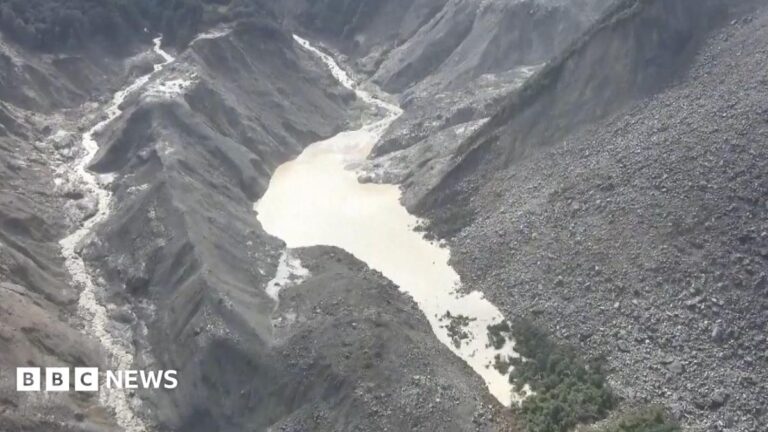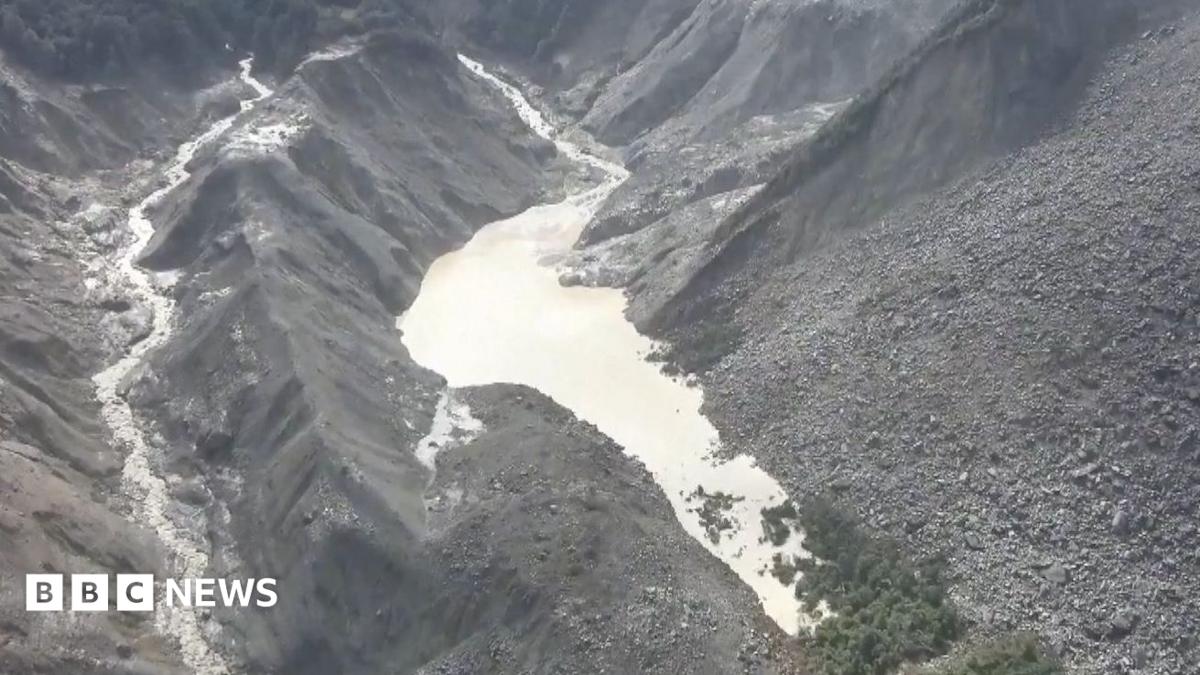
Jakob Steiner, a geoscientist with the University of Graz who has researched lake bursts in Nepal, told the BBC there was still a possibility that the lake could breach its banks.
“Not all the material on the mountain could have come down, it is still unstable, so there’a a chance that something will drop,” he said, adding that if the material dropped into the lake or even further upstream, “then we have a problem”.
Chinese state media have also reported there will be heavy rainfall and storms in the region in the coming days, and there are concerns that this may cause the lake to swell.
If the lake breaches its banks, there will not likely be a massive deluge of water as seen on Wednesday as the lake has been formed recently and not very deep, said Dr Steiner.
However, the water discharged could further undercut the valley’s slopes and cause more erosion – which could cause more landslides.
“Authorities need to be very careful for the rescue and prepared for any secondary wave and post-disaster landslides as the valley walls have been scoured and much more vulnerable,” said Mohd Farooq Azam, a glacio-hydrologist with scientific institution the International Centre for Integrated Mountain Development.
Steiner said it was unlikely that the Chinese could stop the lake from overflowing.
He pointed out that while it is technically possible to artificially drain the lake using excavators, there are no proper roads which would allow them to transport heavy machinery to the lake’s location.
But both experts said it is possible that the problem could eventually resolve by itself.
Azam points to recent flash floods in India’s Chamoli and Dharali where artificial lakes “drained slowly without much impact downstream”.
Similarly, “the only thing [China] can do is hope that the water will slowly drain out naturally” out of the barrier lake in Tibet, said Steiner.
“And it will slowly drain – the melting season will be over by October so things are going to get calmer. There’s going to be less water, and then by winter [what’s left] will be all frozen.”
About the Author