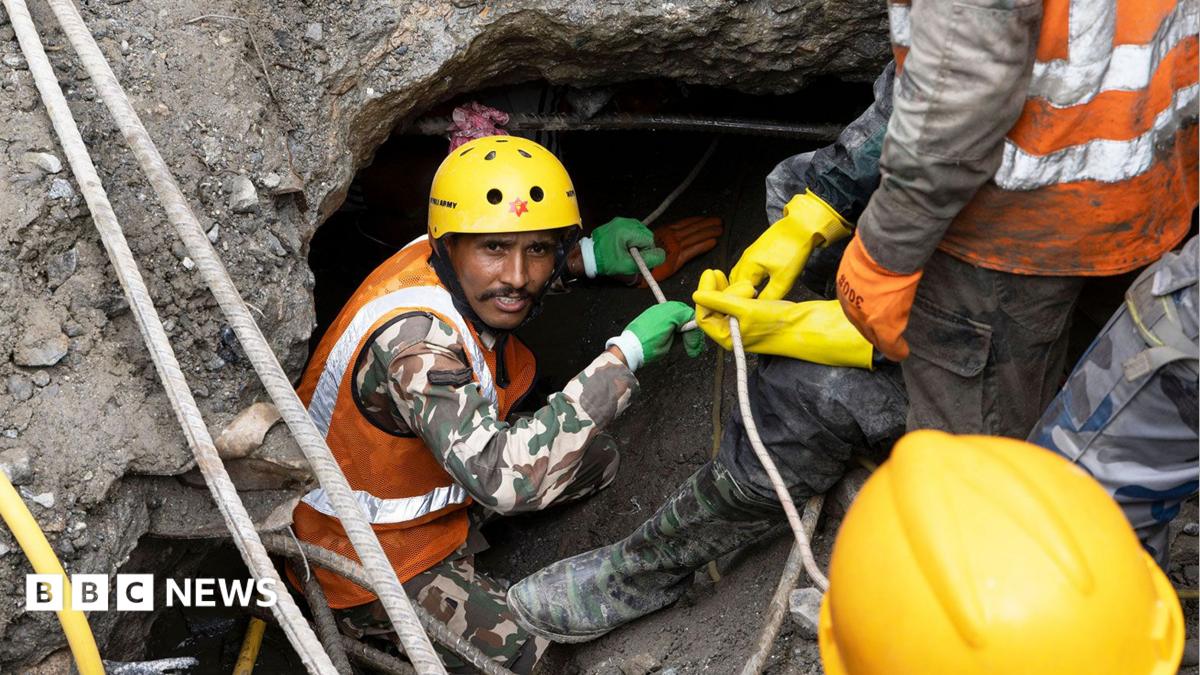
A tunnelling expert involved in the rescue operation at a blocked Nepalese hydropower tunnel has described to the BBC how they managed to reach survivors.
Arnold Dix has been advising Nepal’s hydropower authorities on how to dig through the blocked tunnel to Trishuli 3A Hydropower Station, which was one of several stations hit by last week’s massive flash flood on the Nepal-Tibet border.
“It’s like layer upon layer of layer of miracles” that they found two men on Friday, he said, given the multiple challenges that they faced.
The first hurdle was to locate the hydropower station, in a landscape rendered nearly unrecognisable by the flood that has so far killed 1,300 people.
“I’ve never known a rescue operation where you had to look for an entrance of a tunnel that was previously up the hill, that was now underground. You can imagine the enormity of the avalanche, it completely buried the entrance,” said Dix, who is the president of the International Tunnelling and Underground Space Association.
Using engineering techniques, old topographic maps, satellite imagery of the area after the disaster, video footage from helicopters and “anything else we could find on the surface of the mountain such as power poles”, Dix and his team triangulated the likely position of the entrance and started digging.
They found it – but the next challenge was to locate the survivors.
“We knew they would be up ahead, but we didn’t know where exactly. So you just have to start digging in the right direction. And you listen out if you can hear anybody,” he said.
Rescuers had to get through a tunnel blocked entirely by mud and rocks – some bigger than cars – and had to resort to using explosives to clear the way.
“We had to use explosives which we normally never do because of the risk of blowing up people [trapped in the tunnel] and blowing ourselves up,” said Dix.
He credited the Nepalese army for doing “a wonderful job” in managing the explosions with precision to ensure they would not destabilise the tunnel.
At the same time, they discovered the tunnel was still full of water.
Using excavators and pumping machines, Nepalese rescuers dug a series of trenches from the tunnel all the way to the river outside, so they could drain the water.
About the Author