
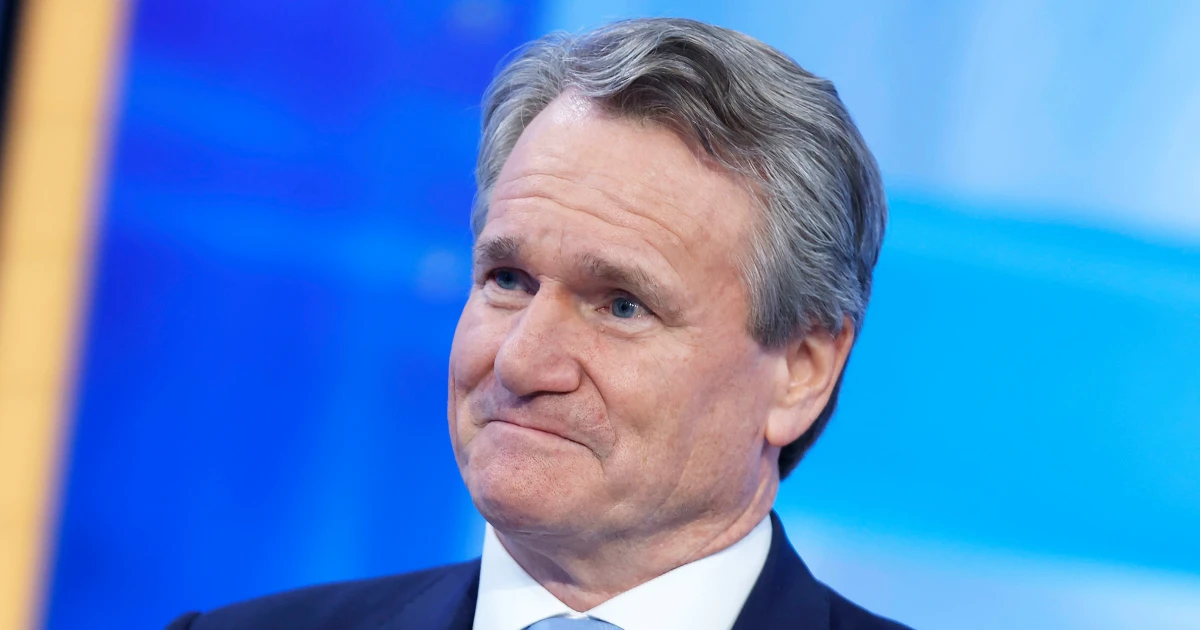
Bank of America CEO Brian Moynihan is one of the few people who really knows in real time how Americans are contending with rising inflation and higher gas prices. And he sees clues to how they are responding in the pet food aisle.
Subscribe to read this story ad-free
Get unlimited access to ad-free articles and exclusive content.

“You know, higher end pet food is not being charged as much on our credit and debit cards as the next brand down,” Moynihan said during a recent interview with NBC News, citing aggregated internal bank data. This, he added, is despite a wave of advertising by the premium pet food brands.
“What you’re seeing is people are shifting, so people shift around and make room for the higher gas prices,” he said. “That’s the reality of the day-to-day consumer.”
With almost 70 million customers, Bank of America’s data offers a detailed picture of how people are managing their money.
Inflation outpaced wage growth in May for the second month in a row, and consumers were paying around 40% more at the pump than they were before the U.S. launched a war against Iran.
But the trend of consumers trading down is only one part of a bigger picture, Moynihan told NBC News at the bank’s New York Financial Center, the latest installment in NBC’s recently launched Business in America series.

FORSUBSCRIBERS

Monthly spending on the bank’s credit and debit cards was up 5% overall in May over last year, Moynihan said.
The data also showed that spending extended well beyond the bare necessities. Consumers “are still spending on vacations and things like that, which is good for America. They still go out to eat, which is also good. Those are job-creating activities.”
Despite what the data shows, Moynihan acknowledged that the U.S. economy is facing a vibes problem. In surveys and interviews, Americans overwhelmingly say they are pessimistic about both their own finances and the economy overall. Yet they keep spending.
“We watch what they do, not what they say,” said Moynihan, and “they’re spending money and doing things.”
“What they’re saying is they’re very upset and they’re worried about high prices, affordability. We have to watch that, because if it goes from ‘what they say versus what they do’ to what they’re doing, that’s a real problem for the U.S. economy.”
Today’s bills vs. tomorrow’s plans
Consumer spending is responsible for the lion’s share of U.S. gross domestic product. But financial security on a personal level is about far more than having enough money to get to the end of the month.
For many Americans, it’s also impacted by how much they can afford to invest in their children and grandchildren.
Moynihan understands this first-hand. Growing up, “We had eight kids, and my parents were unbelievable. My dad was middle class, but they sent eight kids to college.”
Student loans were a big part of that, but Moynihan also remembers how his dad would step in to bridge the gap between what they could pay and what school was going to cost.
“It was a simple thing: You took all the money you earned, and you put it on a table. And you borrowed all you could, and then basically pushed that on the table. And he would pay the difference, and he had to borrow to do it.”
For millions of American families, the challenge of balancing today’s bills with investments in tomorrow is just as tough now as it was for his parents, said Moynihan.
“That’s the question, invest in the future but also make sure that you’re always trying to figure out how you can make a balance in the household.”
This isn’t just an individual question, though. “To the societal question, we’ve got to make sure all Americans earn a great standard of living, better than anybody in the world.”
To this end, Moynihan says the bank is trying to do its part, in a job market and an economy that’s changing faster than many of the workers in it.
A new corporate social responsibility
Moynihan also has a message for his fellow business leaders across the country: Keep hiring.
“Our job, a corporation’s job, is to hire people, pay them well, train them well, get them ready for this brave new thing called AI,” he said.
As artificial intelligence reshapes every industry, Moynihan said corporate leaders had a new social responsibility to keep hiring entry-level workers and be ready to train them to use AI in new ways, instead of planning for a future where AI replaces them.
“Apply AI, because you need to do that for the shareholder, and make sure you’re making money. But do it in a way that you’re making sure that you’re reskilling your people, retraining your people.”
The rapid adoption of AI tools in the workplace has sparked concerns that many types of jobs — and especially entry-level positions — will be replaced by this revolutionary technology.
Yet the bank recently hired 2,000 recent college graduates and another 2,000 summer interns, and it pledged to hire 10,000 veterans and 8,000 community college recruits over the next five years.
“Corporate leaders have to take that burden on,” said Moynihan, who recalled how he used to roll quarters together to pay his rent when he was first starting his career.
With a headcount of roughly 210,000, Moynihan says the bank needs to hire 1,300-1,500 people a month to keep up with job movers and retirements. He says the bank plans headcount very carefully and uses that attrition to re-deploy and retrain workers.
“Affordability is very tough on people, but we have to do our part to make sure our teammates can live well.”
Last year, Bank of America raised its minimum wage to $25 an hour, increasing the annual starting salary to more than $50,000.
About the Author