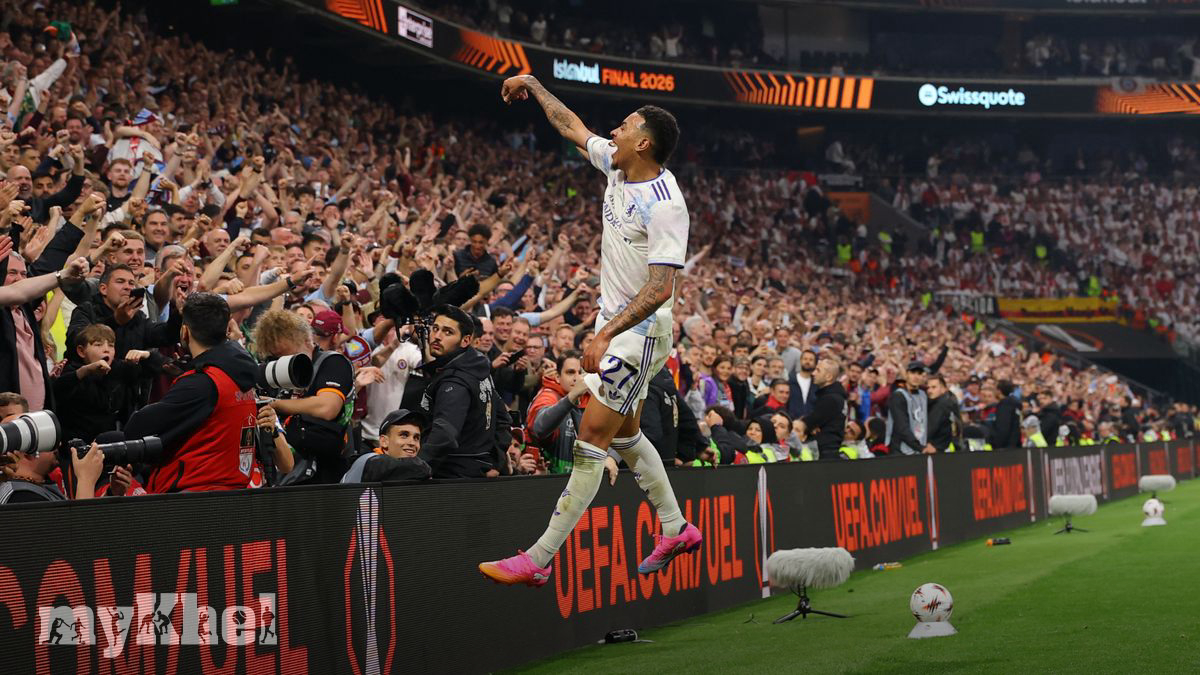
Aston Villa claimed a first major European trophy since 1982 with a 3-0 win over Freiburg, and Morgan Rogers believes the squad has written a lasting chapter in the club’s story. Unai Emery’s team controlled the Europa League final at Tupras Stadyumu, with Youri Tielemans, Emiliano Buendia and Rogers all scoring in a one-sided contest.
The breakthrough came on 41 minutes when Tielemans struck from a corner routine, before Buendia doubled the advantage with another precise finish just before half-time. Rogers then slid in a third goal shortly before the hour, guiding Buendia’s driven cross beyond Noah Atubolu and completing a result that ended Villa’s 44-year wait for European silverware.
Rogers’ close-range finish not only confirmed the victory, it also placed the forward in elite company. At 23 years and 298 days, Rogers became the youngest English player to score in a major European final since Steven Gerrard, who was 20 years and 351 days when netting for Liverpool against Alaves in the 2001 UEFA Cup final.
Rogers also played a key part in the opener, lifting a clever pass towards Tielemans to create the first goal. That assist moved Rogers to 11 across all competitions this season. Since the FIFA Club World Cup, only Bruno Fernandes with 21, Rayan Cherki with 16 and Dominik Szoboszlai with 12 have recorded more among Premier League players.
Reflecting on the achievement, Rogers said the group understood the scale of what had been done for Aston Villa. “It’s hard to put into words, we’ve worked so hard for this. We’ve delivered and come through,” Rogers told TNT Sports. “It’s a great moment for the fans, great for the club. We’ll go down in history.”
Rogers explained that Emery had been challenging the forward to attack the penalty area more often and take simpler chances. “There was so much excitement. We’re all really excited. The manager has been banging on at me to get easier goals and get into the box. I’m happy I could get a toe onto it and score. I’m tired but not that tired. It’s all worth it in the end.”
The contest swung firmly in Villa’s favour through Tielemans’ first-half volley, which arrowed into the bottom-left corner from Rogers’ lofted pass. That strike was Villa’s seventh goal from a corner in this season’s Europa League, the highest tally in the competition, with only Porto in 2010-11 ever scoring more from corners in one campaign, with eight.
Villa’s three-goal margin also stood out historically in UEFA competition. Only Borussia Monchengladbach against FC Twente in 1975, Real Madrid against Koln in 1986 and Sevilla against Middlesbrough in 2006 have won either the final, or a leg of the final, in the UEFA Cup or Europa League by a larger margin, with each of those victories decided by four goals.
{TABLE_1}
23y 298d – Morgan Rogers is the youngest Englishman to score in a major European final since Steven Gerrard for Liverpool vs Alavs in the 2001 UEFA Cup final (20y 351d). Lions. pic.twitter.com/kMcnbiE3osOptaJoe (@OptaJoe) May 20, 2026
Tielemans underlined how demanding the campaign had been for Aston Villa, with domestic and European targets achieved. “I feel amazing. My voice is a bit gone, but it’s all good. We put in a shift, top performance. We had a great season. To top it off with this, it’s amazing,” Tielemans added, speaking after collecting the trophy.
The midfielder highlighted the team’s recovery from a difficult opening to the season, stressing the contribution from the entire squad and staff. “It’s been a season with a lot of ups and downs. We started so, so bad. Our standards were very poor. The way we turned things around was a credit to the players and staff. We kept working, believing. We got the win in the end, the Champions League next season and a trophy.”
For Aston Villa, the night in Turkiye echoed the famous victory over Bayern Munich in the 1982 European Cup, adding a fresh European honour after more than four decades. With Champions League qualification also secured, Emery, Rogers, Tielemans, Buendia and their team-mates now sit alongside that earlier side in the club’s European history.
Story first published: Thursday, May 21, 2026, 3:44 [IST]
About the Author