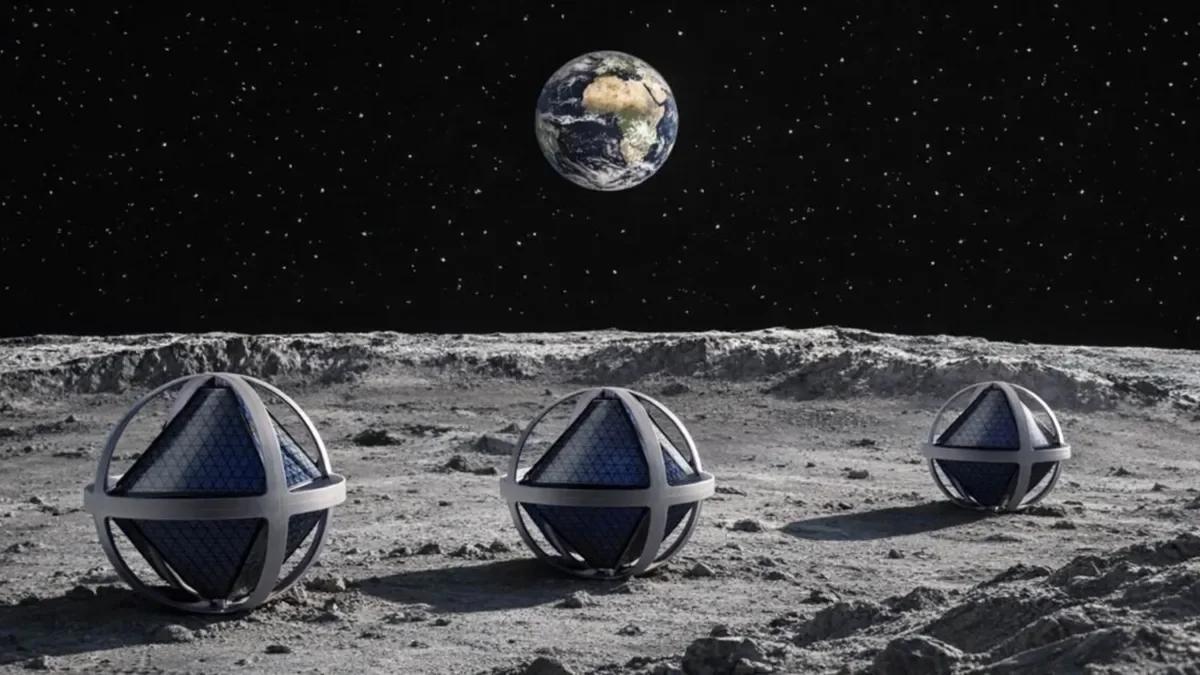
China’s Chang’e-8 Moon lander mission is scheduled for 2029, and just like other major launches, it has some room left over for additional payloads. The latest to be announced is a payload for the Africa2Moon program, consisting of three spherical sensors that will constitute the first-ever African lunar science mission.
The Africa2Moon program is a South Africa-led effort that brings together scientists from around the continent. No African space agency currently has the ability to launch to the Moon, however, so the plan was always predicated on using the launch capabilities of other countries.
Now, China has stepped up to provide that space. The three spherical sensors are called Bounced African Low Lunar Spheres, a somewhat tortured name with an unfortunate acronym. As the name implies, they’re meant to lie on the surface of the Moon and “bounce” signals back to Earth via the Chang’e-8 lander and other Chinese installations.
Illustration of one Bounced African Low Lunar Sphere
Credit: Africa2Moon
Advertisement
Advertisement
Each Bounced African Low Lunar Sphere contains two triangular solar panels within a spherical frame of interlocking rings. They’re intended to pick up signals below 20MHz, which are useful because they’re usually inaccessible from Earth. These low-frequency radio waves can provide insight into the earliest events in the evolution of the universe.
The far side of the Moon offers astronomy a unique benefit: a whole Moon in the way of Earth’s pesky electromagnetic chaos. The confounding signals come from human technology, but also from the Earth’s own ionospheric interference—yes, that’s not just from Star Trek.
Their placement is why these BALLS should be able to pick up tiny, nuanced signals originating near the birth of the universe.
About the Author