Sept. 1 (UPI) — The death toll from a flash flood that hit northeastern Nepal nearly a week ago rose further Tuesday to more than 1,000, officials said, as rescuers raced to find thousands missing.
Nepali Prime Minister Balendra Shah reported that at least 1,050 people in Nepal were dead, and more than 4,400 were missing. Combined with the 16 people killed in China from the flood, the number of dead is 1,066 as of Tuesday afternoon.
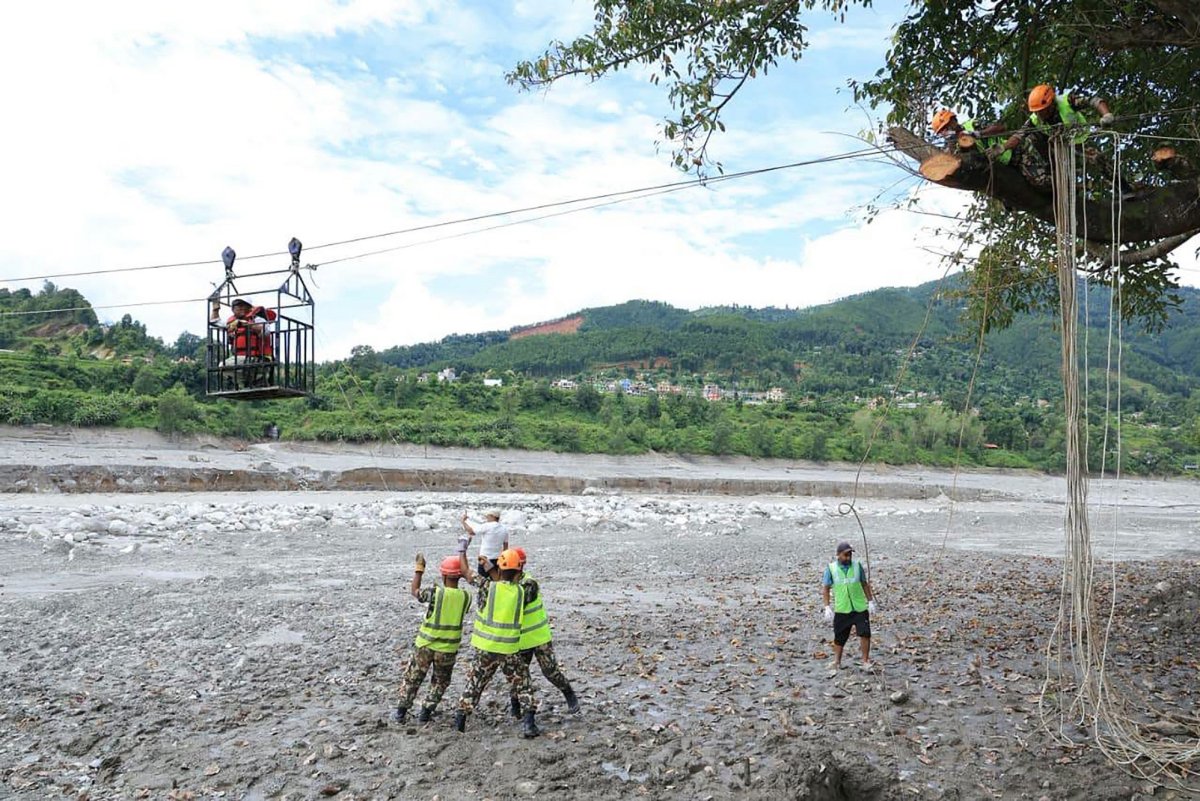
Nearly 12,000 people have been rescued since the flood hit near the Nepali-Tibet border Wednesday morning, causing widespread destruction and devastation.
There were 583 foreign nationals missing. Around 75 Americans were missing in Nepal, a U.S. State Department spokesperson told CNN Tuesday. So far, 14 American citizens are confirmed safe, the spokesperson said.
A United Nations report Monday, from the Office of the U.N. Resident Coordinator in Nepal, said several areas in the mountains haven’t been reached.
“Access challenges persist across affected areas due to erosion along riverbanks, damaged bridges, road failures and disruptions to electricity and communication services,” the report said.
The report said there were about 2,600 children under 5 at risk for “severe wasting,” while thousands of pregnant women required nutritional support, CNN reported. It said about 100 children, according to preliminary data, were separated from their parents or caregivers. At least 19 schools were damaged.
The glacier that collapsed causing the landslide and flooding had visible signs of change days ahead of the disaster, a new report from a consortium of scientists said.
“In hindsight, there were some pre-event indications,” including melt water that had turned visibly brown and signs of a crack propagating into the surrounding bedrock slope days before the collapse, scientists said in a report published last week.
The report also recommended more comprehensive early warning systems, saying it could have saved a “significant number of lives.”
Chinese and Nepali authorities met in May to discuss cooperation on monitoring natural hazards in the Himalayas, a government official told CNN.
Early warning systems had been added recently in the region focusing on glacial lakes in China, but none in this area for glacial issues, according to the report from the HiRISK scientific consortium, which monitors risk data in mountainous environments.
But the speed of the landslide meant that warning systems wouldn’t have been enough for evacuation at the border checkpoint that was destroyed.
“To be clear, there is almost no way that anyone could have detected this event prior — it happened in a blind spot,” Austin Lord, a senior fellow in the Energy, Water and Sustainability program at the Stimson Center think tank in Washington, D.C., wrote in a commentary. “Despite much debate about why there was no prior warning and how alerts could have been generated, this event was extremely difficult to detect. No one, in China or Nepal or within the international scientific community monitoring such risks [including our team at Stimson], was able to identify this site as an emergent risk. No one held back any information. The speed and intensity of this event were overwhelming for all.”
About the Author