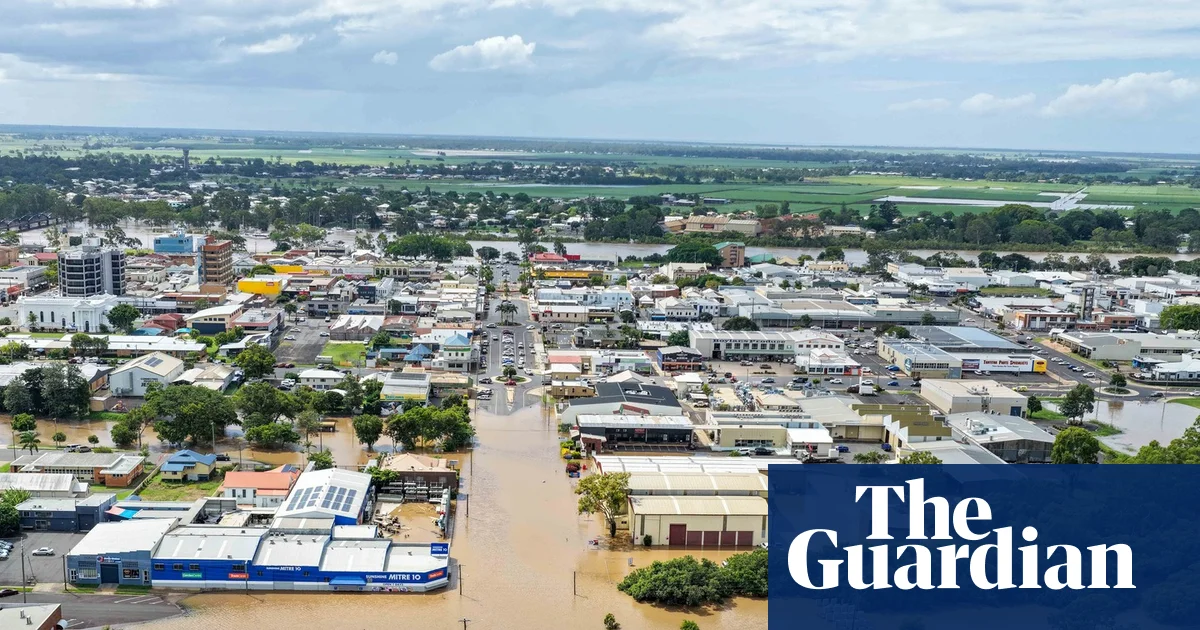
Thousands of residents of the coastal Queensland city of Bundaberg could be isolated for days amid major flooding in the wake of a tropical low.
Hundreds of homes in the regional hub are set to be affected after the Burnett River burst its banks, triggering memories of a 2010 disaster.
More than 400 homes and businesses are under threat, with the river set to peak at 7.6 metres early on Wednesday.
It is only just below the 7.92m levels of 16 years earlier when the city of more than 70,000 people was inundated and hundreds forced to evacuate.
Sign up: AU Breaking News email
Locals were asked to leave immediately late on Tuesday before the community’s two major bridges were shut down, leaving about 10,000 people isolated.
Helen Blackburn, mayor of Bundaberg Regional Council, said on Tuesday afternoon that about 280 homes and 120 businesses were expected to be impacted.
“This is a difficult time for many people and mental health comes into it as well, with those people impacted in previous floods feeling anxiety,” she said.
She implored people to put their personal safety first. “We’re not new to this, we’ve done it before,” she said. “We can replace possessions. We can’t replace people.”
Water rescue crews and extra emergency services, including more than 30 police officers, were sent to the Bundaberg region in preparation.
It comes after days of heavy rain across northern Australia, with parts of the Northern Territory experiencing its worst flooding in decades, and Darwin residents asked to reduce water use after the Darwin River Dam – the city’s major water source – stopped operating due to flooding.
Temporary generators were put in place, with the full water supply set to return in the coming days.
More rain has stalled the clean-up at Katherine, which on Saturday experienced its worst flooding in decades, and where hundreds of people remain in shelters. Houses are still without power and crocodiles have been spotted in flood waters.
Hundreds of residents from the communities of Daly River, Palumpa, Beswick and Jilkminggan were airlifted at the weekend, mostly to Darwin.
Flood watches were in place across much of the NT, particularly on the Top End’s north-west coast including Darwin, the Bureau of Meteorology said.
“Within this flood watch area, any river, creek, lagoon, billabong, any waterway, is going to be very, very responsive to heavy falls that can occur,” the Bureau of Meteorology’s Shenage Gamble told reporters on Tuesday. That could readily lead to localised and flash flooding, she said.
Almost 800 roads across Queensland have been cut by flood waters after the tropical low left a trail of destruction, claiming about 1,000 livestock.
Inland, Gayndah residents on Tuesday were urged to take shelter at the local community hall, with a flood emergency warning issued by the North Burnett regional council.
Among Queensland’s highest three-day rainfall totals – from 9am Saturday to 9am Tuesday – were 396mm at Boondooma, 381mm at Marodian, 279mm at Bundaberg South and 263mm at Gympie.
The prime minister, Anthony Albanese, on Tuesday urged people in affected communities to prioritise their safety by following flood advice and warnings.
He warned motorists not to drive through flood waters after several people were rescued from inside or on top of their cars, including a child from Bargara near Bundaberg.
“If it’s flooded, forget it – we can’t say it too many times,” he said. “If people follow that advice, we’ll continue to provide support, as we always do, with the state and territory governments.”
Across Australia, the 2025-26 summer was the wettest in nearly a decade, according to the BoM, with rainfall 32% higher than average across the country.
Global heating is making Australia more vulnerable to extreme weather and natural disasters, including flash flooding and intense rainfall. In 2025, the third-hottest year on record, global surface air temperatures averaged 1.48C above preindustrial levels. For each 1C of warming, the atmosphere can hold 7% more moisture.
About the Author