
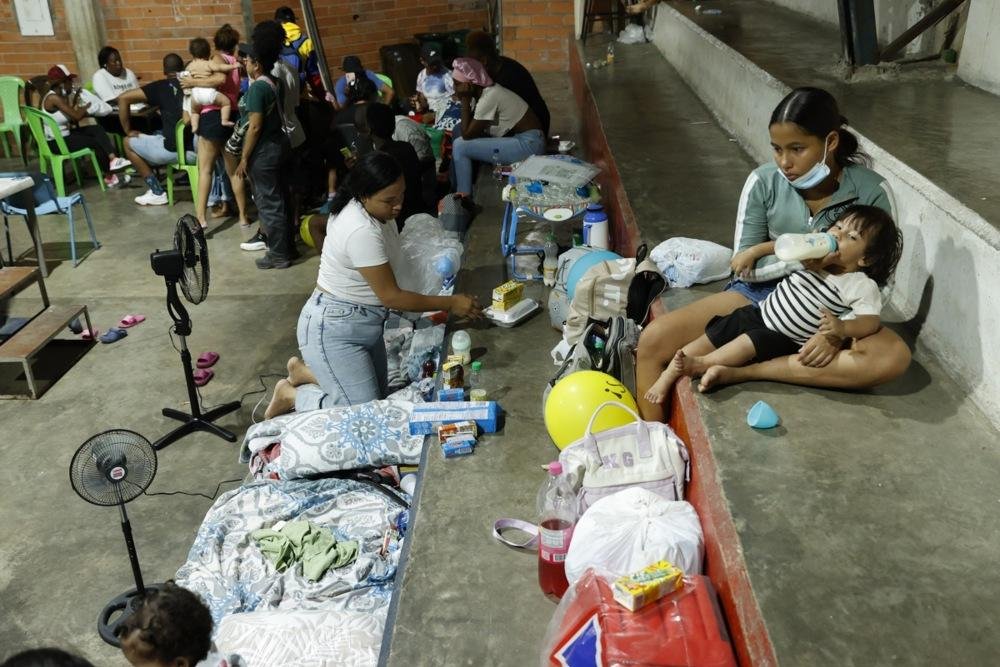
Families rest Thursday in a shelter in Chico, one of Colombia’s poorest departments, after a 7.4-magnitude earthquake struck several regions of the country three days earlier. Photo by Mauricio Duenas Castaneda/EPA
Aug. 13 (UPI) — Colombia’s government declared a state of economic, social and ecological emergency to accelerate reconstruction and address the humanitarian crisis caused by Monday’s magnitude 7.4 earthquake.
President Abelardo de la Espriella invoked the constitutional measure in response to the scale of the disaster, which has severely affected Chocó, the Coffee Region and Valle del Cauca amid fiscal pressures and limited budget resources.
Tthe death toll has risen to 273. Another 3,824 people have received medical treatment and 377 remain missing, according to a report from Colombia’s National Unit for Disaster Risk Management.
During a news conference in Bogotá, De la Espriella announced the creation of the “Fondo Milagro,” or Miracle Fund, a special mechanism designed to centralize and transparently manage domestic and international donations and other financial resources to rebuild destroyed infrastructure.
The emergency decree will also allow the government to provide rental subsidies, utility relief and debt refinancing for people affected by the disaster.
Finance Minister Miguel Gómez announced that the government will seek up to $450 million in financing from the World Bank, Noticias Caracol reported.
Gómez had previously estimated that reconstruction could require about $6.4 billion. The economic emergency declaration will give the government greater flexibility to redirect existing budget resources and quickly secure international financing.
According to the official assessment, 40,753 families, representing 97,515 people, have been directly affected. Authorities reported 11,347 homes destroyed, 74,873 homes severely damaged and 172 large buildings collapsed.
The earthquake also caused structural damage to 2,198 schools and 631 community centers.
Colombian authorities also imposed restrictions on international urban search-and-rescue operations. Only specialized teams from the United States, Israel, Ecuador and El Salvador were authorized to enter the country for operations on the ground because they met required international standards, El País reported.
The Foreign Ministry said Colombia remains open to receiving financial assistance and other forms of international aid from countries around the world.
The state of emergency gives the executive branch extraordinary authority to issue decrees with the force of law, redirect national budget funds and expedite direct contracting without the usual congressional procedures.
The declaration will initially remain in effect for 30 days and will be subject to review by Colombia’s Constitutional Court, which will determine whether each presidential decree is directly and exclusively related to mitigating the effects of the national disaster, RTVC Noticias reported.
About the Author