
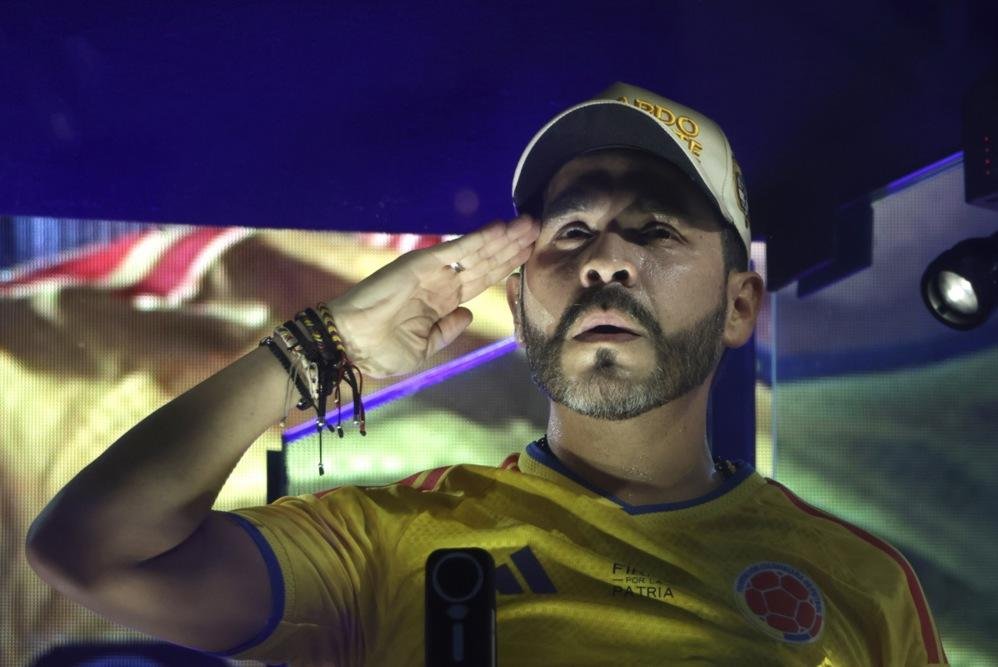
Colombian presidential candidate Abelardo de la Espriella gives a military-style salute at a campaign event in Cartagena, Colombia, on Tuesday. De la Espriella appeared after a Bogota court ordered his campaign to remove electoral propaganda using national symbols and emblems of military and police institutions. Colombia’s presidential runoff election is scheduled June 21, Photo by Ricardo Maldonado/EPA
June 11 (UPI) — A group of former Colombian high court justices and prominent constitutional scholars questioned the presidential candidacy of attorney Abelardo de la Espriella, warning that the U.S. citizenship he obtained through naturalization could be incompatible with serving as Colombia’s president.
The legal experts argue that a potential constitutional conflict exists because the U.S. naturalization process requires an oath renouncing allegiance to foreign governments and pledging loyalty to the United States.
In their view, that obligation could come into tension with the duties inherent to Colombia’s presidency, particularly given the office’s role as head of state and commander in chief of the armed forces, a position that demands exclusive commitment to the country’s sovereignty, national defense and interests.
They also noted that naturalization entails assuming legal obligations to the United States, including defending its Constitution and, under certain circumstances, the possibility of military service.
In a statement released Wednesday, the jurists said Colombia’s 1991 Constitution establishes three requirements for serving as president: being a Colombian citizen by birth, being a citizen in good standing and being older than 30.
“The legal issue does not lie in the existence of a second nationality, but in the duties and obligations acquired through naturalization,” the signatories said.
De la Espriella holds three nationalities: Colombian, Italian and American. According to the jurists, his Italian citizenship, obtained through descent, does not create incompatibilities with holding public office in Colombia.
The former justices said they decided to intervene publicly because they believe there is an ethical and constitutional duty to warn about the possible legal, political and sovereignty implications arising from the candidate’s possession of both nationalities.
The position prompted a swift response from De la Espriella’s campaign.
Germán Calderón España, attorney for the presidential candidate, rejected the arguments and said the Constitution is clear regarding the requirements for assuming the nation’s highest office.
The attorney added that the only constitutional restriction related to dual nationality does not apply to Colombians by birth, a condition that, he said, De la Espriella meets because he was born in Bogotá.
“The general requirements for becoming president of the Republic are being a Colombian citizen by birth, being a citizen in good standing and being older than 30,” Calderón España wrote on the social media platform X.
According to Calderón España, the objections raised by the former justices lack legal basis because the Constitution expressly provides an exception for Colombians by birth who hold another nationality.
The campaign’s legal representative also announced that he will file a legal challenge against a ruling by the Superior Court of Bogotá that prohibited the use of national symbols and the slogan “Firmes por la Patria” in activities related to the candidacy.
Ramiro Bejarano, a professor at Externado University of Colombia, said the debate over the candidate’s U.S. citizenship deserves detailed analysis.
Speaking to Blu Radio, Bejarano argued that the discussion should focus on whether the commitments assumed through U.S. naturalization could influence the decisions of a future president, although he clarified that the controversy does not necessarily affect the legality of the candidacy.
De la Espriella became the biggest political surprise of Colombia’s election after winning the first round of the presidential race with 43.74% of the vote.
The right-wing candidate from the Firmes por la Patria movement defeated government-backed candidate Iván Cepeda, who received 40.90%, and advanced to the runoff backed by a platform centered on security, free markets and close ties with Washington, earning the public endorsement of President Donald Trump.
About the Author


