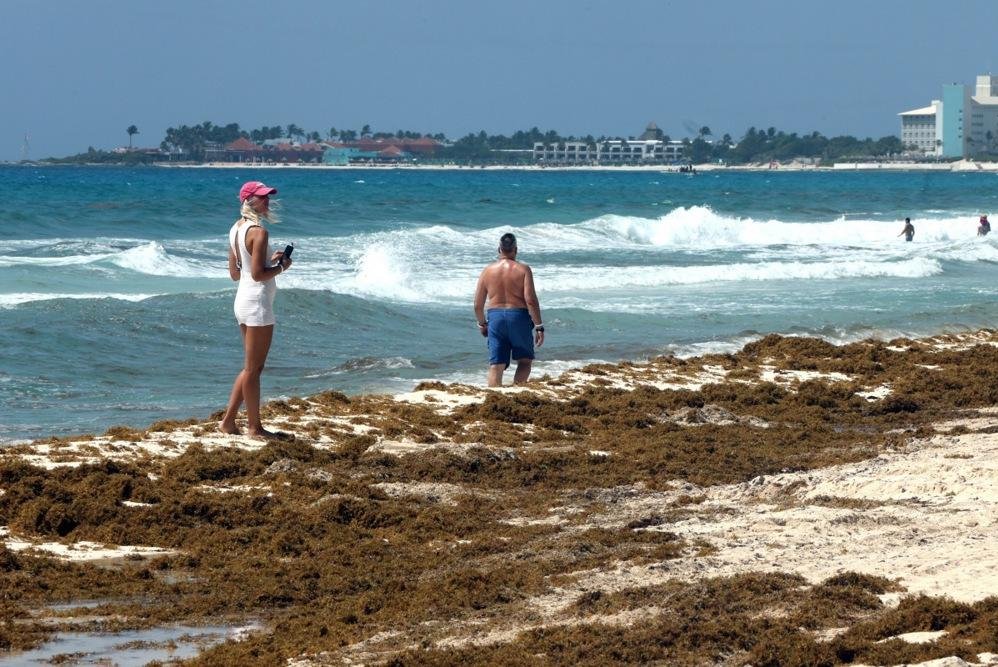
People walk on a beach covered in sargassum in Cancun, Quintana Roo, Mexico, earlier this month. Photo by Alonso Cupul/EPA
July 29 (UPI) — Mexican President Claudia Sheinbaum said Wednesday her government will present a comprehensive agreement to address the sargassum crisis in the Mexican Caribbean.
Her announcement came after meeting with representatives of Quintana Roo’s tourism sector, as the state faces the largest accumulation of the macroalgae on record.
During her daily Mañanera del Pueblo news conference, Sheinbaum said she would meet with tourism business leaders to define a joint strategy and said the agreements reached would be announced afterward.
“This afternoon, we will reach an agreement on the management of sargassum, which we will announce at Thursday’s Mañanera [early morning press conference],” the president said.
The announcement comes as Quintana Roo continues to face a record sargassum season.
According to the Quintana Roo Secretariat of Ecology and Environment, the state has collected more than 92,000 tons of the macroalgae this year — an amount that has kept eight coastal municipalities on alert.
State environmental authorities expect 119,000 tons of sargassum to reach the coastline before the end of the year, far exceeding the record 96,000 tons recorded in 2025, La Nación reported.
The accumulation of sargassum has forced temporary closure of beaches at several tourist destinations and significantly increased costs for the region’s main industry.
According to La Nación, Quintana Roo Gov. Mara Lezama estimated that sargassum management represents a cost equivalent to approximately 11% of the state’s gross domestic product, or about $2 billion annually.
The news outlet reported that the Riviera Maya Hotel Association estimates hotels and resorts spend about $150 million annually to remove the seaweed from beaches.
The Quintana Roo Sargassum Monitoring Network also reported that, by late June, 92.5% of the state’s beaches were experiencing “excessive” levels of sargassum.
In recent weeks, Sheinbaum toured the coastline between Tulum and Puerto Morelos by helicopter with the secretary of the Navy to assess the impact.
As part of the strategy, she said the government will acquire more vessels to intercept the sargassum before it reaches shore.
“We are going to buy more boats to capture it at sea, which is the best way to do it,” the president said, adding that the plan also includes expanding the processing and recycling of the macroalgae.
Playa del Carmen Mayor Estefanía Mercado said the comprehensive plan “will bring great news” for the municipality and strengthen efforts to combat sargassum ahead of 2027.
Mercado said the strategy is the result of efforts by Gov. Mara Lezama with the federal government and recalled that Sheinbaum recently flew over Quintana Roo’s coastline to identify the hardest-hit areas.
Tourism Secretary Josefina Rodríguez said the strategy aims to make Mexico an international benchmark in sargassum management.
According to Reportur, the official said no other country has developed a system combining offshore collection, beach cleaning and the comprehensive use of the macroalgae.
The Secretariat of the Navy has an operation that consists of 11 specialized vessels, one amphibious harvester, 18 support boats, two barges, four drones and more than 29,500 feet containment barriers, according to official information.
Specialists attribute the increase in sargassum influxes to rising ocean temperatures, greater nutrient availability and prolonged hours of solar radiation.
According to La Nación, which cited Brian Barnes, an assistant research professor in the University of South Florida College of Marine Science in St. Petersburg, those factors have fueled the accelerated growth of the macroalgae in the tropical Atlantic.
About the Author