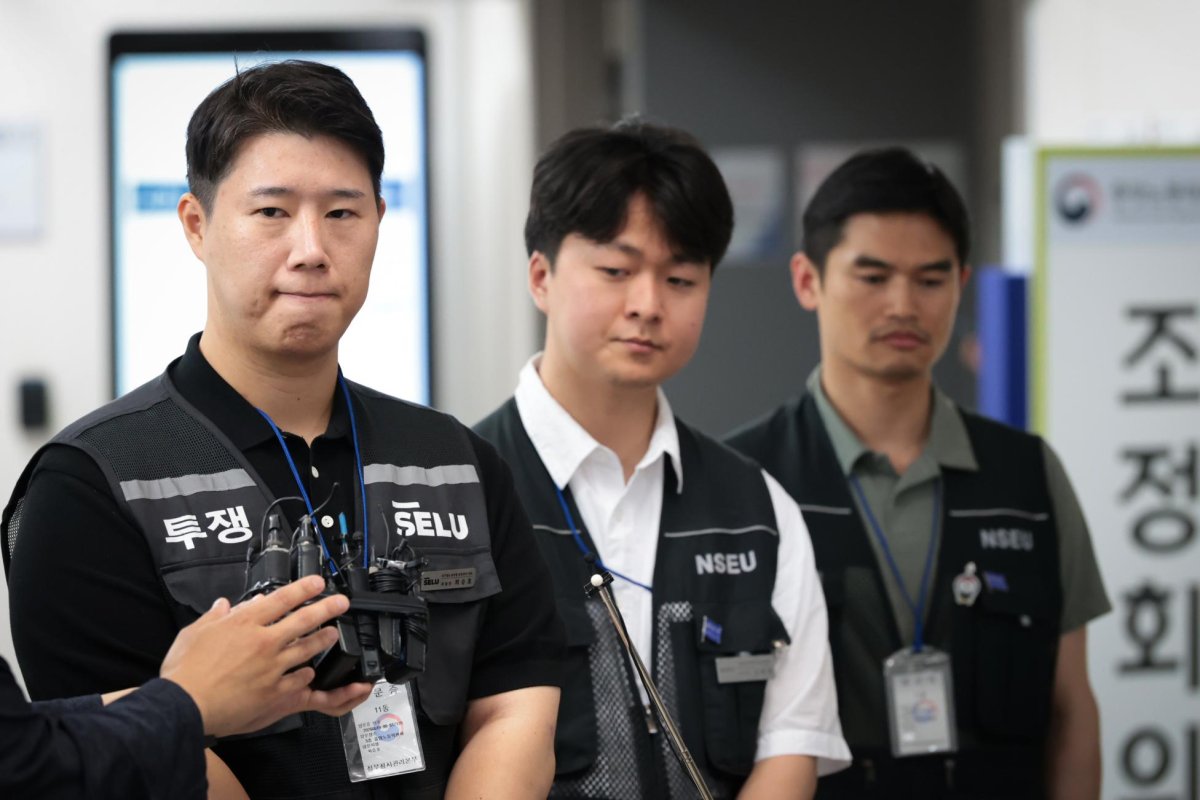
Choi Seung-ho (L), head of Samsung Electronics Co.’s largest labor union, speaks to reporters after attending the third government-led mediation talks with management at the National Labor Relations Commission office in Sejong on Wednesday. Photo by Yonhap
Last-minute wage talks between Samsung Electronics Co. and its largest labor union were held Wednesday, with South Korea’s labor minister personally mediating negotiations as unionized workers prepared to stage a major strike at the world’s largest memory chipmaker.
About 48,000 workers are set to walk off the job for 18 days starting Thursday after management rejected a mediation proposal that the union had accepted following the latest round of government-mediated negotiations earlier in the day.
Labor Minister Kim Young-hoon resumed the talks at 4 p.m. The latest negotiations differ from previous mediation efforts and are not intended to produce a binding arbitration proposal.
The meeting raises the question of whether or not the government will issue an emergency arbitration order, as officials have raised concerns about potential losses to South Korea’s export-dependent economy and the possible impact on the global chip supply chain.
Under South Korean law, the labor minister can issue an emergency arbitration order if a labor dispute is deemed likely to harm the national economy or seriously disrupt the daily lives of ordinary citizens.
“We accepted the mediator’s proposal,” the company’s largest union earlier said, adding that it will go ahead with the legally scheduled general strike as planned.
Samsung management, meanwhile, expressed “deep regret” and urged the union to continue negotiations, saying a strike should not take place under any circumstances.
“Despite the company largely incorporating the union’s demands, it continues to insist on an unreasonably large compensation package even for loss-making business units,” the company said in a press release.
Park Soo-keun, head of the National Labor Relations Commission, said a mediation proposal had been presented and accepted by the union, but the company declined to sign it.
“Since an understanding will be reached, if both sides agree, we will respond to a change in stance, at any time, day or night, weekday or holiday,” he said.
Labor and management have been deadlocked since late last year over performance-based bonuses tied to earnings from the tech giant’s artificial intelligence (AI)-related semiconductor business amid an ongoing global memory supercycle.
The company has proposed maintaining the current excess profit incentive system while allowing the bonus pool to be calculated based on 10 percent of operating profit. It also proposed introducing a special compensation system, saying it would create a more flexible incentive structure.
In contrast, the union is demanding fixed performance bonuses equal to 15 percent of the semiconductor division’s operating profit, along with the removal of payout caps.
During government-mediated talks, the two sides reached understanding on eliminating bonus caps set at 50 percent of annual salary, according to an industry source.
However, they remained divided over how bonuses should be distributed across loss-making business units and whether any agreement should be formally institutionalized.
Industry officials had warned of the astronomical impact a full-scale strike could have on the broader South Korean economy, with estimated losses reaching up to 100 trillion won (US$66.98 billion).
Semiconductor exports account for roughly 35 percent of South Korea’s exports, fueled by growing investment in AI data centers.
In the first quarter of 2026, the country’s exports reached a record $219.9 billion, with semiconductor shipments surging 139 percent from a year earlier to $78.5 billion.
Others warned that a strike at Samsung Electronics, which accounts for about one-quarter of the benchmark Korea Composite Stock Price Index (KOSPI) market capitalization, could accelerate declines in the stock index.
Global companies that rely on South Korea’s semiconductor supply chain also expressed concerns over potential supply disruptions.
Samsung accounts for roughly one-third of the global dynamic random-access memory (DRAM) market. DRAM chips, key components in laptops and smartphones, have become essential building blocks for AI data centers worldwide.
Samsung reclaimed the top spot in the global DRAM market in the fourth quarter of last year, driven by increased sales of high-bandwidth memory (HBM) chips, according to market research firm TrendForce.
Industry estimates suggested that an 18-day strike could reduce the global DRAM supply by 3 to 4 percent and NAND flash supply by 2 to 3 percent, likely driving further price increases.
Copyright (c) Yonhap News Agency prohibits its content from being redistributed or reprinted without consent, and forbids the content from being learned and used by artificial intelligence systems.
About the Author