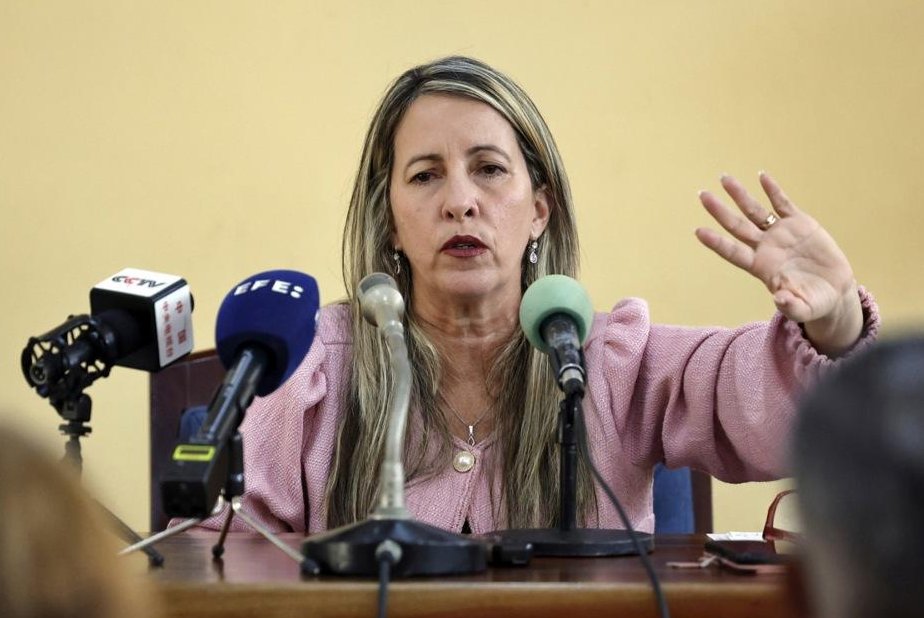
Cuban Education Minister Naima Trujillo announced in a press conference in Havana on Thursday that the upcoming school year will begin with shortages of teachers and school uniforms, alongside curriculum and operational adjustments across all educational levels caused by the country’s ongoing economic and energy crisis. Photo by Ernesto Mastrascusa/EPA
Aug. 28 (UPI) — Cuba will begin the school year Tuesday for 1.4 million students despite a severe economic crisis and widespread disruptions to the power system.
The Education Ministry announced Thursday that it will allow greater flexibility in in-person attendance, school schedules and uniform requirements in an effort to keep classrooms open, the Cuban News Agency reported.
Amid rumors that the start of classes could be postponed because of the energy crisis and warnings from the United Nations Educational, Scientific and Cultural Organization, or UNESCO, about risks to students’ futures, authorities reaffirmed instruction will begin as scheduled.
President Miguel Díaz-Canel reinforced the announcement by posting a video on X showing him visiting several educational institutions.
“To those who talk about collapse in Cuba: More than 1.5 million children and adolescents return to classrooms on Sept. 1,” Díaz-Canel wrote. “To the Education Ministry, local governments, educators and families: Thank you.”
Shortly after the official announcement, Cuba’s state-run Electric Union reported another partial disconnection of the National Electric System, knocking out service in areas between Holguín and Guantánamo, home to approximately 3.4 million people.
At a news conference, Education Minister Naima Trujillo acknowledged the country’s “tremendous difficulties” and said the greatest achievement of the coming school year will simply be carrying it out.
Trujillo said staffing remains one of the main challenges, with the country expected to fill only 73% of teaching positions nationwide. She said the most difficult shortages are concentrated in Havana and other western provinces.
Producing school uniforms poses another challenge. Trujillo said production in August reached only 12% of the amount needed for primary school students, with similar levels for secondary schools. She attributed the shortfall to power outages at factories, a lack of fuel to transport fabric and difficulties importing supplies.
On school meals, Trujillo said initial supplies are available in all regions, although coverage varies significantly. Authorities have prioritized securing food for the first 15 days of the school year.
The government will also seek local alternatives to address transportation difficulties for students and teachers who live far from their schools, Trujillo said.
The new measures come after numerous families questioned the decision on social media to reopen classrooms amid power outages, food shortages and difficulties purchasing shoes, backpacks and other school supplies, Diario de Cuba reported.
About the Author