
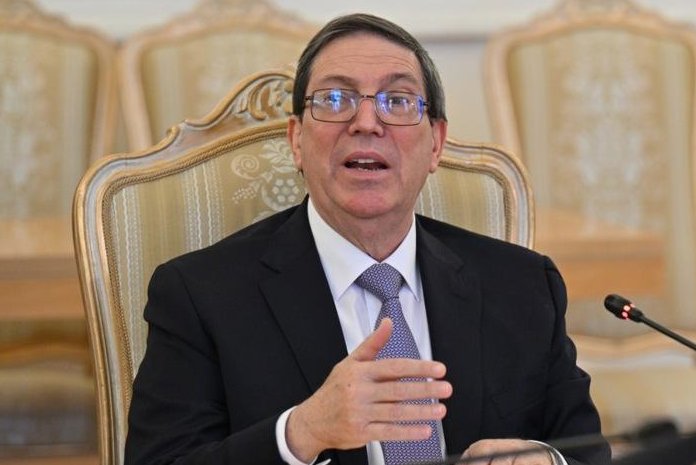
Cuban Foreign Minister Bruno Rodriguez Parr denied a media report that Cuba obtained more than 300 military drones. File Photo by Hector Retamal/EPA/Pool
May 18 (UPI) — Cuba’s foreign minister on Monday reaffirmed the country’s right to “self-defense” against external aggression after a media report alleging his government acquired more than 300 military drones.
Bruno Rodríguez Parrilla made the remarks after Axios published a report that cited classified information and claimed Cuba had purchased the drones from Russia and Iran.
The Cuban foreign minister accused media outlets of echoing narratives promoted by United States authorities through leaked information.
“Those who seek to illegitimately attack Cuba use any pretext, no matter how false or ridiculous, to justify an attack rejected by U.S. and global public opinion,” Rodríguez wrote on X.
Rodríguez added that it was “regrettable that media outlets continue to be accomplices to such a crime.”
The Cuban government has not explicitly denied acquiring military equipment. Instead, Rodríguez dismissed the accusations as a “fabrication” intended to justify economic aggression against the island.
“Without any legitimate excuse, the U.S. government builds, day after day, a fraudulent case to justify the ruthless economic war against the Cuban people and a possible military aggression,” he wrote.
Rodríguez said “Cuba does not threaten nor seek war. It defends peace and prepares itself to confront external aggression in exercise of the right to legitimate self-defense recognized by the U.N. Charter.”
According to the Axios report, officials in Havana allegedly discussed plans to use drones against the U.S. naval base at Guantánamo Bay, U.S. military vessels and Key West, Fla.
Cuban President Miguel Díaz-Canel joined other Cuban officials responding to the reports and said Monday that his country can employ self-defense.
“Cuba, which already suffers from multidimensional aggression from the U.S., does have the absolute and legitimate right to defend itself from a military attack, which cannot logically or honestly be used as an excuse to impose a war against the noble Cuban people,” Diaz=Canel said.
He reiterated that Cuba “does not represent a threat and has no aggressive plans or intentions against any country.”
“It has none against the U.S., nor has it ever had them — something well-known by that nation’s government, especially its defense and national security agencies,” he added.
Díaz-Canel warned that a U.S. military attack on Cuba would have devastating consequences for both sides and the region.
“If carried out, it would provoke bloodshed with incalculable consequences, along with a destructive impact on regional peace and stability,” he said.
The drone story emerged after CIA Director John Ratcliffe traveled to Havana to convey what reports described as a message from Washington that U.S. offers of economic assistance to Cuba were genuine, but time-limited.
According to a report by El Nuevo Herald, Ratcliffe visited Havana to discuss steps the Cuban government would need to take to build a productive relationship with the United States.
Cuba’s Ministry of the Revolutionary Armed Forces, known as MINFAR, joined the government’s public messaging campaign over the weekend, emphasizing Cuba’s right to defend itself against a potential U.S. attack, while likewise avoiding any direct denial of the drone allegations, according to Cuban digital outlet CiberCuba.
MINFAR reposted on Facebook comments by Deputy Foreign Minister Carlos Fernández de Cossío, who said that “those in the U.S. who seek the submission and ultimately the destruction of the Cuban nation through military aggression and war do not waste a minute fabricating pretexts, creating and spreading falsehoods and portraying as extraordinary the logical preparations to confront a possible aggression.”
About the Author