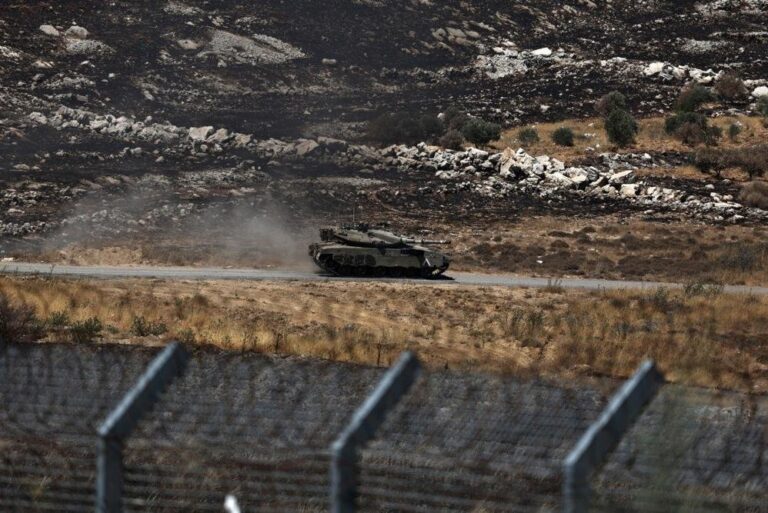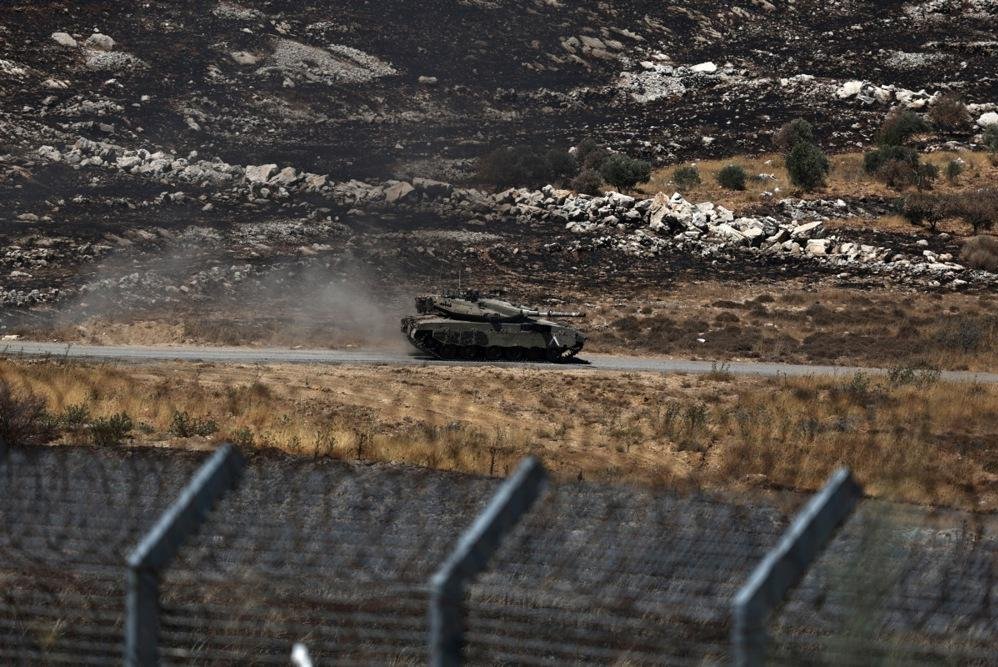
Israeli tanks cross the ceasefire line into the buffer zone near the Israeli-annexed Golan Heights village of Majdal Shams on July 23. Colombia became the second country in the world to recognize Israeli sovereignty over the Golan Heights Photo by Etaf Safadi/EPA
Aug. 11 (UPI) — Israel recorded two diplomatic advances in Latin America, as Colombia became the second country in the world to recognize Israeli sovereignty over the Golan Heights and Venezuela agreed to restore consular services with Israel for the first time since diplomatic relations were severed in 2009.
Colombia’s Foreign Ministry announced Monday its recognition of Israeli sovereignty over the Golan Heights, a strategic plateau along the border between Israel and Syria, saying the decision was in response to “persistent regional instability in the Middle East” and the territory’s strategic importance to Israel’s security.
“Colombia recognizes that Israel’s continued control and sovereignty over the Golan Heights constitutes an essential component of its national defense,” the Colombian Foreign Ministry said.
The decision makes Colombia the second country in the world, after the United States, to recognize Israeli sovereignty over the territory. The United States did so in 2019 during President Donald Trump’s first term.
Israel captured most of the Golan Heights from Syria during the 1967 Six-Day War and extended its laws, jurisdiction and administration over the territory in 1981. The United Nations does not recognize that move and considers the Golan occupied Syrian territory.
U.N. Security Council Resolution 497 declared Israel’s decision “null and void and without international legal effect.”
Syria condemned Colombia’s recognition, saying it violates Syrian sovereignty and international resolutions concerning the territory. The Syrian Foreign Ministry said the Golan is an “integral and indivisible part” of Syria and called on Colombia to reconsider its decision.
The Arab League, Saudi Arabia and Egypt also rejected the move and reaffirmed Syria’s sovereignty over the territory.
Colombia’s decision comes amid a broader shift in relations with Israel under President Abelardo de la Espriella. His government also announced plans to relocate the Colombian Embassy from Tel Aviv to Jerusalem, reversing policies adopted under Gustavo Petro, who severed diplomatic relations with Israel in May 2024 in response to the war in Gaza.
Israeli Foreign Minister Gideon Saar described Colombia’s recognition of Israeli sovereignty over the Golan Heights as a “historic” decision, according to Israel’s Foreign Ministry.
Separately, Israel and Venezuela announced Tuesday that they had agreed to establish a coordination mechanism to provide consular services to their citizens, creating the first official link between the two countries since Caracas severed diplomatic relations with Israel 17 years ago.
The agreement, announced in a joint statement released by Israel’s Foreign Ministry, does not amount to the full restoration of diplomatic relations or include the reopening of embassies.
The two countries also agreed to continue bilateral technical cooperation that began after Israel sent humanitarian assistance to Venezuela following the magnitude-7.2 and 7.5 earthquakes that struck the country June 24.
An Israeli delegation composed of Foreign Ministry and Israel Defense Forces personnel traveled to Venezuela after the earthquakes and worked with Venezuelan authorities and emergency teams on disaster response, recovery and humanitarian assistance.
The rapprochement also comes amid efforts by Venezuela’s Jewish community to promote the normalization of relations.
Venezuela’s Foreign Ministry said Isaac Cohen, chief rabbi of the Venezuelan Israelite Association, delivered a letter to President Delcy Rodríguez asking her to consider restoring diplomatic relations with Israel.
Venezuelan Foreign Minister Félix Plasencia said the request was intended to “address the needs of the Jewish community in our country.”
In their joint statement, Israel and Venezuela highlighted the relationship between Israel and Venezuela’s Jewish community, describing it as an “important bridge of historic friendship” between the two countries.
Venezuela severed diplomatic relations with Israel in January 2009 under then-President Hugo Chávez amid the Israeli military offensive in Gaza.
About the Author