
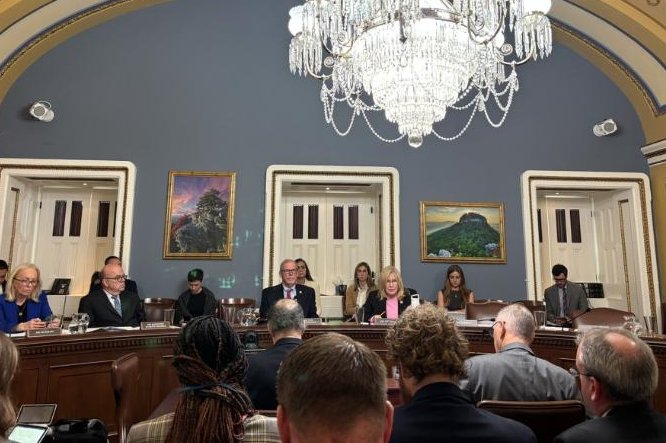
The House Rules Committee debates the Cashless Bail Reporting Act on Tuesday in Washington before advancing it to the full House, which passed it Thursday. Photo by Olivia Ardito/Medill News Service
WASHINGTON, May 14 (UPI) The House on Thursday passed the Cashless Bail Reporting Act, which is intended to deter states and communities from releasing people charged with crimes before trial without paying bail. Ninety-six Democrats joined most Republicans to approve the measure, 308 to 116.
If the Senate were to write a companion bill and pass it, the act could have significant repercussions for the Black, Latino and low-income communities, according to researchers and activists. Advocacy groups also had raised concerns that the bill would lessen states’ rights.
“We have seen state and local governments making reforms to their bail systems in response to the growing body of research which has highlighted the inequities in bail systems, which disproportionately burden racial minorities, women and overwhelmingly the poor,” Rep. Mary Gay Scanlon, D-Pa., said in an earlier hearing on the bill
The bill expanded on a 2025 executive order from President Donald Trump, “Taking Steps to End Cashless Bail to Protect Americans,” which required the U.S. Attorney General to send a list of states and local jurisdictions that have eliminated cash bail for some crimes that “pose a clear threat to public safety and order.”
These crimes include violent, sexual and indecent acts, and burglary, looting and vandalism. To encourage elimination of cashless bail, the executive order also directed agencies to identify funding to these communities that could be “suspended or terminated.”
The bill would require annual lists of states and communities that allow cashless bail.
“It would be creating a bit of a hit list for different policymakers to attack and to try to pressure those states, counties, localities to change their policies and practices, to avoid … a lot of public safety funding that they get every year from the federal government getting completely gutted,” Nicole Zayas Manzano, deputy director of policy for the Bail Project, a non-profit group that advocates for bail reform and provides bail assistance, said about the lists.
In a Rules Committee meeting on Tuesday, Republicans said the act would lower crime rates.
“We know violent criminals released on cashless or artificially low bail have reoffended,” said Rep. Andy Biggs, R-Ariz.
Rep. Jamie Raskin, D-Md. voted for the bill, but said it would do little more than track bail practices in states and localities.
“It’s hard to see how issuing a report advances community safety or justice, given the strangely hostile rhetoric we are hearing from our colleagues about cashless bail,” Raskin said in the debate before the vote.
In a 2024 study, the Brennan Center for Justice found that there was “no statistically significant relationship” between cashless bail policies and increases in violent crime.
In the Rules Committee meeting, Rep. Michelle Fischbach, R-Minn., referenced the Bail Project, a non-profit organization that pays bail for low-income people who cannot afford it. She claimed that the group put violent offenders back on the street.
“In Indiana, from 2019 to 2021, 24% of the roughly 1,000 defendants cut loose by the Bail Project … had been charged with a crime of violence, so we’re putting violent offenders back on the road. And 35% were facing felony charges and had a previous charge of at least one crime of violence,” Fischbach said.
The group rejected the congresswoman’s description.
“The cutting loose reference mischaracterizes our work. We only step in after a judge has deemed somebody eligible for release, and it is only the affordability of cash bail that is preventing them from getting out, which is also unconstitutional,” Zayas Manzano said. “Then we really connect them with social services in their own communities.”
Moreover, studies found that cash bail disproportionately harms minorities, notably those in Black, Latino and low-income communities. In 2024, the Criminology & Public Policy Journal reported that Black defendants were 34% more likely to be recommended to be held behind bars until their cases were resolved when compared to white defendants.
Zayas Mazano said people jailed before trial were more likely to pre-emptively plead guilty, receive harsher punishments and end up with worse criminal records.
“Your life also just falls apart once you’re trapped inside, right? You could lose your housing if you can’t go and pay rent. You can lose your job if you’re not able to show up after a certain number of days. You could lose custody of your children. I mean, all kinds of things can really happen, but then just really snowball onto communities of color, in particular, and low-income people in general,” she said.
According to the Prison Policy Initiative, 69% of pretrial detainees were people of color, with Black (43%) and Hispanic (19.6%) defendants especially overrepresented compared to their share of the total U.S. population.
“Study after study shows that judges tend to assign people of color higher cash bail amounts and that they are less likely to be able to afford those cash bail amounts. And so they are very often forced into whether or not they must stay behind bars, which we certainly see huge racial disparities in jail, pretrial, and otherwise,” Zayas Manzano said.
During the Rules Committee meeting, Democrats mirrored concerns about the bill passing. Notably, Raskin discussed how the federal court system has functioned on a cashless bail system for about 60 years, instead of making bail decisions based on the danger of flight or violence to others.
“In America, whether you’re a president or a pope or a pauper, you’re innocent until proven guilty beyond a reasonable doubt as to every element of the charged offense,” Raskin said. “And no one should be detained pretrial simply because they don’t have the financial resources to post bail.”
About the Author