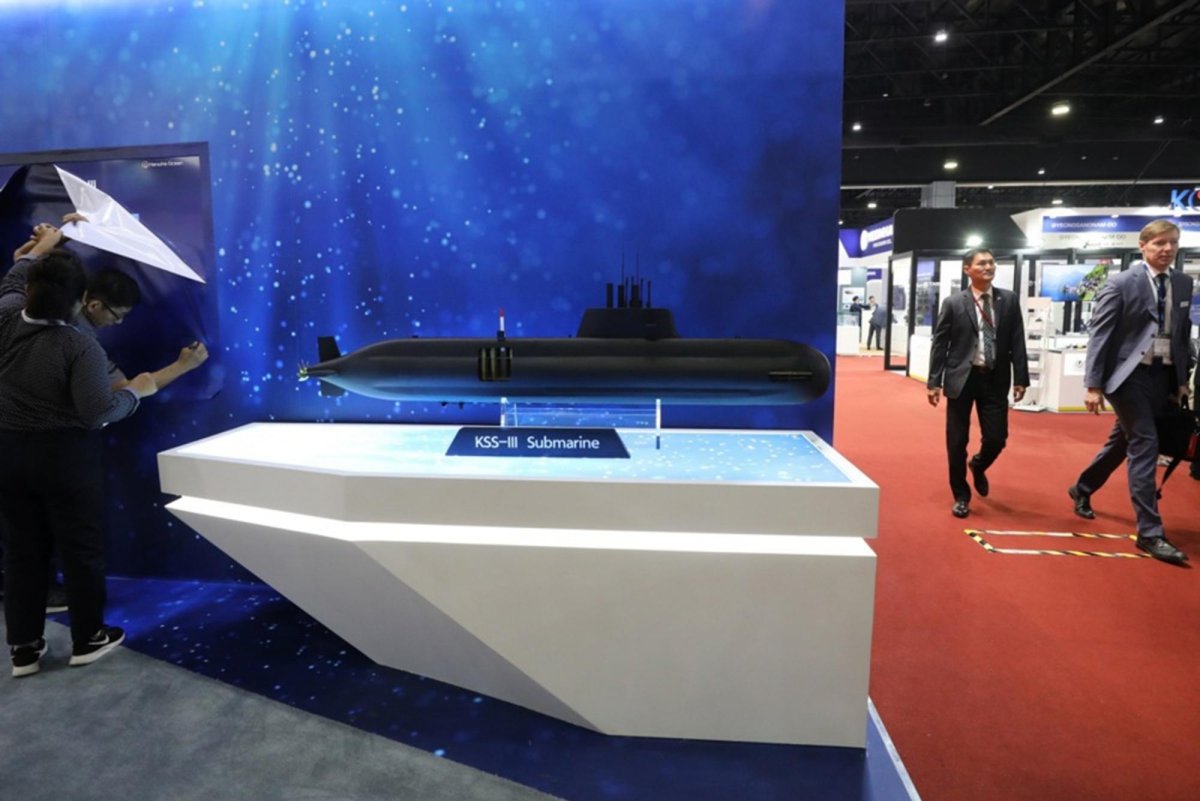
A model of the KSS-III Submarine from South Korean company Hanwha Ocean is on display at the Defense and Security 2023 exhibition, a Tri-Service defense and internal security showcase, at IMPACT Muang Thong Thani in Nonthaburi province, Thailand. Photo by NARONG SANGNAK / EPA
June 24 (Asia Today) — Economic benefits are emerging as a potential deciding factor in Canada’s competition to acquire a new submarine fleet, with South Korea promoting a broad industrial cooperation package to counter a larger economic-impact proposal from Germany.
Canada is preparing to select a preferred bidder for the Canadian Patrol Submarine Project, a program worth as much as 60 trillion won ($39.2 billion).
German shipbuilder TKMS and South Korea’s Hanwha Ocean are the two qualified suppliers remaining in the competition.
Canadian Secretary of State for Defense Procurement Stephen Fuhr said this week that both proposals meet the Royal Canadian Navy’s requirements, according to industry officials.
With the technical assessment effectively completed, the economic and industrial benefits offered by each bidder could become increasingly important in the final evaluation.
Based on publicly disclosed projections, TKMS appears to have proposed the larger economic contribution.
The German company said its proposal could generate 160 billion Canadian dollars in economic activity and add 86 billion Canadian dollars to Canada’s gross domestic product over the life of the program.
It also projected employment totaling more than 650,000 job-years.
Hanwha Ocean said South Korea’s proposal could support more than 22,500 Canadian jobs annually, equivalent to more than 400,000 job-years, and generate approximately 94.1 billion Canadian dollars in cumulative GDP contributions.
Industry officials said the scale and feasibility of the proposed partnerships may be more important than a direct comparison of headline figures.
Hanwha Ocean has established partnerships with more than 100 Canadian companies, universities and other organizations.
HD Hyundai Group has proposed several billion dollars in cooperation across the energy, commercial shipbuilding and naval sectors.
Hyundai Motor Group is also supporting the broader South Korean proposal through Project Beaver, an initiative intended to establish a hydrogen mobility ecosystem in Canada.
The effort is part of a government-backed package that seeks to position South Korea as a long-term industrial and security partner rather than simply a submarine supplier.
Germany is also offering substantial government and industrial support.
TKMS has emphasized its cooperation with Norway, which is jointly developing and acquiring Type 212CD submarines with Germany.
Norway has offered to share experience involving submarine design and maintenance, repair and overhaul systems.
The German proposal also highlights the benefits of integrating Canada into an existing supply and support network among North Atlantic Treaty Organization allies.
Sustainment carries greatest weight
Canada’s evaluation structure places the greatest emphasis on the ability to support the submarines throughout their operational lives.
Sustainment accounts for 50% of the assessment, while the submarine platform itself represents 20%.
Financial considerations account for 15%, with strategic and economic partnerships making up the remaining 15%.
The weighting indicates that Canada’s primary concern is not simply acquiring advanced submarines but ensuring that it can operate and maintain them reliably for several decades.
Some industry observers have cautioned that excessive attention to economic projections could distract from the program’s core defense objectives.
Both South Korea and Germany have proposed major investments, local partnerships and job-creation plans.
Critics say an escalating competition over economic promises could transform a military procurement decision into a broader contest for foreign investment.
The figures presented by the bidders are also based on different assumptions, industries and time periods, making direct comparisons difficult.
The projected employment numbers may include jobs supported for multiple years rather than distinct permanent positions.
“The technological capabilities, delivery competitiveness and industrial cooperation package offered by South Korean shipbuilders are clear strengths,” a South Korean shipbuilding industry official said.
“Both countries are making an all-out effort, so it remains difficult to predict the outcome before the final decision.”
South Korea stresses delivery and industrial ties
Hanwha Ocean is offering a Canadian version of its KSS-III submarine, a platform developed for and operated by the South Korean Navy.
South Korea has emphasized its shipbuilding capacity and ability to deliver vessels within Canada’s accelerated timetable.
The proposal also includes Canadian participation in construction, maintenance, technology development and supply chains extending beyond the submarine program.
South Korean companies have pursued cooperation with Canadian businesses in steel, automotive manufacturing, artificial intelligence, aerospace, energy and critical minerals.
The package is intended to demonstrate that selecting Hanwha Ocean would produce economic benefits across multiple regions and industries in Canada.
TKMS, meanwhile, is offering a submarine supported by the German and Norwegian governments and an established European defense network.
Its proposal stresses operational compatibility with NATO allies, shared training and access to a multinational submarine supply chain.
Canada is expected to announce its preferred approach between late June and early July. Industry officials said a decision could come as early as this week.
— Reported by Asia Today; translated by UPI
© Asia Today. Unauthorized reproduction or redistribution prohibited.
About the Author