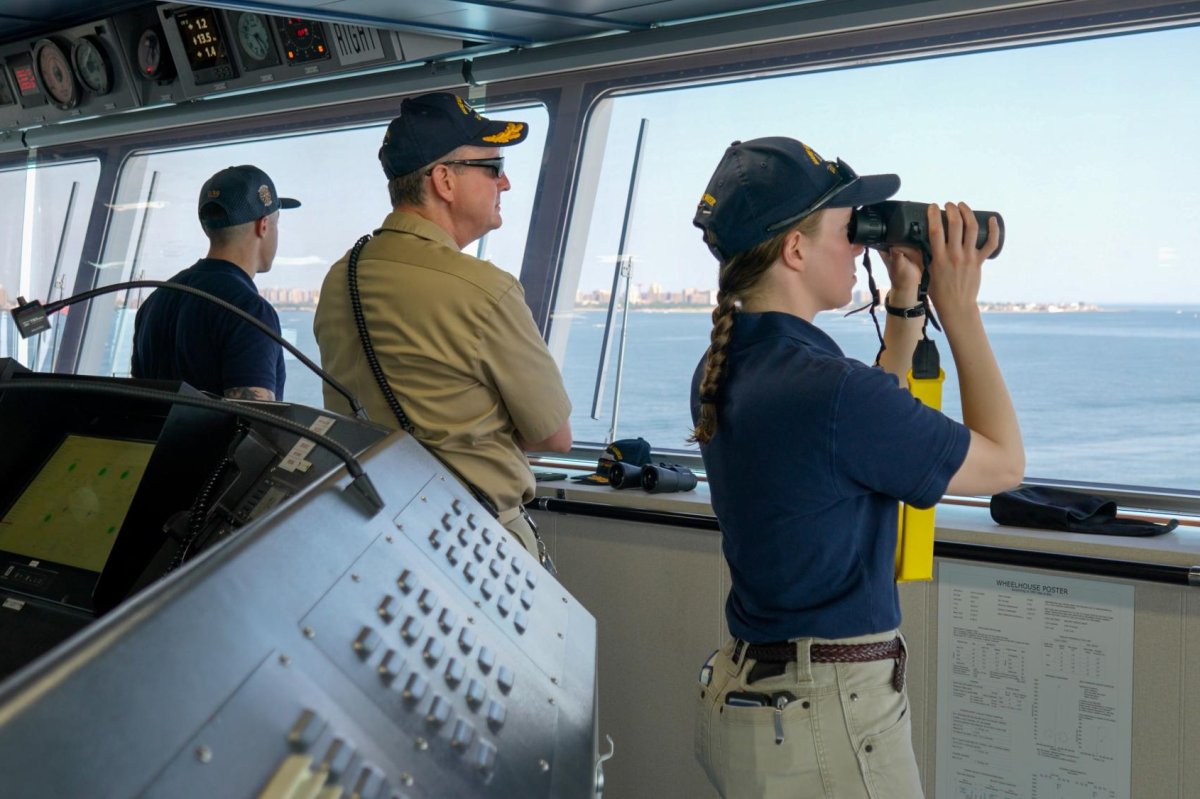
1 of 3 | Captain Gordon McArhtur looks out from the State of Maine’s bridge with two students. Photo courtesy of Maine Maritime Academy
CASTINE, Maine, July 30 (UPI) — The new State of Maine has arrived in historic Castine, where Revolutionary War history and maritime tradition converge on the shores of Penobscot Bay, bringing advanced technology to the Maine Maritime Academy as it trains the next generation of merchant mariners.
The $330 million, 525-foot ship is the third of five National Security Multi-Mission Vessels built for the U.S. Maritime Administration. to prepare the next generation of merchant mariners. The ship accommodates up to 600 cadets and features advanced navigation and engineering systems, classrooms and modern diesel propulsion.
Constructed at the Hanwha Philly Shipyard in Philadelphia by more than 2,000 American shipbuilders, engineers and apprentices, the vessel also reflects renewed investment in the U.S. shipbuilding industry. The shipyard was acquired by South Korea’s Hanwha Group in late 2024 for $100 million, bringing advanced automation and digital manufacturing technology there.
The South Korean shipbuilding conglomerate is betting $5 billion on a dramatic revival of American shipbuilding, planning to turn its Philadelphia yard into a high-volume production hub.
The investment would increase annual output from fewer than two vessels to as many as 20, pairing advanced Korean manufacturing technology with expanded U.S. capacity to build commercial ships and naval vessels.
For Maine Maritime Academy, the new ship represents a dramatic leap from the wooden schooners and comparatively simple navigation instruments that once defined maritime training along the Maine coast.
Its bridge features sophisticated navigation and communications systems, digital charts and advanced ship-control technology designed to prepare cadets for an increasingly automated global maritime industry.
Despite the technology, the fundamentals of seamanship have changed little. Cadets must still read weather and sea conditions, work as a crew and make decisions under pressure.
“We start with the basics,” said the academy’s Captain Gordon “Mac” McArthur, 56. “Rowing in an eight-person lifeboat is a large part of the fall semester freshman year. We build from tying knots and turning a wrench to the more complicated things. We are training problem-solvers and critical thinkers. The technology-based things don’t matter if you don’t have those fundamentals.”
The training ship’s arrival underscores the community’s enduring maritime identity, where centuries-old seafaring traditions meet the technology shaping the future of global shipping.
Nowhere is that contrast more evident than at Maine Maritime Academy, where the state-of-the-art ship shares the waterfront with Bowdoin, the academy’s 1921 National Historic Landmark schooner — a living symbol of the evolution from wind-powered seamanship to the digital age of navigation.
Yet, both are classrooms for learning many of the same fundamental lessons about life at sea.
The academy’s new flagship reflects Castine’s balance of maritime tradition and the future of seafaring. While Maine Maritime Academy trains the next generation of mariners for a high-tech global industry, the town is fighting to preserve the working-waterfront traditions that shaped its identity.
Just down the harbor, Eaton’s Boatyard — where wooden boats have been built and repaired since 1931 — remains a living workshop of Maine craftsmanship, proving that even in the digital age, some skills are still best learned by hand.
Eaton’s Boatyard preserves a cornerstone of Castine’s maritime heritage as the birthplace of the 18-foot wooden Castine Class sloop, designed by Mace Eaton in 1951. On July 18, 13 of the one-design racing sailboats, including two originals still owned by descendants of their first owners, competed in Castine Harbor, continuing a nearly 70-year racing tradition on Penobscot Bay.
David Biggs, honorary chairman of the 27th annual Castine-to-Camden Yacht Race, said the Downeast harbor’s maritime traditions continue to thrive as new generations embrace sailing.
“It’s still exciting to see these beautiful boats in our harbor, especially our own Castine Class Caroline B,” Biggs, 93, who has lived there with his wife, Marian, for more than 50 years, told UPI.
Though Castine has evolved from a working fishing and shipbuilding port into an upscale summer village, its identity remains firmly tied to the sea through Maine Maritime Academy, one of the nation’s leading schools for merchant mariners.
“It’s become a college town with a deep maritime soul,” Biggs said.
Kenny Eaton, 81, Mace Eaton’s grandson and the third generation of the boatbuilding family, has watched Castine’s waterfront change from a working harbor toward one increasingly shared with recreational boats and seasonal residents.
“You can’t stop change,” Eaton said. “But you hope the next generation understands that Castine wasn’t built just because it had a beautiful view of the water. It was built because people worked on it.”
That maritime connection continues among a new generation at Maine Maritime Academy.
That sense of maritime tradition also runs through families. Marin Griffin, 18, of Bangor, Maine, recently completed her freshman year at the academy and is following a path already taken by two generations before her.
“I’m the third generation in my family to attend Maine Maritime,” Griffin told UPI.
A harbor shaped by history
Castine’s ties to the sea run deep. Once a strategic outpost and later a bustling center of fishing, shipbuilding and coastal trade on Penobscot Bay, the town has evolved into a quiet Downeast harbor, while Maine Maritime Academy has carried its seafaring legacy into the modern era, training generations of merchant mariners and maritime professionals.
The State of Maine’s Captain Craig ‘Mac’ McArthur said Castine’s centuries-old connection to the Atlantic world continues to define both the school and the town.
“I’ve run into Maine Maritime alumni in Korea, Malaysia, Brazil, Dubai and other places around the world. Most don’t talk about their time at Maine Maritime,” McArthur said. “They talk about their time ‘in Castine.’ There is something about the remoteness of this place that prepares you for world travel.”
The academy’s legacy endures in the careers of graduates who credit its seamanship training for their success. Jon Parsons, 59, spent 23 years with Polar Tankers, transporting oil from Valdez, Alaska, while Tip Macdonald, 70, served as a ship pilot at the Port of Baltimore.
“I was a successful ship pilot at the Port of Baltimore for thirty years,” Macdonald told UPI. Both men say the academy’s rigorous instruction remains as strong today as when they attended, and that Castine continues to preserve the maritime traditions that have shaped generations of mariners.
An industry under pressure
Across coastal Maine, maritime trades are being reshaped by rising costs, technological change and a changing marine environment. Fishing remains dependent on generations of accumulated knowledge, but boats, engines, electronics, fuel and regulatory uncertainty have made entering the industry increasingly expensive.
A warming, rapidly changing Gulf of Maine is reshaping life on the water. Veteran tuna fisherman Justin McCarthy said Atlantic bluefin catches have declined and prices have fallen sharply, squeezing a fishery that once yielded five-figure paydays.
Yet, he sees hope in the next generation: his son, Mac, graduated from Maine Maritime Academy and returned home aboard the State of Maine, extending the family’s seafaring tradition.
Today’s merchant marine cadets are entering a maritime industry transformed by satellite navigation, electronic charts, automation and digital communications. Built for that environment, the State of Maine provides hands-on training with modern shipboard technology, preparing future deck officers and engineers to operate increasingly sophisticated commercial vessels.
Retired Navy Capt. Justin Cooper II, Maine Maritime Academy’s commandant of midshipmen, brings decades of naval experience to Castine. A former fighter pilot, Cooper served aboard the aircraft carriers USS Enterprise, USS Abraham Lincoln and USS Nimitz.
“We are training these young men and women to take their place in the maritime community,” Cooper told UPI. “We want them to be good leaders and to prepare them to enter the global maritime industry.”
Founded during World War II, Maine Maritime Academy still instills the discipline and seamanship demanded by U.S. Coast Guard standards. While most graduates now head into the commercial maritime industry rather than military service, the academy’s mission remains the same: preparing mariners to lead when conditions at sea turn unforgiving.
That emphasis on fundamental seamanship is reinforced by another academy vessel.
The Bowdoin, a 1921 Arctic exploration schooner, comes from an era when sailors depended on wind, weather, charts and celestial observation. Berthed alongside the State of Maine, the two vessels bridge more than a century of maritime education, reflecting both the evolution of seafaring and the enduring maritime heritage that has defined this coastal community for generations.
About the Author